Institute of Molecular Pathology and Pathomorphology, Federal Research Center for Fundamental and Translational Medicine, 2 Timakova St., Novosibirsk 630117, Russia.
Research Institute of Clinical and Experimental Lymphology, Branch of the Institute of Cytology and Genetics, Siberian Branch of Russian Academy of Sciences, 6 Arbuzova, Novosibirsk 630060, Russia.
Int J Mol Sci. 2024 Oct 17;25(20):11183. doi: 10.3390/ijms252011183.
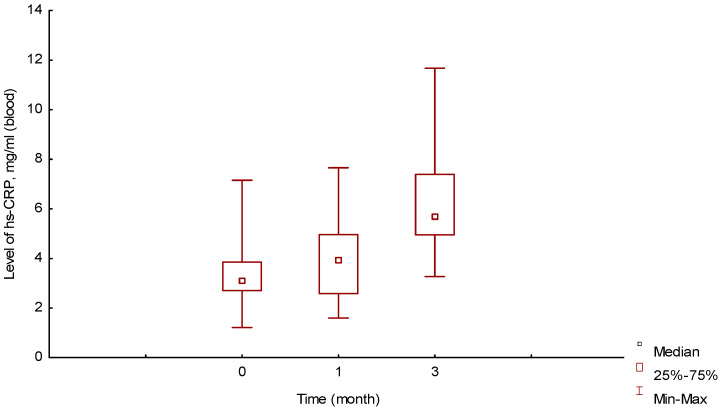
Implants made of biodegradable polymers are replaced by regenerating tissues through inflammation. The changes occurring in tissues and the organism are of practical interest for studying the biocompatibility of the material and searching for systemic markers in the blood that reflect inflammation in peri-implantation tissues. The highly sensitive C-reactive protein (hs-CRP) measurements in blood and morphometric studies of tissue surrounding the implant were carried out in the experiment within three months of implantation of a biopolymer consisting of polycaprolactone (PCL) and polytrimethylene carbonate (PTMC). During the first month, tissue inflammation decreased, and the blood level of hs-CRP did not increase. The polymer biotransformation began in the tissues after a month of implantation and was accompanied by inflammation moving deeper into the matrix. Proliferation of inflammatory cells in tissues was reflected in an increase in the hs-CRP level three months after polymer installation. The result achieved confirmed the polymer's bioinertness. The level of hs-CRP in the blood of the animals correlated with the level of inflammation in peri-implantation tissues, reflecting the activity of inflammation in the process of polymer biotransformation. This inflammation protein can be recommended for assessing tissue processes following implantation of biopolymers and their biocompatibility.
可生物降解聚合物制成的植入物通过炎症被再生组织所取代。组织和生物体中发生的变化对于研究材料的生物相容性以及寻找反映植入周围组织炎症的血液中的系统标志物具有实际意义。在将由聚己内酯 (PCL) 和聚三亚甲基碳酸酯 (PTMC) 组成的生物聚合物植入三个月内,在实验中对血液中的高敏 C 反应蛋白 (hs-CRP) 测量和植入周围组织的形态计量学研究进行了研究。在第一个月,组织炎症减少,hs-CRP 血液水平没有增加。聚合物生物转化在植入一个月后开始,并伴有炎症向基质深处移动。炎症细胞在组织中的增殖反映在聚合物安装三个月后 hs-CRP 水平的升高。所达到的结果证实了聚合物的生物惰性。动物血液中的 hs-CRP 水平与植入周围组织的炎症水平相关,反映了聚合物生物转化过程中炎症的活性。这种炎症蛋白可推荐用于评估生物聚合物植入后的组织过程及其生物相容性。