Dame Clara, Viellard Marine, Elissalde Sara-Nora, Pergeline Hugo, Grandgeorge Pauline, Garie Laure-Anne, Solla Federico, Martino Sonia De, Avenel Elodie, Salle-Collemiche Xavier, Fernandez Arnaud, Poinso François, Jouve Elisabeth, Guivarch Jokthan
Medical School, Aix-Marseille University, 13385 Marseille, France.
Department of Child Psychiatry, Sainte Marguerite Hospital, Assistance Publique des Hôpitaux de Marseille (APHM), 13009 Marseille, France.
Children (Basel). 2024 Oct 15;11(10):1241. doi: 10.3390/children11101241.
Social Communication Disorder (SCD), introduced in the DSM-5, is distinguished from Autism Spectrum Disorder (ASD) by the absence of restricted and repetitive behaviors or interests (RRBIs).
To compare the adaptive, sensory, communication, and cognitive profiles of children with ASD and SCD.
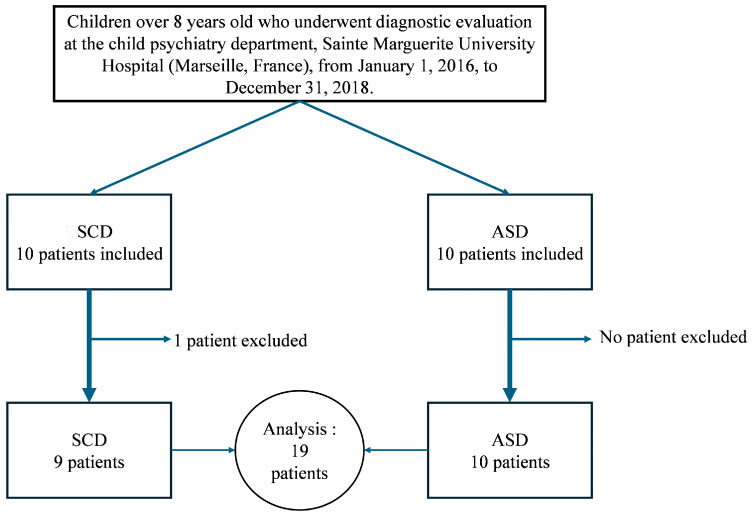
The assessments of nine children with SCD and ten with ASD were compared with either Fisher's Exact Test or the Mann-Whitney Test. Assessments included the Vineland Adaptive Behavior Scales, the Autism Diagnostic Observation Schedule (ADOS), the Short Sensory Profile, Bishop's Children's Communication Checklist, a pragmatics evaluation, and the Wechsler Intelligence Scale for Children IV.
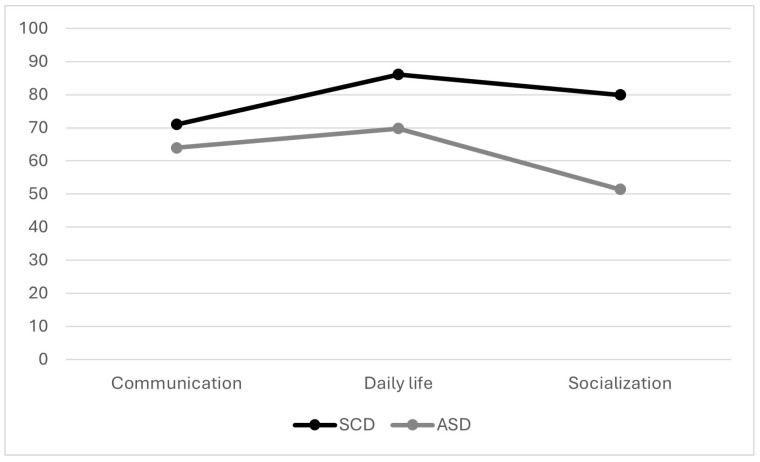
The total ADOS score and the second subtotal "Restricted and Repetitive Behaviors" were significantly higher ( = 0.022) in the ASD group than in the SCD group. The Vineland standard score for the "Socialization" domain was significantly lower ( = 0.037) in the ASD group (mean: 51 +/- 19) than in the SCD group (mean: 80 +/- 28). The working memory index score was also significantly lower ( = 0.013) in the ASD group compared to the SCD group.
While ASD and SCD share similarities in communication and pragmatic difficulties, some distinctions have been identified, e.g. in executive functioning and the impact on socialization, which may be linked to the absence of RRBIs in SCD. These findings highlight the challenges posed by this nosographic separation during diagnostic evaluations due to the scarcity of discriminative tools.
《精神疾病诊断与统计手册》第五版(DSM - 5)中引入的社交沟通障碍(SCD),与自闭症谱系障碍(ASD)的区别在于不存在局限的重复行为或兴趣(RRBIs)。
比较患有ASD和SCD的儿童在适应性、感觉、沟通和认知方面的特征。
采用Fisher精确检验或曼 - 惠特尼检验对9名患有SCD的儿童和10名患有ASD的儿童的评估结果进行比较。评估包括文兰适应行为量表、自闭症诊断观察量表(ADOS)、简短感觉概况、毕晓普儿童沟通检查表、语用学评估以及韦氏儿童智力量表第四版。
ASD组的ADOS总分及第二个子总分“局限的重复行为”显著高于SCD组(P = 0.022)。ASD组在“社交化”领域的文兰标准分显著低于SCD组(P = 0.037),ASD组均值为51±19,SCD组均值为80±28。与SCD组相比,ASD组的工作记忆指数得分也显著更低(P = 0.013)。
虽然ASD和SCD在沟通和语用困难方面有相似之处,但也发现了一些差异,例如在执行功能和对社交化的影响方面,这可能与SCD中不存在RRBIs有关。这些发现凸显了在诊断评估过程中,由于鉴别工具匮乏,这种疾病分类区分所带来的挑战。