Baines Occupational Health Services, Harare 024, Zimbabwe.
Faculty of Medicine, National University of Science and Technology, Bulawayo 029, Zimbabwe.
Int J Environ Res Public Health. 2024 Sep 26;21(10):1282. doi: 10.3390/ijerph21101282.
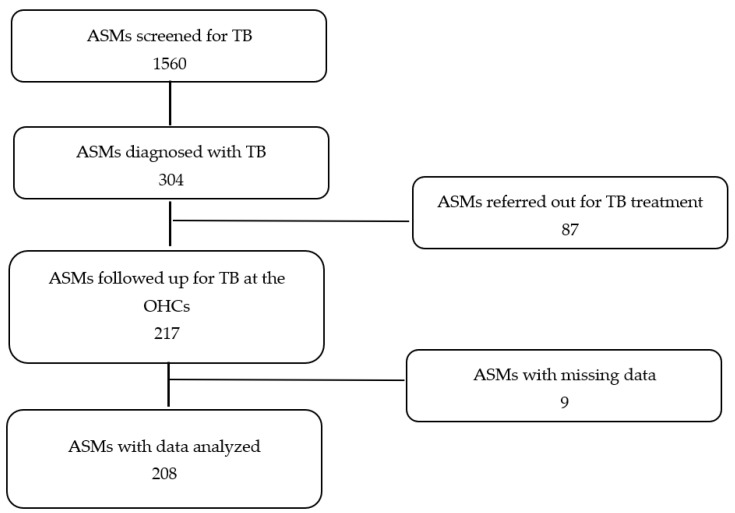
In Zimbabwe, artisanal and small-scale miners (ASMs) are a key vulnerable group with high risk for tuberculosis (TB), HIV, and silicosis. The main purpose of this study was to investigate treatment outcomes of TB among ASMs. We conducted a follow-up observational study using secondary data. We analyzed data from 208 ASMs treated for TB at two occupational health clinics. We found a high treatment success rate of 87%, comparable to the national average for drug-sensitive TB. Unsuccessful outcomes were due to death (5%) and loss to follow-up (7%). Over a quarter of ASMs had unknown HIV status. Our study is the first to document treatment outcomes of TB among ASMs in Zimbabwe. Encouragingly, this study demonstrates the possibility of achieving good TB treatment outcomes even among highly mobile populations like ASMs. Further research is needed to analyze leakages across the whole TB patient pathway among ASMs. Additionally, addressing the high rate of unknown HIV statuses among ASMs is crucial to further improve overall TB treatment outcomes in this population.
在津巴布韦,个体和小规模采矿业者(ASMs)是结核病(TB)、艾滋病毒和矽肺的高风险弱势群体。本研究的主要目的是调查 ASMs 中的结核病治疗结果。我们使用二手数据进行了一项随访观察性研究。我们分析了在两家职业健康诊所接受结核病治疗的 208 名 ASMs 的数据。我们发现治疗成功率高达 87%,与国家药物敏感性结核病的平均水平相当。不成功的结果是由于死亡(5%)和失访(7%)。超过四分之一的 ASMs 艾滋病毒状况未知。我们的研究首次记录了津巴布韦 ASMs 中的结核病治疗结果。令人鼓舞的是,这项研究表明,即使在像 ASMs 这样高度流动的人群中,也有可能实现良好的结核病治疗结果。需要进一步研究来分析 ASMs 中整个结核病患者途径中的漏洞。此外,解决 ASMs 中高比例的未知艾滋病毒状况对于进一步提高该人群的整体结核病治疗结果至关重要。