Centro de Investigacion Científica y de Educacion Superior de Ensenada (CICESE), Ensenada 22860, Baja California, Mexico.
Departamento de Ecología Pesquera, Centro de Investigaciones Biológicas del Noroeste S.C., La Paz 23205, Baja California Sur, Mexico.
Genes (Basel). 2024 Oct 8;15(10):1303. doi: 10.3390/genes15101303.
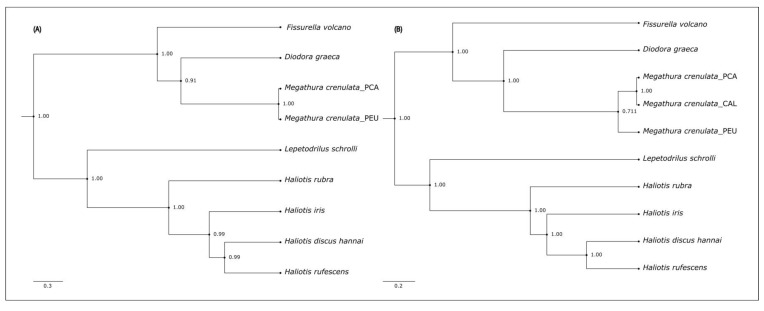
The giant keyhole limpet is a gastropod mollusk (Fissurella superfamily) that is endemic to the eastern Pacific coast from southern California, USA, to Baja California Sur, Mexico. is socioeconomically important as it produces a potent immune-stimulating protein, called Keyhole Limpet Hemocyanin, which is extracted in vivo and utilized for vaccine development. However, ecological studies are scarce and genetic knowledge of the species needs to be improved. Our objectives were to assemble and annotate the mitogenome of , and to assess its phylogenetic relationships with other marine gastropods and to evaluate its population genetic diversity and structure.
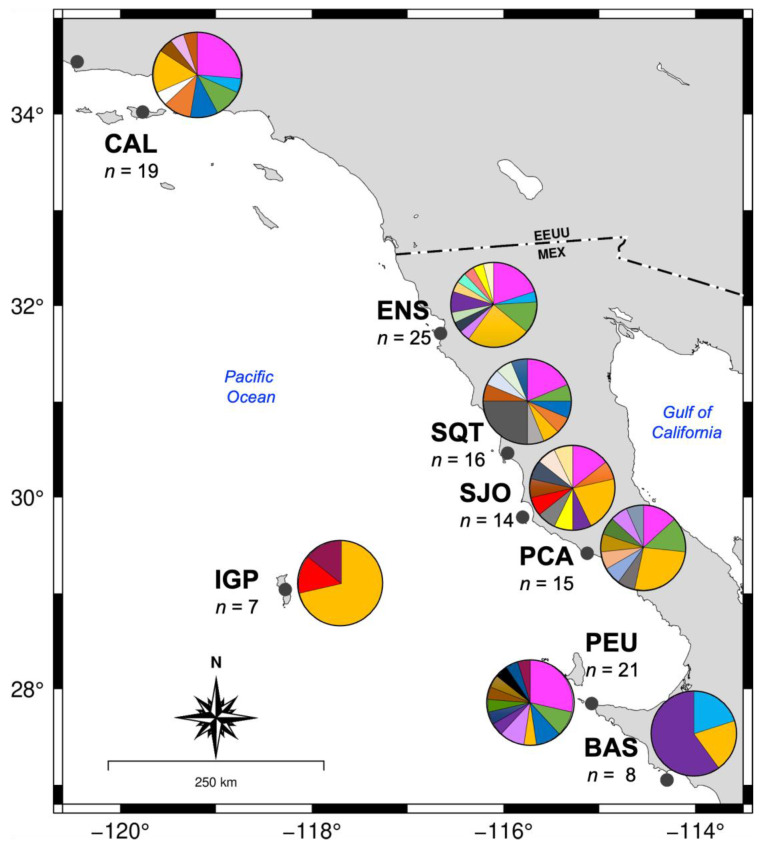
Samples were collected for mitogenome assembly ( = 3) spanning its geographic range, Puerto Canoas (PCA) and Punta Eugenia (PEU), Mexico, and California (CAL), USA. Total DNA was extracted from gills sequenced using Illumina paired-end 150-bp-read sequencing. Reads were cleaned, trimmed, assembled , and annotated. In addition, 125 samples from eight locations were analyzed for genetic diversity and structure analysis at the and genes.
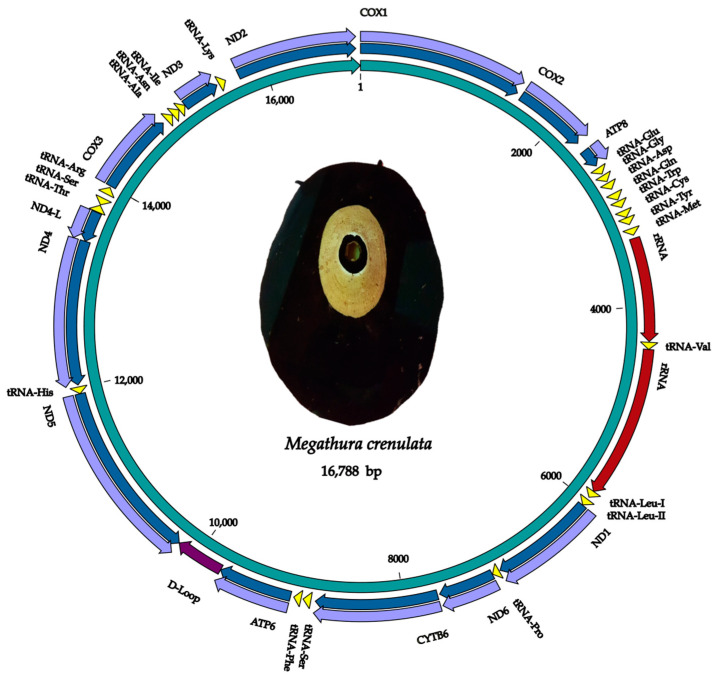
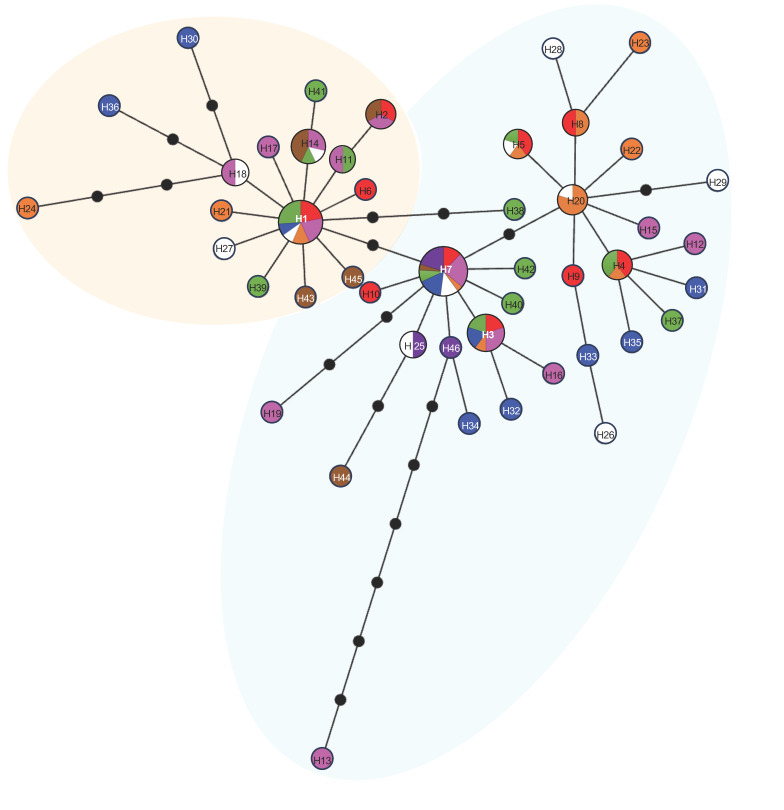
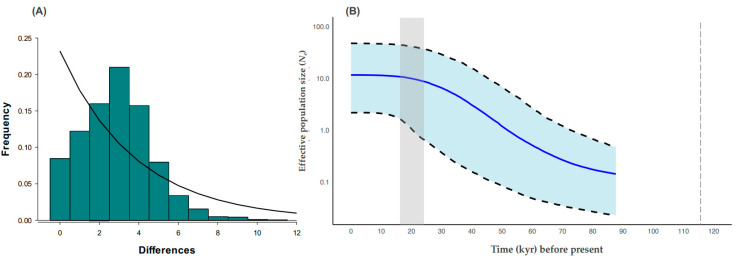
The mitogenomes had lengths of 16,788 bp (PCA) and 16,787 bp (PEU) and were composed of 13 protein-coding regions, 22 tRNAs, two rRNAs, and the D-Loop region. In terms of phylogeographic diversity and structure, we found a panmictic population that has experienced recent demographic expansion with low nucleotide diversity (0.002), high haplotypic diversity (0.915), and low (0.047).
Genetic insights into the giant keyhole limpet provides tools for its management and conservation by delimiting fishing regions with low genetic diversity and/or genetically discrete units.
巨型石鳖是一种腹足纲软体动物(Fissurella 超科),分布于从美国加利福尼亚南部到下加利福尼亚州的东太平洋海岸。由于它能产生一种叫做石鳖血蓝蛋白的强效免疫刺激蛋白,因此具有重要的社会经济价值,这种蛋白是从活体中提取的,用于疫苗开发。然而,生态研究很少,物种的遗传知识有待提高。我们的目标是组装和注释巨型石鳖的线粒体基因组,并评估其与其他海洋腹足动物的系统发育关系,以及评估其种群遗传多样性和结构。
我们从其地理分布范围(墨西哥的蓬卡诺阿斯(PCA)和普恩特欧亨尼亚(PEU)以及美国的加利福尼亚(CAL))采集了 3 个样本进行线粒体基因组组装。从鳃中提取总 DNA,使用 Illumina 配对末端 150-bp 读测序。清洗、修剪、组装和注释reads。此外,还对来自 8 个地点的 125 个样本进行了 基因和 基因的遗传多样性和结构分析。
巨型石鳖的线粒体基因组长度分别为 16788bp(PCA)和 16787bp(PEU),由 13 个蛋白质编码区、22 个 tRNA、2 个 rRNA 和 D-Loop 区组成。在地理上的多样性和结构方面,我们发现该种群是泛化的,经历了近期的种群扩张,具有低核苷酸多样性(0.002)、高单倍型多样性(0.915)和低 (0.047)。
对巨型石鳖的遗传研究为其管理和保护提供了工具,可划定遗传多样性和/或遗传上离散单元低的捕捞区。