Jenkins Tom L, Castilho Rita, Stevens Jamie R
Department of Biosciences, University of Exeter, Exeter, United Kingdom.
Center for Marine Sciences, Campus de Gambelas, University of Algarve, Faro, Portugal.
PeerJ. 2018 Sep 28;6:e5684. doi: 10.7717/peerj.5684. eCollection 2018.
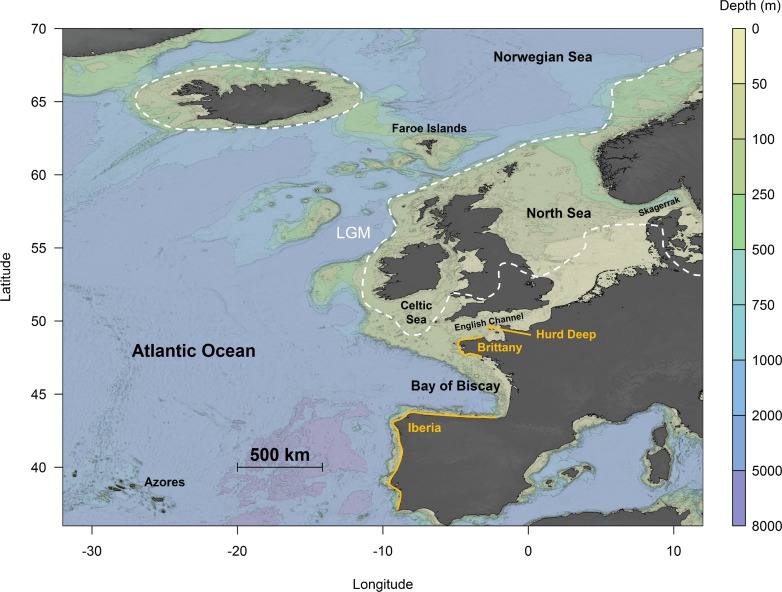
Comparative phylogeography enables the study of historical and evolutionary processes that have contributed to shaping patterns of contemporary genetic diversity across co-distributed species. In this study, we explored genetic structure and historical demography in a range of coastal marine species across the northeast Atlantic to assess whether there are commonalities in phylogeographic patterns across taxa and to evaluate whether the timings of population expansions were linked to the Last Glacial Maximum (LGM).
A literature search was conducted using Web of Science. Search terms were chosen to maximise the inclusion of articles reporting on population structure and phylogeography from the northeast Atlantic; titles and abstracts were screened to identify suitable articles within the scope of this study. Given the proven utility of mtDNA in comparative phylogeography and the availability of these data in the public domain, a meta-analysis was conducted using published mtDNA gene sequences. A standardised methodology was implemented to ensure that the genealogy and demographic history of all mtDNA datasets were reanalysed in a consistent and directly comparable manner.
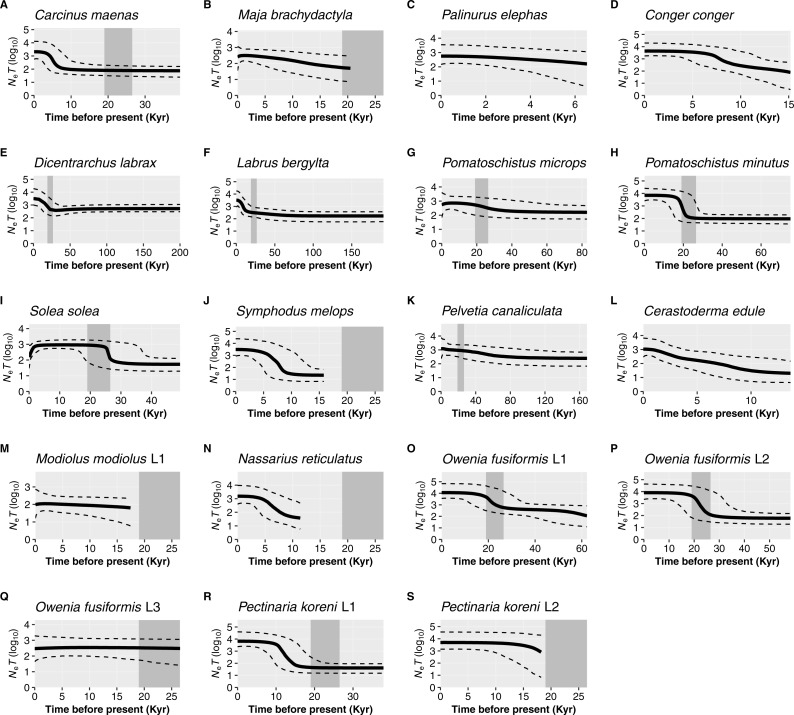
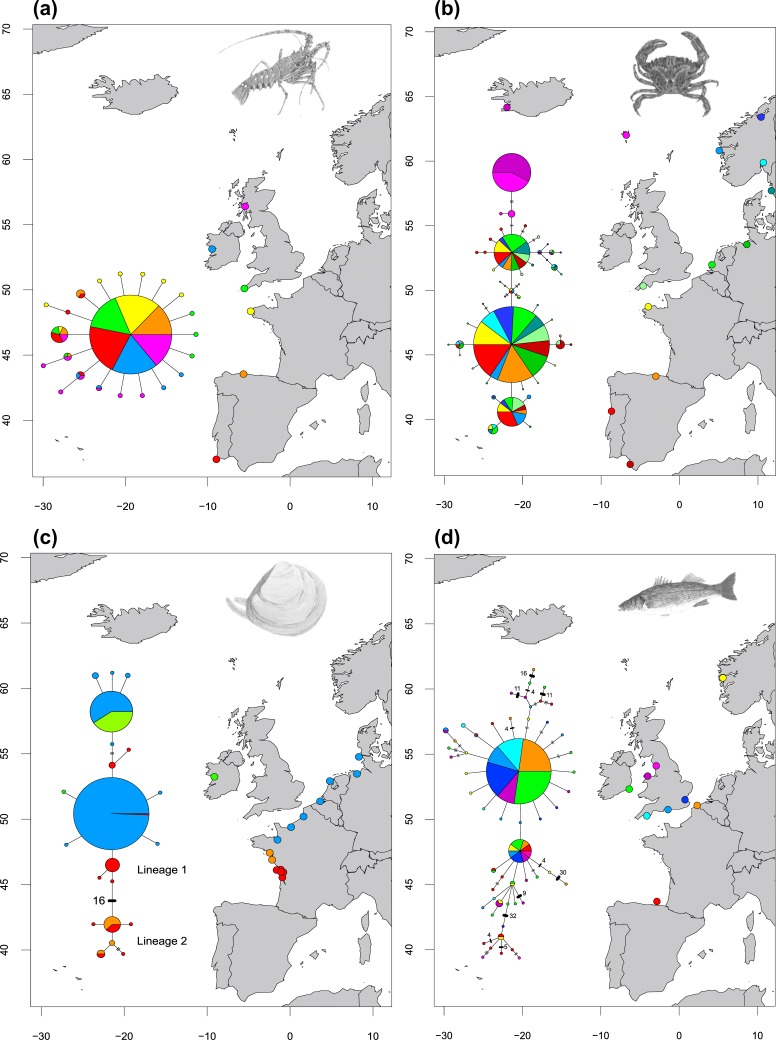
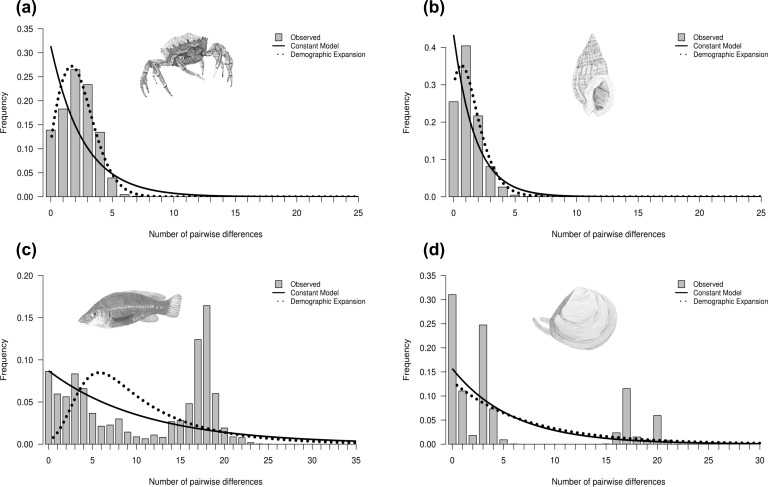
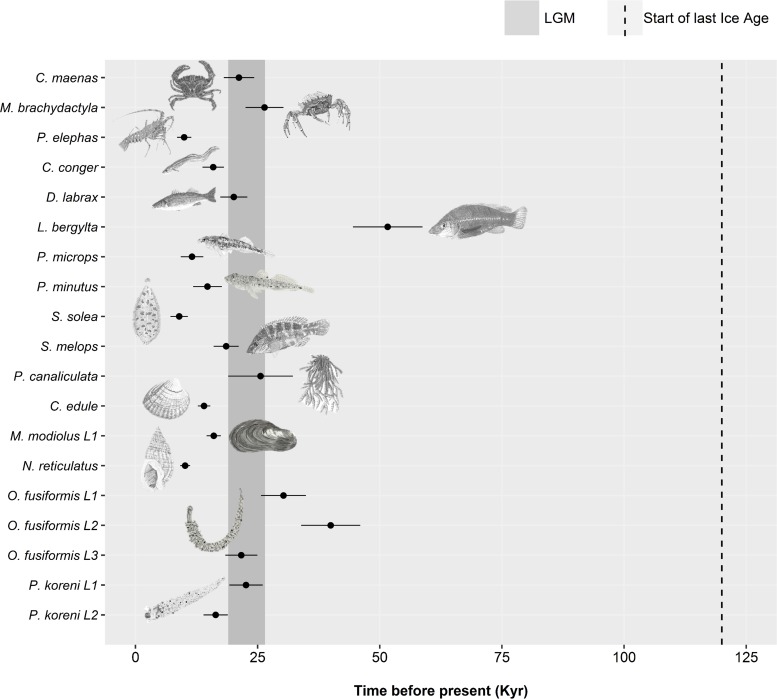
Mitochondrial DNA datasets were built for 21 species. The meta-analysis revealed significant population differentiation in 16 species and four main types of haplotype network were found, with haplotypes in some species unique to specific geographical locations. A signal of rapid expansion was detected in 16 species, whereas five species showed evidence of a stable population size. Corrected mutation rates indicated that the majority of expansions were estimated to have occurred after the earliest estimate for the LGM (∼26.5 Kyr), while few expansions were estimated to have pre-dated the LGM.
This study suggests that post-LGM expansion appeared to be common in a range of marine taxa, supporting the concept of rapid expansions after the LGM as the ice sheets started to retreat. However, despite the commonality of expansion patterns in many of these taxa, phylogeographic patterns appear to differ in the species included in this study. This suggests that species-specific evolutionary processes, as well as historical events, have likely influenced the distribution of genetic diversity of marine taxa in the northeast Atlantic.
比较系统地理学有助于研究历史和进化过程,这些过程对塑造共同分布物种的当代遗传多样性模式起到了作用。在本研究中,我们探究了东北大西洋一系列沿海海洋物种的遗传结构和历史种群动态,以评估不同分类群的系统地理模式是否存在共性,并评估种群扩张的时间是否与末次盛冰期(LGM)相关。
使用科学网进行文献检索。选择检索词以最大限度地纳入报道东北大西洋种群结构和系统地理学的文章;对标题和摘要进行筛选,以确定本研究范围内的合适文章。鉴于线粒体DNA在比较系统地理学中的实用价值以及这些数据在公共领域的可得性,使用已发表的线粒体DNA基因序列进行了荟萃分析。实施了标准化方法,以确保所有线粒体DNA数据集的谱系和种群历史以一致且直接可比的方式重新分析。
为21个物种构建了线粒体DNA数据集。荟萃分析揭示了16个物种存在显著的种群分化,发现了四种主要的单倍型网络类型,一些物种的单倍型在特定地理位置是独特的。在16个物种中检测到快速扩张的信号,而五个物种显示出种群大小稳定的证据。校正后的突变率表明,大多数扩张估计发生在对LGM的最早估计(约26.5千年前)之后,而估计很少有扩张早于LGM。
本研究表明,末次盛冰期后的扩张在一系列海洋分类群中似乎很常见,支持了随着冰盖开始退缩,末次盛冰期后快速扩张的概念。然而,尽管许多这些分类群的扩张模式具有共性,但本研究中所包括的物种的系统地理模式似乎有所不同。这表明特定物种的进化过程以及历史事件可能影响了东北大西洋海洋分类群的遗传多样性分布。