Bukys Tomas, Kurlinkus Benediktas, Sileikis Audrius, Vitkus Dalius
Department of Physiology, Biochemistry, Microbiology and Laboratory Medicine, Institute of Biomedical Sciences, Faculty of Medicine, Vilnius University, LT-03101 Vilnius, Lithuania.
Clinic of Gastroenterology, Nephrourology and Surgery, Institute of Clinical Medicine, Faculty of Medicine, Vilnius University, LT-03101 Vilnius, Lithuania.
Biomedicines. 2024 Oct 15;12(10):2344. doi: 10.3390/biomedicines12102344.
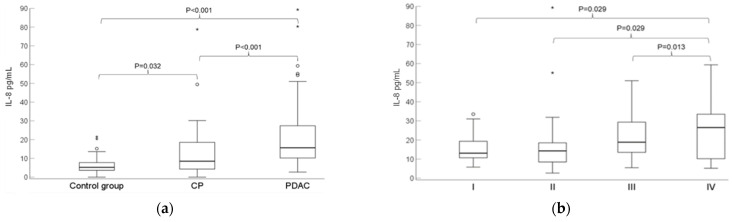
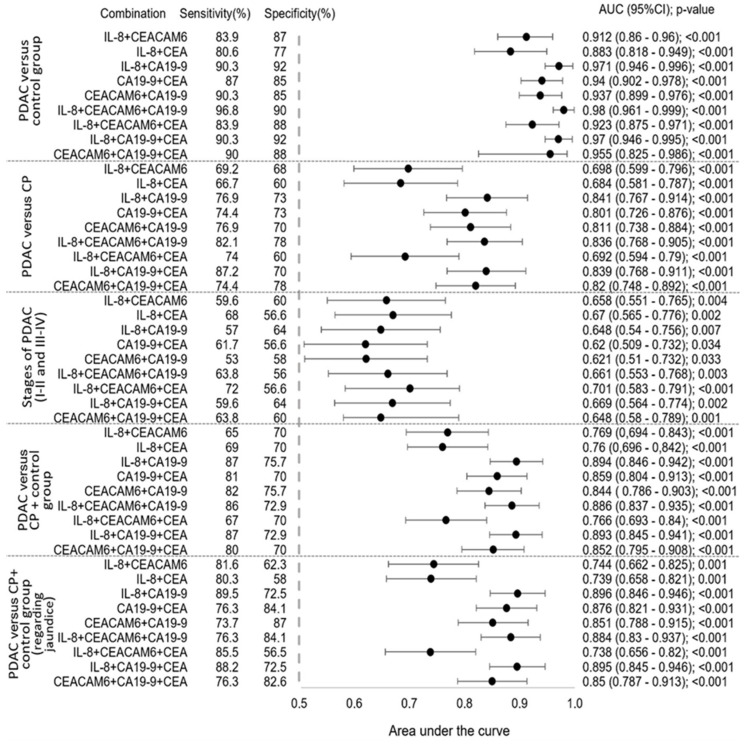
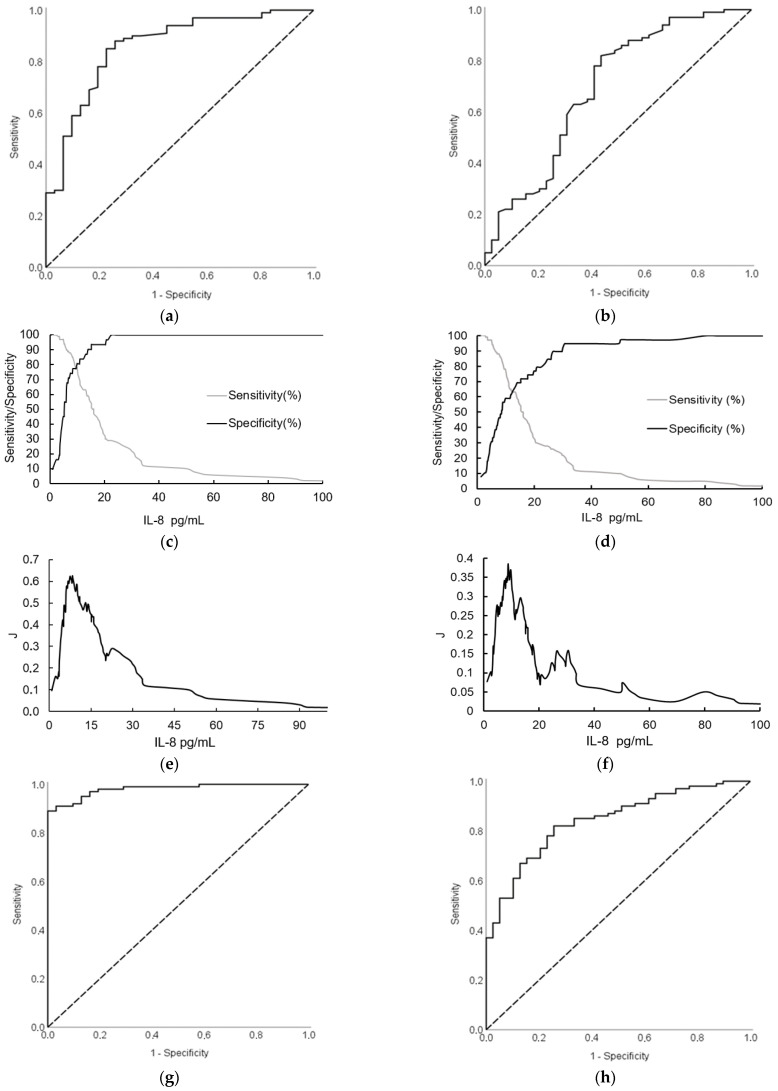
: This study aims to evaluate the possible clinical application of interleukin 8 (IL-8) as a single biomarker and its capabilities in combination with carbohydrate antigen (CA19-9), carcinoembryonic antigen (CEA), and carcinoembryonic antigen cell adhesion molecule 6 (CEACAM6) as diagnostic and prognostic tools for pancreatic ductal adenocarcinoma (PDAC). : A total of 170 serum samples from patients with PDAC (n = 100), chronic pancreatitis (CP) (n = 39), and healthy individuals (n = 31) were analysed. IL-8 and CEACAM6 were measured by an enzyme-linked immunosorbent assay (ELISA). CA19-9 and CEA were determined by chemiluminescent microparticle immunoassay, and bilirubin was quantified using a diazonium salt reaction. Receiver operating characteristic curve analysis, logistic regression, and Kaplan-Meier analyses were performed to evaluate the properties of a single IL-8 and in combination with other biomarkers. : The concentrations of IL-8 were statistically significantly higher in the PDAC group compared to the CP and control groups. Heterogeneous levels of IL-8 correlated with PDAC stages ( = 0.007). IL-8 had good and satisfactory diagnostic efficacy in differentiating PDAC from controls (0.858; < 0.001) and patients with CP (0.696; < 0.001), respectively. High and low expressions of IL-8 were not significantly associated with overall survival (OS) or disease-free survival (DFS). A combination of IL-8, CEACAM6, and CA19-9 reached the highest AUC values for differentiating PDAC from the control group. The best classification score between PDAC and the control group with CP patients was obtained by merging IL-8 and CA19-9 (0.894; < 0.001). : These results provide compelling evidence of IL-8 as a promising diagnostic biomarker. Nonetheless, due to the high complexity of PDAC, only the conjunction of IL-8, CA19-9, and CEACAM6 integrates sufficient diagnostic capabilities.
本研究旨在评估白细胞介素8(IL-8)作为单一生物标志物的可能临床应用,以及其与糖类抗原(CA19-9)、癌胚抗原(CEA)和癌胚抗原细胞粘附分子6(CEACAM6)联合作为胰腺导管腺癌(PDAC)诊断和预后工具的能力。
共分析了170份血清样本,其中来自PDAC患者(n = 100)、慢性胰腺炎(CP)患者(n = 39)和健康个体(n = 31)。通过酶联免疫吸附测定(ELISA)测量IL-8和CEACAM6。通过化学发光微粒子免疫测定法测定CA19-9和CEA,并使用重氮盐反应对胆红素进行定量。进行受试者工作特征曲线分析、逻辑回归分析和Kaplan-Meier分析,以评估单一IL-8以及与其他生物标志物联合使用时的性能。
与CP组和对照组相比,PDAC组中IL-8的浓度在统计学上显著更高。IL-8的异质性水平与PDAC分期相关(P = 0.007)。IL-8在区分PDAC与对照组(AUC = 0.858;P < 0.001)以及与CP患者(AUC = 0.696;P < 0.001)方面具有良好且令人满意的诊断效能。IL-8的高表达和低表达与总生存期(OS)或无病生存期(DFS)均无显著关联。IL-8、CEACAM6和CA19-9联合使用时,在区分PDAC与对照组方面达到了最高的AUC值。通过合并IL-8和CA19-9,获得了PDAC与对照组及CP患者之间的最佳分类评分(AUC = 0.894;P < 0.001)。
这些结果为IL-8作为一种有前景的诊断生物标志物提供了有力证据。尽管如此,由于PDAC高度复杂,只有IL-8、CA19-9和CEACAM6联合使用才具有足够的诊断能力。