Simon Sebastian, Opfermann Philipp, Hofstaetter Jochen G, Marhofer Peter
Department of Orthopedic Surgery, Orthopedic Hospital Speising, 1130 Vienna, Austria.
Department of Anesthesia, Intensive Care Medicine and Pain Medicine, Medical University of Vienna, 1090 Vienna, Austria.
J Clin Med. 2024 Oct 12;13(20):6096. doi: 10.3390/jcm13206096.
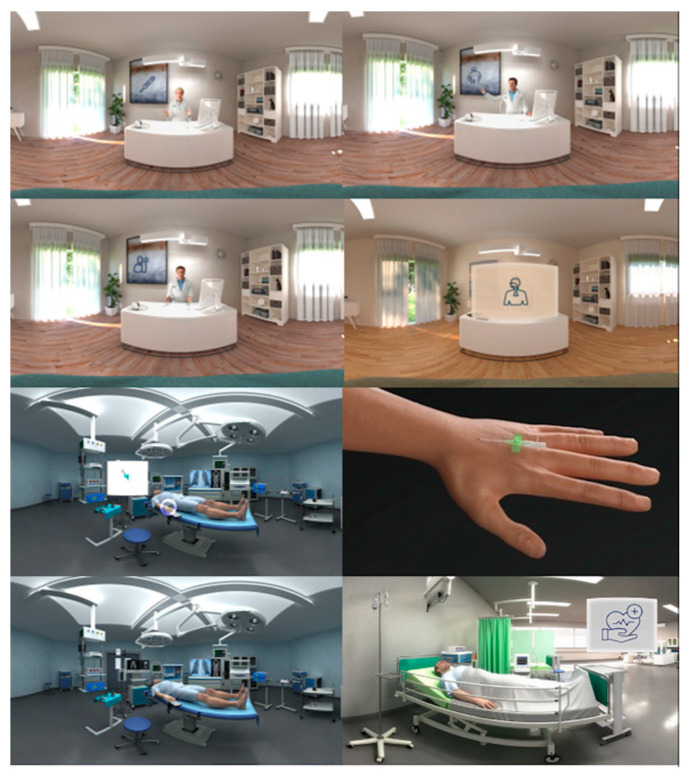
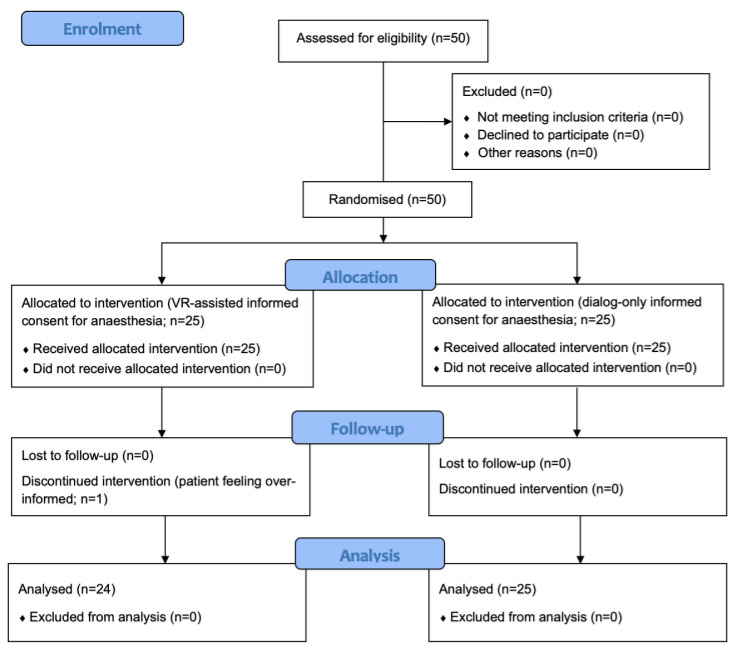
: Informed consent for anesthesia poses both legal challenges and problems of understandable communication. Fulfilling all the requirements through anesthesiologists directly interacting with patients is a time- and staff-consuming strategy. Given today's smart technologies, notably including virtual reality (VR), we explored in a prospective randomized study whether 'VR-assisted informed consent' could improve this situation. : Fifty patients scheduled for orthopedic surgery were randomized. In the control group, informed consent was obtained via patient-specialist dialogs only. The patients in the study group, wearing a head-mounted display, watched an 8 min immersive 3D movie with the standard explanations of general anesthesia, followed by a patient-specialist dialog to address open questions. The time spent on the dialogs in both groups was evaluated as the primary outcome variable. As secondary variables, we analyzed both a three-item Likert scale on patient satisfaction with the VR experience and cost differences between both groups. : Patient-specialist dialogs were carried on for median (IQR) durations of 93 (20-182) seconds in the study group versus 665 (261-829) seconds in the control group ( < 0.001). All the patients exposed to VR rated this experience as favorable (87.5%) or neutral (12.5%). Based on anesthesiologists' incomes in the US and UK, our approach would reduce the staff expenditure for each patient-specialist dialog by median amounts of USD ≈40 or ≈11, respectively (2 × < 0.001). : 'VR-assisted informed consent' for anesthesia is well accepted by patients and reduces the time requirements for patient-specialist dialogs, thus pointing out a potential avenue towards increasing the work-time efficiency of anesthesiologists.
麻醉知情同意既带来了法律挑战,也存在沟通理解方面的问题。通过麻醉医生直接与患者互动来满足所有要求是一种耗时且耗费人力的策略。鉴于当今的智能技术,特别是包括虚拟现实(VR),我们在一项前瞻性随机研究中探讨了“VR辅助知情同意”是否能改善这种情况。
50名计划接受骨科手术的患者被随机分组。在对照组中,仅通过患者与专科医生的对话获得知情同意。研究组的患者佩戴头戴式显示器,观看了一部8分钟的沉浸式3D电影,其中包含全身麻醉的标准解释,随后进行患者与专科医生的对话以解答未解决的问题。将两组对话所花费的时间作为主要结局变量进行评估。作为次要变量,我们分析了关于患者对VR体验满意度的三项李克特量表以及两组之间的成本差异。
研究组患者与专科医生对话的中位(四分位间距)时长为93(20 - 182)秒,而对照组为665(261 - 829)秒(<0.001)。所有接触VR的患者对这种体验的评价为良好(87.5%)或中性(12.5%)。根据美国和英国麻醉医生的收入,我们的方法将使每位患者与专科医生对话的人力成本分别中位数降低约40美元或约11英镑(P<0.001)。
麻醉的“VR辅助知情同意”得到了患者的良好接受,并减少了患者与专科医生对话所需的时间,从而指出了提高麻醉医生工作时间效率的潜在途径。