Ecole du Val de Grace, 75006 Paris, France.
Hôpital d'Instruction des Armées (HIA) Sainte Anne, 83100 Toulon, France.
Nutrients. 2024 Oct 11;16(20):3442. doi: 10.3390/nu16203442.
Caffeine is a well-known psychostimulant reputed to alleviate the deleterious effects of sleep deprivation. Nevertheless, caffeine can alter sleep duration and quality, particularly during recovery sleep. We evaluated the effects of acute caffeine intake on the duration and quality of recovery sleep following total sleep deprivation (TSD), taking into account daily caffeine consumption.
Forty-one participants performed a double-blind, crossover TSD protocol (38 h of continuous wakefulness) with acute caffeine or placebo. Caffeine (2.5 mg/kg) or placebo was administered twice during continuous wakefulness (last treatment 6.5 h before bedtime for the recovery night). Polysomnographic measurements were recorded using a connected headband.
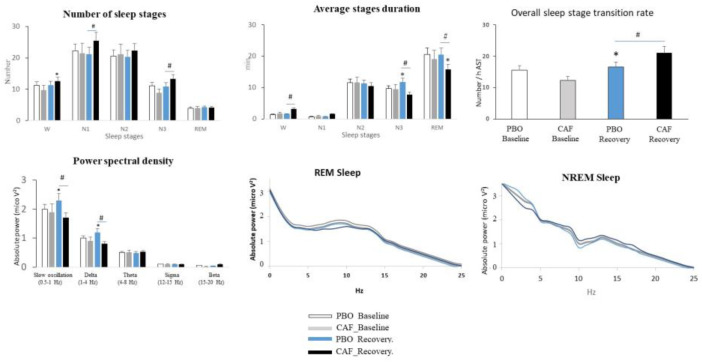
TSD was associated with a rebound in total sleep time (TST) on the recovery night (+110.2 ± 23.2 min, < 0.001). Caffeine intake decreased this recovery TST (-30.2 ± 8.2 min = 0.02) and the N3 sleep stage duration (-35.6 ± 23.2 min, < 0.01). Caffeine intake altered recovery sleep continuity (increased number of long awakenings), stability (higher stage transition frequency), and organization (less time spent in complete sleep cycle) and decreased the delta power spectral density during NREM sleep. On the recovery night, habitual daily caffeine consumption was negatively correlated with TST in caffeine and placebo conditions and positively correlated with wake after sleep onset (WASO) duration and with the frequency of long (>2 min) awakenings in the caffeine condition only.
Acute caffeine intake during TSD affects nighttime recovery sleep, with an interaction with daily consumption. These results may influence advice on caffeine intake for night-shift workers. (NCT03859882).
咖啡因是一种众所周知的精神兴奋剂,据称可减轻睡眠剥夺的有害影响。然而,咖啡因会改变睡眠持续时间和质量,尤其是在恢复性睡眠期间。我们评估了急性咖啡因摄入对完全睡眠剥夺(TSD)后恢复性睡眠的持续时间和质量的影响,同时考虑了日常咖啡因摄入量。
41 名参与者进行了一项双盲、交叉 TSD 方案(连续 38 小时清醒),给予急性咖啡因或安慰剂。咖啡因(2.5mg/kg)或安慰剂在连续清醒期间分两次给予(最后一次治疗在睡前 6.5 小时进行,用于恢复性夜间)。使用连接的头带记录多导睡眠图测量。
TSD 与恢复性夜间总睡眠时间(TST)的反弹有关(+110.2±23.2min,<0.001)。咖啡因摄入减少了这种恢复性 TST(-30.2±8.2min,=0.02)和 N3 睡眠阶段持续时间(-35.6±23.2min,<0.01)。咖啡因摄入改变了恢复性睡眠连续性(增加了长觉醒次数)、稳定性(更高的阶段转换频率)和组织(在完整睡眠周期中花费的时间减少),并降低了 NREM 睡眠期间的 delta 功率谱密度。在恢复性夜间,习惯性每日咖啡因摄入量与咖啡因和安慰剂条件下的 TST 呈负相关,与睡眠后觉醒(WASO)持续时间呈正相关,与咖啡因条件下的长(>2 分钟)觉醒频率呈正相关。
TSD 期间急性咖啡因摄入会影响夜间恢复性睡眠,并与日常摄入量相互作用。这些结果可能会影响夜班工人关于咖啡因摄入的建议。(NCT03859882)。