Department of Pharmaceutical Sciences, College of Pharmacy, Princess Nourah bint Abdulrahman University, P.O. Box 84428, Riyadh 11671, Saudi Arabia.
Pharmacy Services Administration, King Fahad Medical City, P.O. Box 59046, Riyadh 11525, Saudi Arabia.
Medicina (Kaunas). 2024 Oct 9;60(10):1649. doi: 10.3390/medicina60101649.
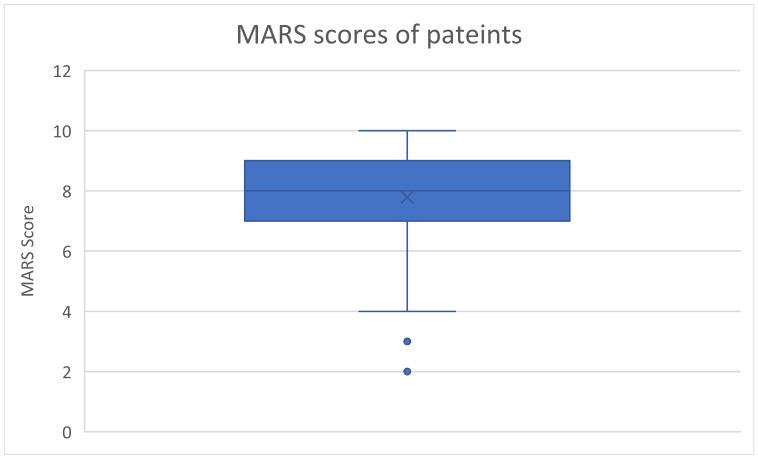
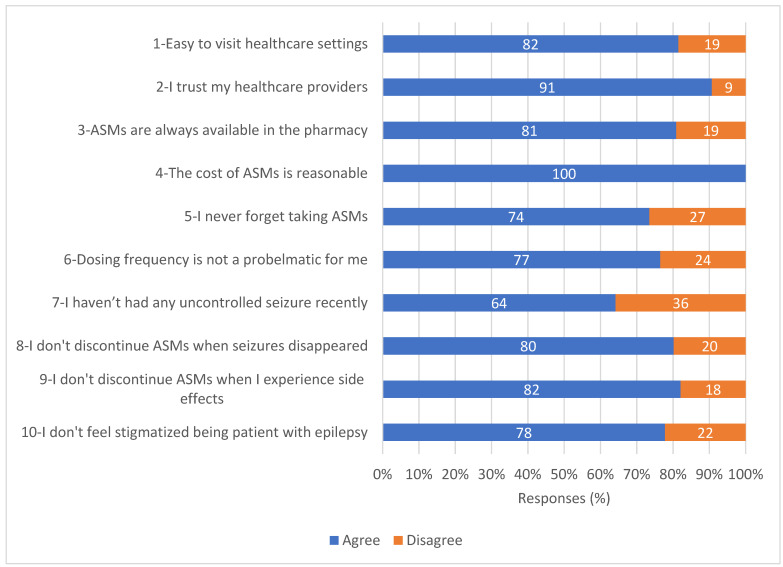
: The objective of this paper is to determine the rate and predictors of non-adherence to antiseizure medications in Saudi Arabia. : A cross-sectional study which involved questionnaires and data collection from patients' medical records was conducted at neurology clinics. The rate of non-adherence to antiseizure medications was measured using "the Medication Adherence Rating Scale" (MARS). Predictors of non-adherence to antiseizure medications were evaluated using a multidimensional questionnaire specific to epilepsy. : One hundred and sixty-two patients participated in the study. The mean (SD) age was 34.1 (10.4) years, and 56% were male. Epilepsy was controlled (i.e., seizure-free ≥ 1 year) in 42% of patients. The mean ± SD (range) MARS scores were 7.80 ± 1.59 (2-10). Out of 162 patients, 58 (36%) patients had MARS scores ≤ 7 out of 10. The most frequently rated predictor for non-adherence was poor seizure control, which was reported by around 36% of patients. Forgetfulness, dosing frequency, and social stigma were also among the commonest predictors of non-adherence to antiseizure medications that were rated by approximately 27%, 24%, and 22% of the patients, respectively. The impacts of several socio-demographic and clinical factors on adherence were assessed. In the regression analysis, the odds of non-adherence in a patient who experienced adverse effects were twice that of a patient who did not have adverse effects ( = 0.113). Furthermore, females, employers, and patients who had comorbidity, those with focal epilepsy, those on polytherapy of antiseizure medication, and those receiving multiple doses per day, were all more likely (but not significantly, > 0.05) to be non-adherent compared to their counterparts. : The significance of this study is that it reveals that adherence to antiseizure medications is suboptimal in Saudi Arabia. Poor seizure control, forgetfulness, dosing frequency, and social stigma were the primary patient-reported predictors of non-adherence in epilepsy. This emphasizes the importance of routine evaluation of adherence in practice to identify and address what individual patients perceive as a barrier to adherence with antiseizure medications.
本文旨在确定沙特阿拉伯抗癫痫药物治疗不依从的发生率和预测因素。这是一项横断面研究,在神经病学诊所通过问卷和患者病历数据收集进行。抗癫痫药物治疗不依从的发生率使用“药物依从性评定量表”(MARS)进行测量。使用专门针对癫痫的多维问卷评估抗癫痫药物治疗不依从的预测因素。共有 162 名患者参与了这项研究。患者的平均(标准差)年龄为 34.1(10.4)岁,56%为男性。42%的患者癫痫得到控制(即无发作≥1 年)。MARS 评分的平均值±标准差(范围)为 7.80±1.59(2-10)。在 162 名患者中,58 名(36%)患者的 MARS 评分≤10 分中的 7 分。最常被评为不依从的预测因素是癫痫控制不佳,约 36%的患者报告了这一点。健忘、剂量频率和社会耻辱感也是不依从抗癫痫药物治疗的常见预测因素,约 27%、24%和 22%的患者分别报告了这些因素。评估了几个社会人口统计学和临床因素对依从性的影响。在回归分析中,经历不良反应的患者不依从的可能性是没有不良反应的患者的两倍(=0.113)。此外,女性、雇主、合并症患者、局灶性癫痫患者、接受多种抗癫痫药物治疗的患者以及每天接受多次剂量的患者,与对照组相比,更有可能(但不显著,>0.05)不依从。这项研究的意义在于,它表明沙特阿拉伯的抗癫痫药物治疗依从性不理想。癫痫患者报告的主要不依从预测因素是癫痫控制不佳、健忘、剂量频率和社会耻辱感。这强调了在实践中定期评估依从性以识别和解决个体患者认为抗癫痫药物治疗依从性的障碍的重要性。