Coelho Madalena Maria Saldanha, Davanzo Emilia Fernanda Agostinho, Dos Santos Rebecca Lavarini, Castro Virgílio Hipólito de Lemos, da Costa Hayanna Maria Boaventura, Dallago Bruno Stéfano Lima, Perecmanis Simone, Santana Angela Patrícia
Faculty of Agronomy and Veterinary Medicine, University of Brasília (UnB), Federal District, Brasília 70910-900, Brazil.
Life (Basel). 2024 Oct 3;14(10):1261. doi: 10.3390/life14101261.
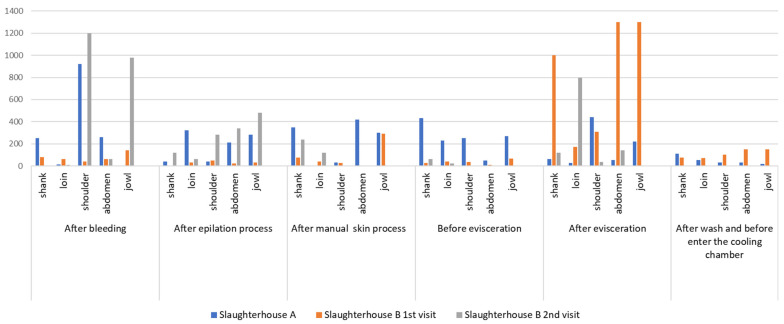
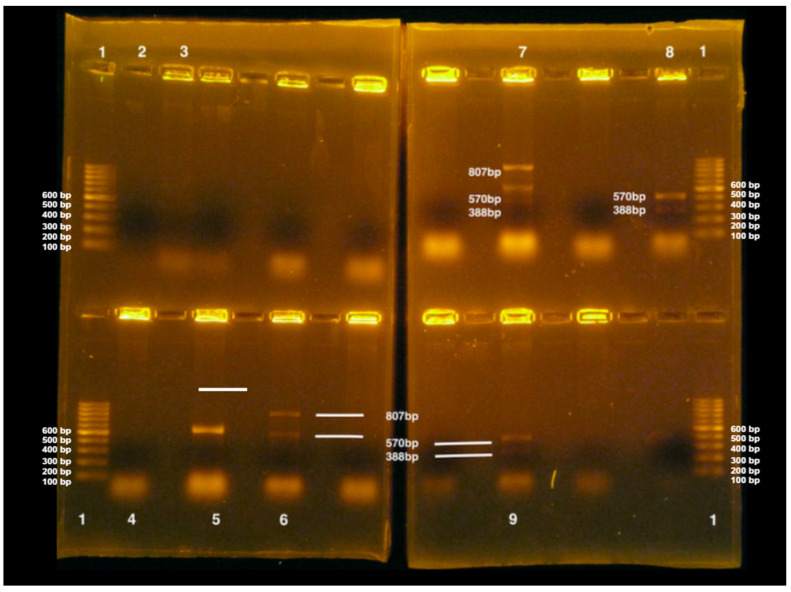
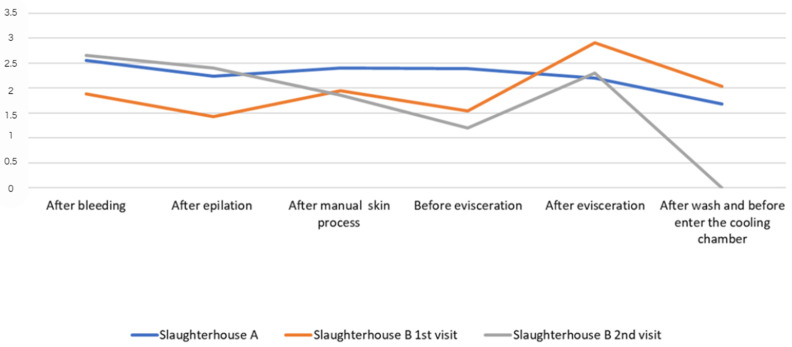
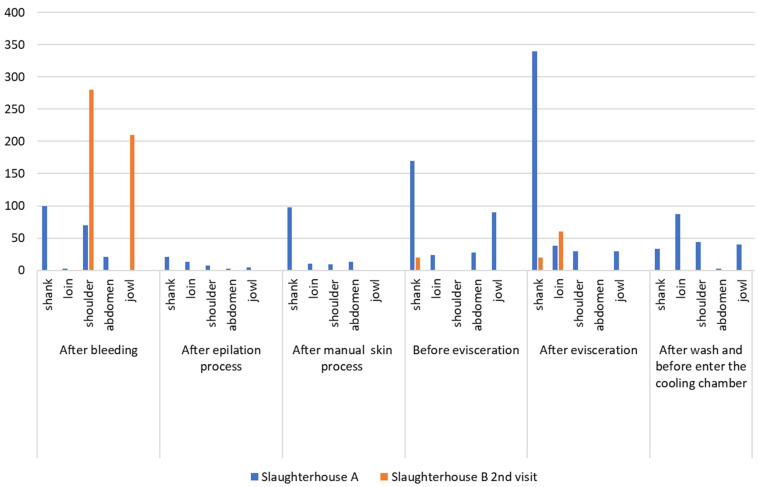
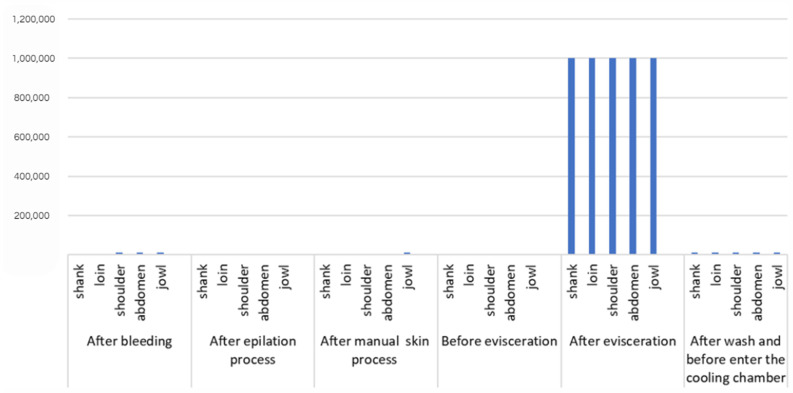
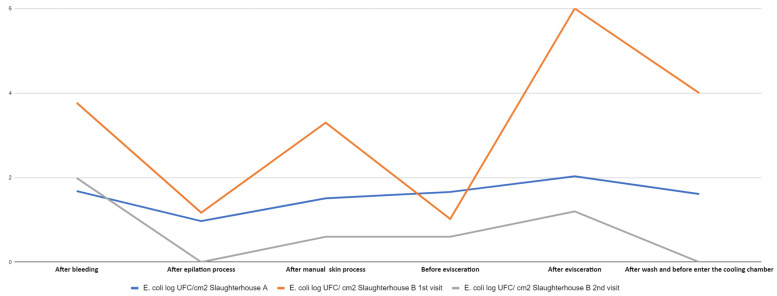
This study aimed to count and in different locations on pig carcasses (shank, loin, abdomen, shoulder, and jowl) from two slaughterhouses (A and B) between September 2019 and July 2021 during different slaughter stages (after bleeding, after passing through the epilator machine, after manual toileting in the dirty area, before and after evisceration, and after the final washing), as well as verify antimicrobial resistance and biofilm formation capacity. The main points of and contamination were identified in the two slaughterhouses through three collections. The stages with the highest counts were post-bleeding and evisceration in both slaughterhouses and after manual toileting in slaughterhouse B in the first collection. Most isolates were resistant to multiple antimicrobials, with higher resistance frequencies to amoxicillin, ampicillin, chloramphenicol, sulfonamides, and streptomycin. The virulence genes , , and were also detected. Three isolates had all three genes and exhibited resistance to at least six antimicrobial classes (β-lactams, macrolides, aminoglycosides, sulfonamides, amphenicols, and quinolones). isolates also showed a high frequency of strains with moderate and strong in vitro biofilm-forming capacity. This is the first study to characterize microbial contamination by pig slaughter stage in the Federal District region, demonstrating the critical points for hygienic production. was isolated from the surface of pig carcasses, as well as the virulence genes , , and were detected. The multi-antimicrobial resistant isolates also had a moderate-to-strong biofilm formation capacity, thus demonstrating risks to public health.
本研究旨在对2019年9月至2021年7月期间来自两个屠宰场(A和B)的猪胴体不同部位(小腿、腰部、腹部、肩部和脸颊)在不同屠宰阶段(放血后、通过脱毛机后、在脏区人工清理后、去内脏前后以及最终清洗后)的[具体微生物]进行计数,并验证其抗菌药物耐药性和生物膜形成能力。通过三次采样确定了两个屠宰场中[具体微生物]污染的主要点。两个屠宰场中计数最高的阶段是放血后和去内脏后,在第一次采样中,屠宰场B在人工清理后[具体微生物]数量也很高。大多数[具体微生物]分离株对多种抗菌药物耐药,对阿莫西林、氨苄西林、氯霉素、磺胺类药物和链霉素的耐药频率较高。还检测到了毒力基因[具体基因1]、[具体基因2]和[具体基因3]。三个分离株含有所有这三个基因,并对至少六种抗菌药物类别(β-内酰胺类、大环内酯类、氨基糖苷类、磺胺类、氯霉素类和喹诺酮类)耐药。[具体微生物]分离株还显示出具有中度和强体外生物膜形成能力的菌株频率较高。这是第一项对联邦区地区猪屠宰阶段微生物污染进行特征描述的研究,证明了卫生生产的关键点。[具体微生物]从猪胴体表面分离出来,同时检测到了毒力基因[具体基因1]、[具体基因2]和[具体基因3]。多重抗菌药物耐药分离株也具有中度至强的生物膜形成能力,因此对公众健康构成风险。