Velasco Luis, Ahmadian Morteza, Ortiz Laura, Brito Juan P, Pastor Antonio, Rivas Jose M, Barzegar Sima, Comellas Jaume, Martin Vicente, Ruiz Marc
Advanced Broadband Communications Center (CCABA), Universitat Politècnica de Catalunya (UPC), 08034 Barcelona, Spain.
Electrical Engineering, Chalmers University of Technology, 41296 Gothenburg, Sweden.
Sensors (Basel). 2024 Oct 15;24(20):6631. doi: 10.3390/s24206631.
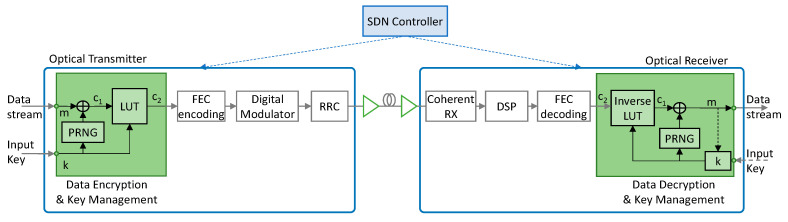
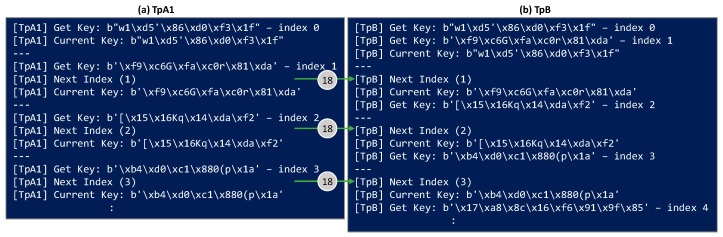
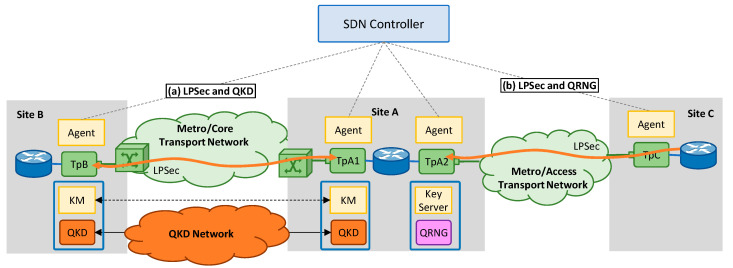
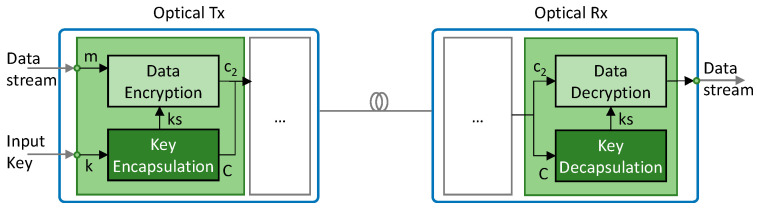
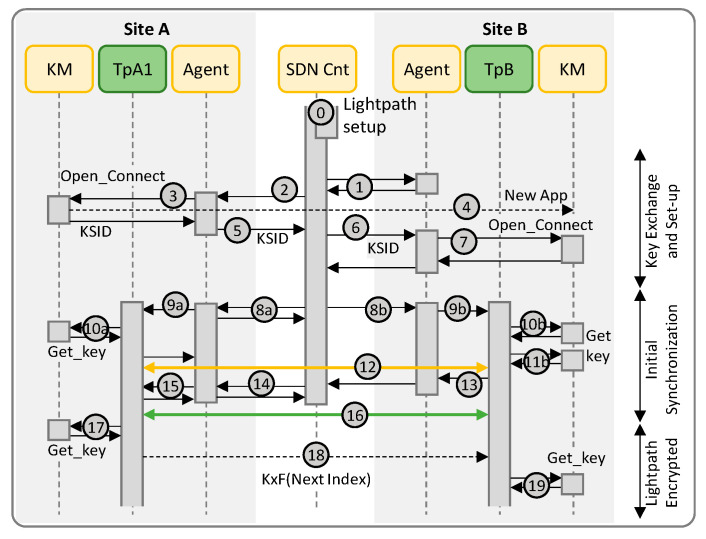
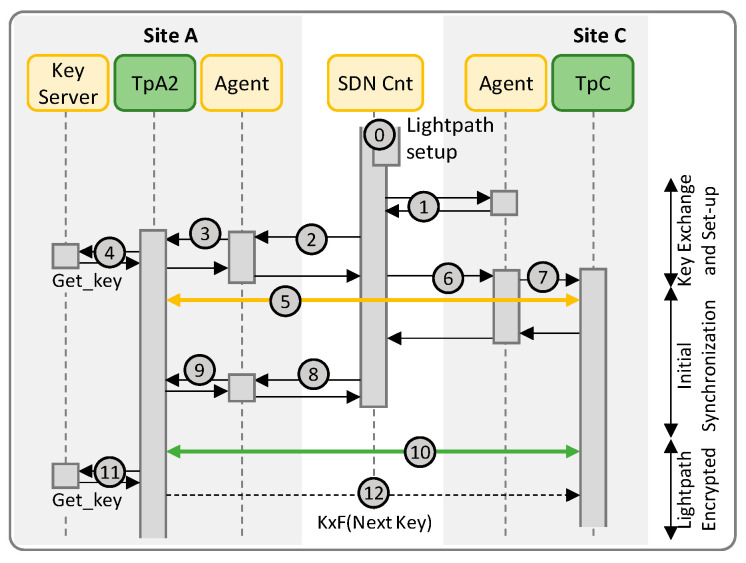
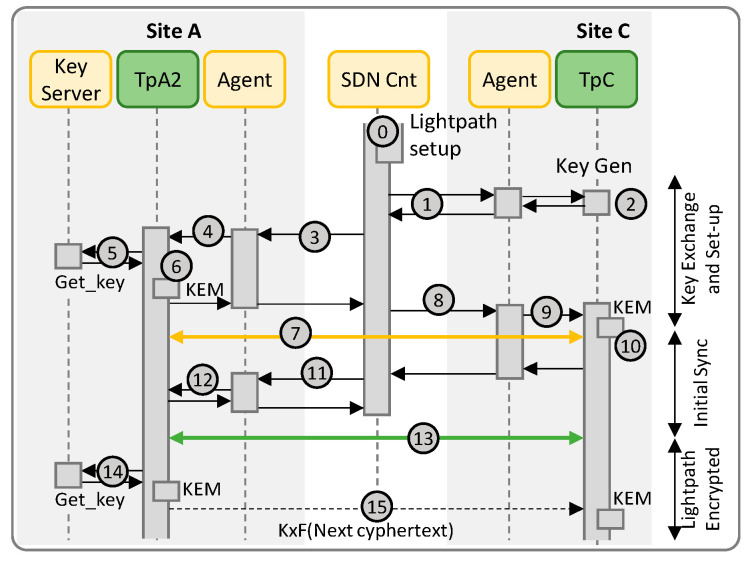
Optical communications providing huge capacity and low latency remain vulnerable to a range of attacks. In consequence, encryption at the optical layer is needed to ensure secure data transmission. In our previous work, we proposed LightPath SECurity (LPSec), a secure cryptographic solution for optical transmission that leverages stream ciphers and Diffie-Hellman (DH) key exchange for high-speed optical encryption. Still, LPSec faces limitations related to key generation and key distribution. To address these limitations, in this paper, we rely on Quantum Random Number Generators (QRNG) and Quantum Key Distribution (QKD) networks. Specifically, we focus on three meaningful scenarios: In Scenario A, the two optical transponders (Tp) involved in the optical transmission are within the security perimeter of the QKD network. In Scenario B, only one Tp is within the QKD network, so keys are retrieved from a QRNG and distributed using LPSec. Finally, Scenario C extends Scenario B by employing Post-Quantum Cryptography (PQC) by implementing a Key Encapsulation Mechanism (KEM) to secure key exchanges. The scenarios are analyzed based on their security, efficiency, and applicability, demonstrating the potential of quantum-enhanced LPSec to provide secure, low-latency encryption for current optical communications. The experimental assessment, conducted on the Madrid Quantum Infrastructure, validates the feasibility of the proposed solutions.
提供大容量和低延迟的光通信仍然容易受到一系列攻击。因此,需要在光层进行加密以确保数据传输的安全性。在我们之前的工作中,我们提出了光路径安全(LPSec),这是一种用于光传输的安全加密解决方案,它利用流密码和迪菲-赫尔曼(DH)密钥交换进行高速光加密。尽管如此,LPSec仍面临与密钥生成和密钥分发相关的限制。为了解决这些限制,在本文中,我们依赖于量子随机数发生器(QRNG)和量子密钥分发(QKD)网络。具体来说,我们关注三种有意义的场景:在场景A中,参与光传输的两个光转发器(Tp)在QKD网络的安全范围内。在场景B中,只有一个Tp在QKD网络内,因此密钥从QRNG中获取并使用LPSec进行分发。最后,场景C通过采用后量子密码学(PQC),实现密钥封装机制(KEM)来确保密钥交换,从而扩展了场景B。基于安全性、效率和适用性对这些场景进行了分析,证明了量子增强型LPSec为当前光通信提供安全、低延迟加密的潜力。在马德里量子基础设施上进行的实验评估验证了所提出解决方案的可行性。