Department of Hygiene, Graduate School of Medicine, Hokkaido University.
Department of Environmental Engineering, Graduate School of Engineering, Kyoto University.
Environ Health Prev Med. 2024;29:57. doi: 10.1265/ehpm.24-00108.
The acute effects of temperature and air pollution on mortality are well-known environmental factors that have been receiving more recognition lately. However, the health effects resulting from the interaction of air pollution and temperature remain uncertain, particularly in cities with low levels of pollution. This study aims to examine the modification effects of particulate matter with a diameter of 2.5 µm or less (PM) and ozone (O) on the association between temperature and mortality.
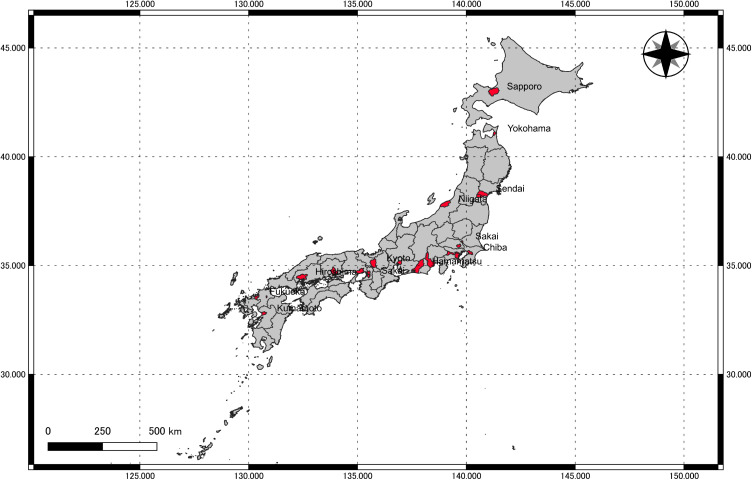
We collected the daily number of all-cause, cardiovascular, and respiratory mortality from 20 major cities in Japan from 2012-2018. We obtained meteorological data from the Japan Meteorological Agency and air pollution data from the National Institute for Environmental Studies. We conducted analyses using a quasi-Poisson regression model with a distributed lag non-linear model for temperature in each city and subsequently performed a random-effects meta-analysis to derive average estimates.
We found that high levels of O might positively modify the mortality risk of heat exposure, especially for cardiovascular diseases. Subgroups such as the elderly and females were susceptible. We did not observe consistent evidence of effect modification by PM, including effect modification on cold by both pollutants.
PM and O may positively modify the short-term association between heat and mortality in the urban areas of Japan. These results highlight the need for public health policies and interventions to address the collective impacts of both temperature and air pollution.
温度和空气污染对死亡率的急性影响是众所周知的环境因素,最近受到了更多的关注。然而,空气污染和温度相互作用对健康的影响仍不确定,特别是在污染水平较低的城市。本研究旨在探讨 2.5µm 或以下粒径的颗粒物(PM)和臭氧(O)对温度与死亡率之间关联的修饰作用。
我们收集了 2012 年至 2018 年日本 20 个主要城市的全因、心血管和呼吸道死亡率的每日数据。我们从日本气象厅获取气象数据,从国立环境研究所获取空气污染数据。我们在每个城市使用具有分布滞后非线性模型的拟泊松回归模型进行温度分析,然后进行随机效应荟萃分析以得出平均估计值。
我们发现高水平的 O 可能会对热暴露的死亡风险产生积极的修饰作用,尤其是对心血管疾病。老年人和女性等亚组更容易受到影响。我们没有观察到 PM 的一致的修饰作用证据,包括两种污染物对冷的修饰作用。
PM 和 O 可能会对日本城市地区热与死亡率之间的短期关联产生积极的修饰作用。这些结果强调了需要制定公共卫生政策和干预措施,以应对温度和空气污染的综合影响。