South Ethiopia Region Health Bureau Public Health Institute, Jinka, Ethiopia.
Department of Health Studies, College of Human Sciences, University of South Africa, Pretoria, South Africa.
Front Public Health. 2024 Oct 11;12:1482208. doi: 10.3389/fpubh.2024.1482208. eCollection 2024.
Despite the implementation of different interventions, food insecurity remains a major public health issue in rural areas of Ethiopia. However, there has been limited evidence regarding food insecurity and responsible factors in rural areas of Ethiopia, particularly in South Omo, Ethiopia. Hence, this study aimed to assess food insecurity and determinants in agrarian and pastoralist communities of South Omo Zone, Southern Ethiopia.
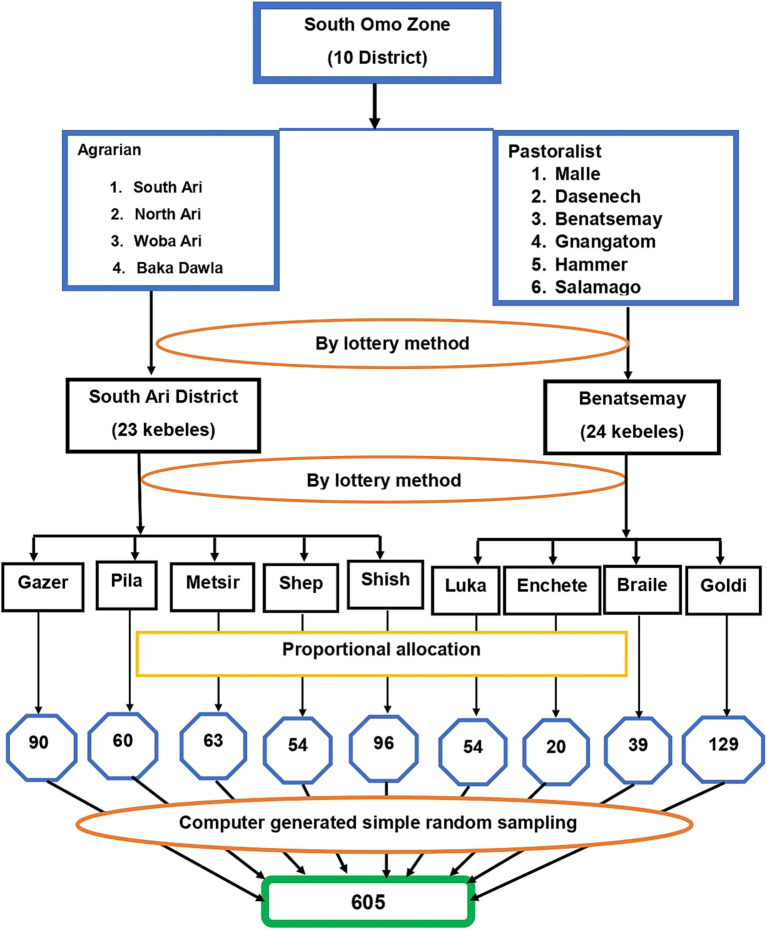
A cross-sectional study was done among 605 randomly selected households in Benatsemay and South Ari districts from February 1 to 28, 2023. A standardized and validated Household Food Insecurity Access Scale (HFIAS) was used to measure food insecurity status. Data were entered using Epi-Info 7.1 and then transferred to SPSS V25 for analysis. To identify associated factors, a binary logistic regression model was employed. The strength of association was evaluated considering the adjusted odds ratio (AOR) and a 95% confidence interval (CI). A statistical significance was stated at -value <0.05.
A total of 597 participants were involved in the study with a response rate of 98.7%. The overall prevalence of food insecurity using HFIAS was 42.2% (95%CI: 38.2, 46.3%), among which mild, moderate, and severe food insecurity accounted for 17.4, 16.6, and 8.2%, respectively. Of pastoralists, 114 (47.1%) were food insecure whereas 138 (38.9%) were food insecure in the agrarian. Food insecurity was affected by household head sex (AOR = 1.73, 95%CI: 1.14, 2.62), high dependency ratio (AOR = 2.53, 95%CI: 1.53, 4.20), no formal maternal education (AOR = 2.11, 95%CI: 1.07, 4.18), productive safety net program (AOR = 2.00, 95%CI: 1.16, 3.46) and land ownership (AOR = 1.80, 95% CI: 1.19, 2.72).
Food insecurity was a significant problem in the study areas. Thus, it is crucial to improve female education, advance agricultural technologies, advocate family planning, and broaden productive safety net programs.
尽管实施了不同的干预措施,粮食不安全仍然是埃塞俄比亚农村地区的一个主要公共卫生问题。然而,关于埃塞俄比亚农村地区,特别是在埃塞俄比亚南部奥莫地区的粮食不安全问题及其决定因素,证据有限。因此,本研究旨在评估南奥莫地区农业和牧民社区的粮食不安全状况及其决定因素。
2023 年 2 月 1 日至 28 日,在本纳塞马和南阿里区随机选择了 605 户家庭进行横断面研究。使用标准化和经过验证的家庭粮食不安全获取量表(HFIAS)来衡量粮食不安全状况。数据使用 Epi-Info 7.1 输入,然后转移到 SPSS V25 进行分析。为了确定相关因素,使用了二元逻辑回归模型。关联的强度通过调整后的优势比(AOR)和 95%置信区间(CI)来评估。统计显著性定义为 - 值<0.05。
共有 597 名参与者参与了研究,应答率为 98.7%。使用 HFIAS 总体粮食不安全发生率为 42.2%(95%CI:38.2,46.3%),其中轻度、中度和重度粮食不安全分别占 17.4%、16.6%和 8.2%。牧民中,114 人(47.1%)粮食不安全,而农业区有 138 人(38.9%)粮食不安全。粮食不安全受到家庭户主性别(AOR=1.73,95%CI:1.14,2.62)、高抚养比(AOR=2.53,95%CI:1.53,4.20)、母亲未接受正规教育(AOR=2.11,95%CI:1.07,4.18)、生产性安全网计划(AOR=2.00,95%CI:1.16,3.46)和土地所有权(AOR=1.80,95%CI:1.19,2.72)的影响。
粮食不安全是研究地区的一个重大问题。因此,提高女性教育水平、推广农业技术、倡导计划生育和扩大生产性安全网计划至关重要。