Department of Medicine, The University of Hong Kong, Hong Kong SAR, P. R. China.
Department of Medicine, Queen Mary Hospital, Hong Kong SAR, P. R. China.
Sci Rep. 2024 Oct 28;14(1):25701. doi: 10.1038/s41598-024-76890-0.
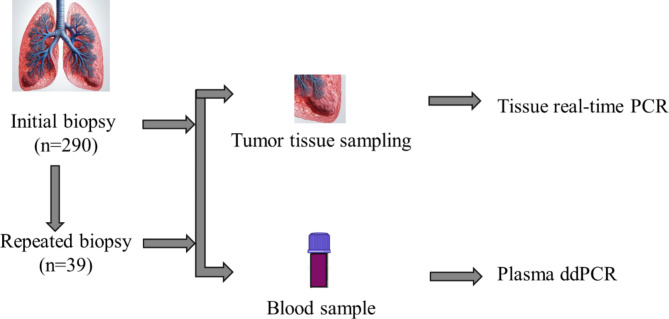
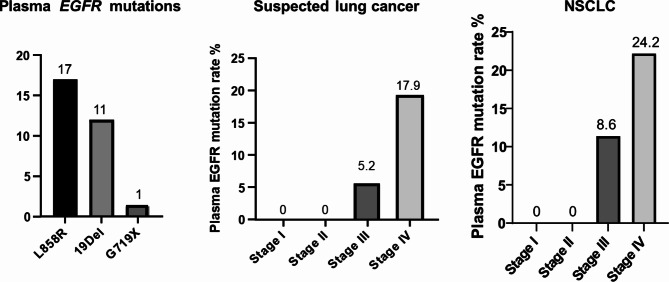
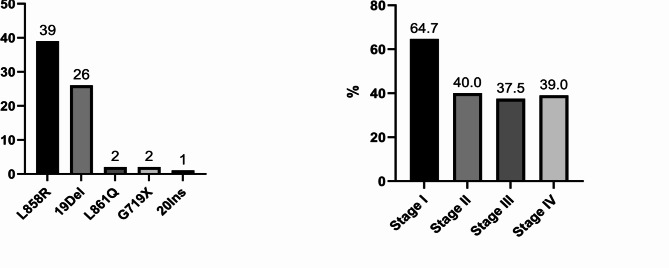
Detecting EGFR mutations in plasma using droplet digital PCR (ddPCR) assay offers a promising diagnostic tool for lung cancer patients. The performance of plasma-based ddPCR assay relative to traditional EGFR mutation testing in tissue biopsies among Asian patients with suspected lung cancer remains underexplored. Consecutive patients admitted for diagnostic workup for suspected lung cancer were recruited. Peripheral blood samples were collected on the same day of tissue biopsies. Tissue samples were subjected to EGFR mutation analysis via real-time PCR, whereas plasma samples were processed for ddPCR assay to evaluate for EGFR mutation status. The tissue re-biopsy rate was 43.8% while 0.7% of patients failed blood taking. Despite repeat biopsy, 15.2% of patients could not achieve histological diagnosis. Of the 202 patients newly diagnosed with lung cancer, EGFR mutations were detected in 13.4% of plasma samples, compared to 44.3% in tissue samples. Plasma ddPCR for EGFR mutations detection were barely detectable in stages I and II non-small cell lung cancer (NSCLC), but the sensitivity was 25.0%, 56.3%, and 75.0% in stages III, IVA, and IVB NSCLC, respectively. Plasma EGFR mutations were highly specific among all stages of lung cancer. Concordance rates of plasma ddPCR assay also rose with more advanced stages, recorded at 41.9% for stages I and II, 71.9% for stage III, 86.3% for stage IV. In stage IV lung cancer, the false negative rate for the plasma ddPCR assay was 34.4%, whereas that for the tissue testing was 19.2% due to insufficient tissue samples. Plasma-based EGFR genotyping using ddPCR is a non-invasive method that offers early diagnosis and serves as a valuable adjunct to tissue-based testing for patients with advanced-stage lung cancer. However, its usefulness is limited in the context of early-stage lung cancer, indicating a need for further research to improve its accuracy in these patients.
利用液滴数字 PCR(ddPCR)检测血浆中的 EGFR 突变可为肺癌患者提供一种有前途的诊断工具。ddPCR 检测血浆中 EGFR 突变的性能相对于传统的组织活检在亚洲疑似肺癌患者中的 EGFR 突变检测仍未得到充分探索。连续招募因疑似肺癌接受诊断性检查的患者。在进行组织活检的同一天采集外周血样本。组织样本通过实时 PCR 进行 EGFR 突变分析,而血浆样本则进行 ddPCR 检测以评估 EGFR 突变状态。组织再活检率为 43.8%,有 0.7%的患者未能采血。尽管进行了重复活检,仍有 15.2%的患者无法获得组织学诊断。在 202 例新诊断为肺癌的患者中,血浆样本中检测到 EGFR 突变的比例为 13.4%,而组织样本中的比例为 44.3%。ddPCR 检测血浆 EGFR 突变在 I 期和 II 期非小细胞肺癌(NSCLC)中几乎无法检测到,但在 III 期、IVA 期和 IVB 期 NSCLC 中的灵敏度分别为 25.0%、56.3%和 75.0%。血浆 EGFR 突变在所有肺癌分期中均具有高度特异性。随着分期的进展,血浆 ddPCR 检测的一致性也有所提高,I 期和 II 期为 41.9%,III 期为 71.9%,IV 期为 86.3%。在 IV 期肺癌中,ddPCR 检测血浆的假阴性率为 34.4%,而组织检测的假阴性率为 19.2%,原因是组织样本不足。基于 ddPCR 的血浆 EGFR 基因分型是一种非侵入性方法,可为晚期肺癌患者提供早期诊断,并可作为组织检测的有价值的辅助手段。然而,在早期肺癌的背景下,其用途有限,表明需要进一步研究以提高其在这些患者中的准确性。