Shillito Tom, Watkins Lance, Ali Hafsha, Page Georgina, Pullen Angie, Mitchell Sarah, Roy Ashok, Sen Arjune, Kinney Michael, Thomas Rhys, Tittensor Phil, Bagary Manny, Subramanium Arun, Kent Bridie, Shankar Rohit
Epilepsy Action, UK.
University of South Wales, UK; Cornwall Intellectual Disability Equitable Research (CIDER), University of Plymouth Peninsula School of Medicine, UK; and Adult Learning Disability Epilepsy Service, Swansea Bay University Health Board, UK.
BJPsych Open. 2024 Oct 28;10(6):e186. doi: 10.1192/bjo.2024.749.
People with intellectual disability (PwID) and epilepsy have increased premature and potentially preventable mortality. This is related to a lack of equitable access to appropriate care. The Step Together guidance and toolkit, developed with patient, clinical, charity and commissioning stakeholders, allows evaluation and benchmarking of essential epilepsy service provision for PwID in eight key domains, at a care system level.
To evaluate care provisions for adult PwID and epilepsy at a system level in the 11 integrated care systems (ICSs) of the Midlands, the largest NHS England region (population: approximately 11 million), using the Step Together toolkit.
Post training, each ICS undertook its benchmarking with the toolkit and submitted their scores to Epilepsy Action, a national UK epilepsy charity, who oversaw the process. The outcomes were analysed descriptively to provide results, individual and cumulative, at care domain and system levels.
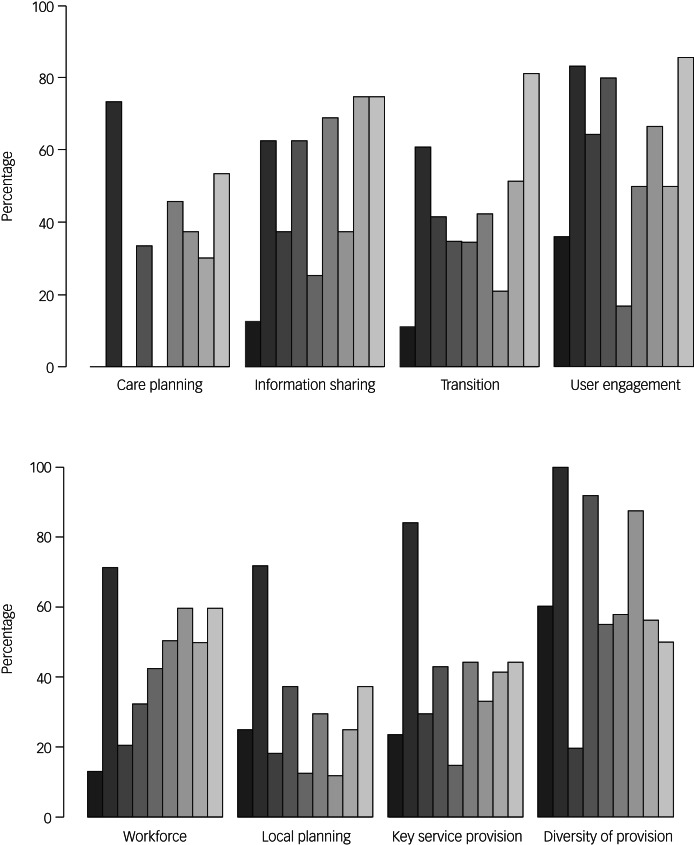
The toolkit was completed fully by nine of the 11 ICSs. Across all eight domains, overall score was 44.2% (mean 44.2%, median 43.3%, range 52.4%, interquartile range 23.8-76.2%). The domains of local planning (mean 31.1%, median 27.5%) and care planning (mean 31.4%, median 35.4%) scored the lowest, and sharing information scored the highest (mean 55.2%, median 62.5%). There was significant variability across each domain between the nine ICS. The user/carer participation domain had the widest variation across ICSs (0-100%).
The results demonstrate a significant variance in service provision for PwID and epilepsy across the nine ICSs. The toolkit identifies specific areas for improvement within each ICS and region.
智障人士(PwID)和癫痫患者的过早死亡率以及潜在可预防死亡率有所上升。这与缺乏公平获得适当护理的机会有关。与患者、临床、慈善和委托利益相关者共同开发的“携手共进”指南和工具包,能够在护理系统层面评估和衡量针对智障人士的基本癫痫服务在八个关键领域的提供情况。
使用“携手共进”工具包,在英格兰国民保健服务体系(NHS)最大的地区——中部地区的11个综合护理系统(ICS)中,对成年智障人士和癫痫患者的护理服务进行系统层面的评估。该地区人口约为1100万。
培训后,每个ICS使用该工具包进行基准测试,并将其分数提交给英国全国性癫痫慈善机构“癫痫行动”,由该机构监督整个过程。对结果进行描述性分析,以提供护理领域和系统层面的个体及累积结果。
11个ICS中有9个完全完成了该工具包。在所有八个领域中,总体得分率为44.2%(平均44.2%,中位数43.3%,范围52.4%,四分位间距23.8 - 76.2%)。地方规划领域(平均31.1%,中位数27.5%)和护理规划领域(平均31.4%,中位数35.4%)得分最低,信息共享领域得分最高(平均55.2%,中位数62.5%)。九个ICS在每个领域的差异都很大。用户/护理者参与领域在各ICS中的差异最大(0 - 100%)。
结果表明,九个ICS在为智障人士和癫痫患者提供服务方面存在显著差异。该工具包确定了每个ICS和地区内需要改进的具体领域。