Department of Infectious Diseases, Key Laboratory of Molecular Biology for Infectious Diseases (Ministry of Education), Institute for Viral Hepatitis, The Second Affiliated Hospital, Chongqing Medical University, Chongqing, China.
Department of Endocrine and Breast Surgery, The First Affiliated Hospital of Chongqing Medical University, Chongqing, China.
Virol J. 2024 Oct 28;21(1):268. doi: 10.1186/s12985-024-02535-3.
Hepatitis B virus (HBV) infection is a persistent global public health problem, and curing for chronic hepatitis B (CHB) through the application of existing antiviral drugs is beset by numerous challenges. The viral protein HBx is a critical regulatory factor in the life cycle of HBV. Targeting HBx is a promising possibility for the development of novel therapeutic strategies.
The Nano-Glo HiBiT Lysis Detection System was used to screen the herbal monomer compound library for compounds that inhibit HBx expression. Western blotting was used to examine proteins expression. Southern blotting or Northern blotting were used to detect HBV DNA or HBV RNA. ELISA was performed to detect the HBsAg level. The effect of asiatic acid on HBV in vivo was investigated by using recombinant cccDNA mouse model.
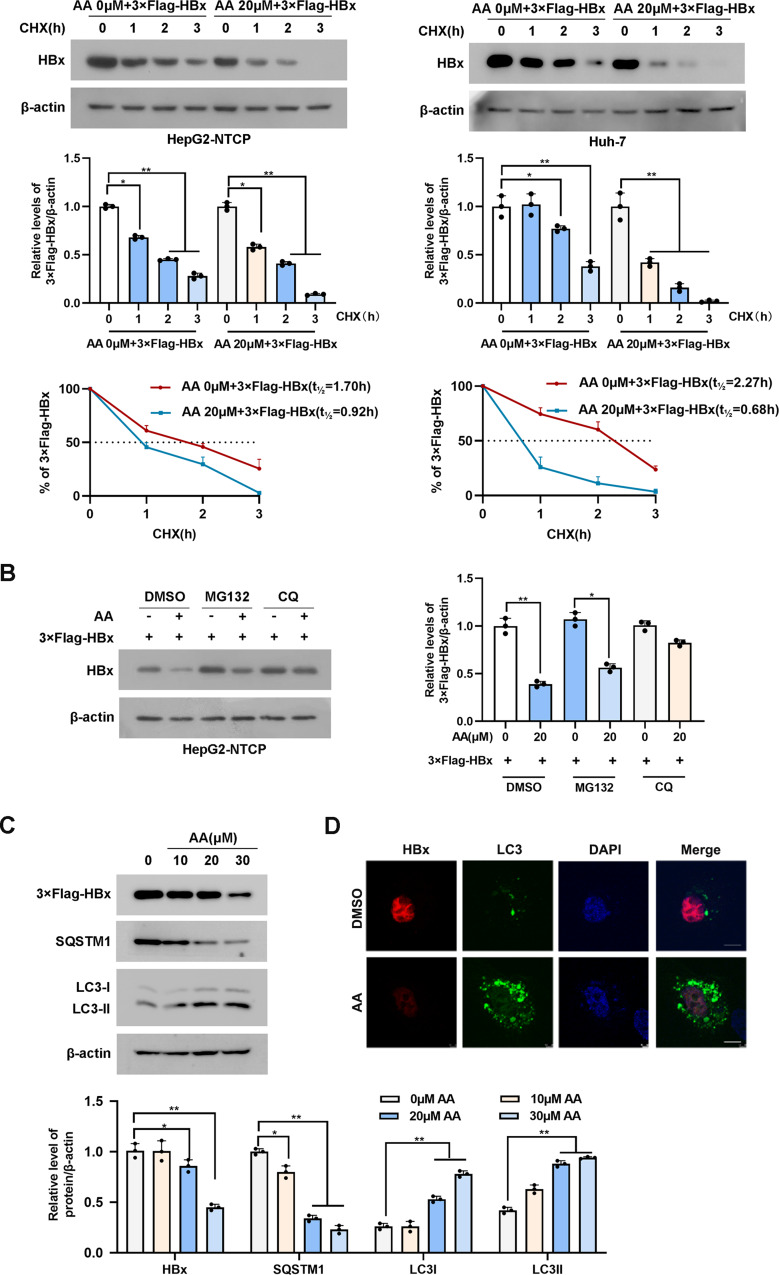
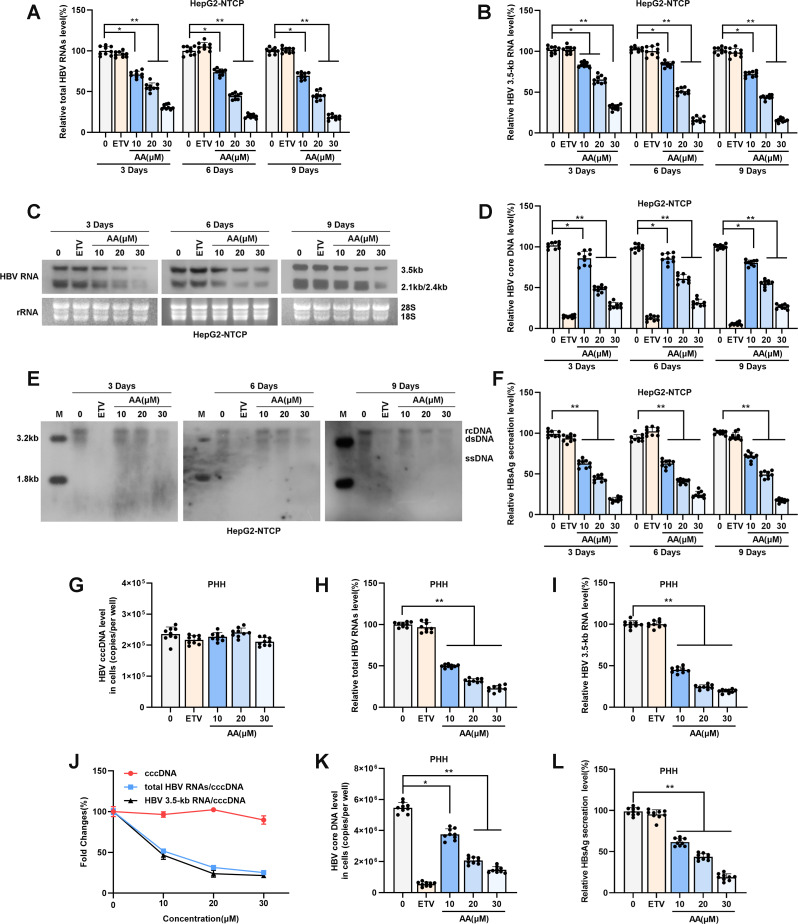
Asiatic acid, an extract of Centella asiatica, significantly reduced the HBx level. Mechanistic studies demonstrated that asiatic acid may promote the degradation of HBx in an autophagy pathway-dependent manner. Subsequently, asiatic acid was found to reduce the amount of HBx bound to covalently closed circular DNA (cccDNA) microchromosomes, and repressive chromatin modifications then occurred, ultimately inhibiting cccDNA transcriptional activity. Moreover, in HBV-infected cells and a mouse model of persistent HBV infection, asiatic acid exhibited potent anti-HBV activity, as evidenced by decreased levels of HBV RNAs, HBV DNA and HBsAg.
Asiatic acid was identified as a compound that targets HBx, revealing its potential for application as an anti-HBV agent.
乙型肝炎病毒(HBV)感染是一个持续存在的全球性公共卫生问题,通过应用现有抗病毒药物治愈慢性乙型肝炎(CHB)面临诸多挑战。病毒蛋白 HBx 是 HBV 生命周期中的一个关键调节因子。靶向 HBx 是开发新治疗策略的一个有前途的可能性。
使用 Nano-Glo HiBiT 裂解检测系统筛选抑制 HBx 表达的草药单体化合物库。使用 Western blot 检测蛋白表达。使用 Southern blot 或 Northern blot 检测 HBV DNA 或 HBV RNA。使用 ELISA 检测 HBsAg 水平。使用重组 cccDNA 小鼠模型研究齐墩果酸对 HBV 的体内作用。
积雪草酸,一种积雪草的提取物,显著降低了 HBx 水平。机制研究表明,积雪草酸可能通过自噬途径依赖性促进 HBx 的降解。随后,发现积雪草酸减少了与共价闭合环状 DNA(cccDNA)微染色体结合的 HBx 量,并且发生了抑制染色质修饰,最终抑制了 cccDNA 的转录活性。此外,在 HBV 感染的细胞和持续 HBV 感染的小鼠模型中,积雪草酸表现出强大的抗 HBV 活性,HBV RNA、HBV DNA 和 HBsAg 的水平降低。
鉴定出积雪草酸是一种靶向 HBx 的化合物,表明其具有作为抗 HBV 药物的应用潜力。