University of Colorado School of Medicine, Aurora, CO, USA.
Division of Allergy-Immunology, Department of Pediatrics, National Jewish Health, Denver, CO, USA.
Adv Ther. 2024 Dec;41(12):4601-4616. doi: 10.1007/s12325-024-02998-4. Epub 2024 Oct 29.
Patients with atopic dermatitis (AD) often have other comorbid type 2 inflammatory conditions. The aim of this study was to evaluate the impact of type 2 comorbidities on the response to and safety of dupilumab in young children with AD.
LIBERTY AD PRESCHOOL part B was a randomized, placebo-controlled trial in children aged 6 months to 5 years with moderate-to-severe AD. In this post hoc analysis, patients were stratified by the presence or absence of caregiver-reported selected type 2 comorbidities at baseline: asthma, allergic rhinitis (AR), and food allergies (FAs).
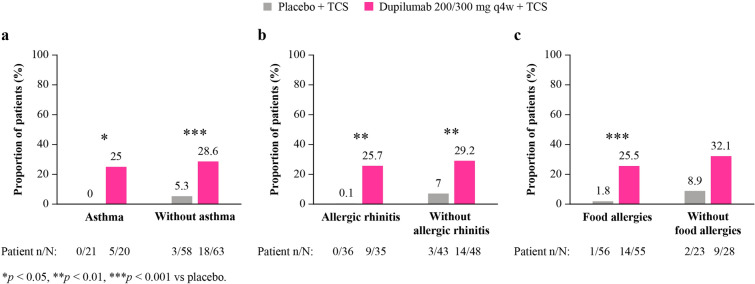
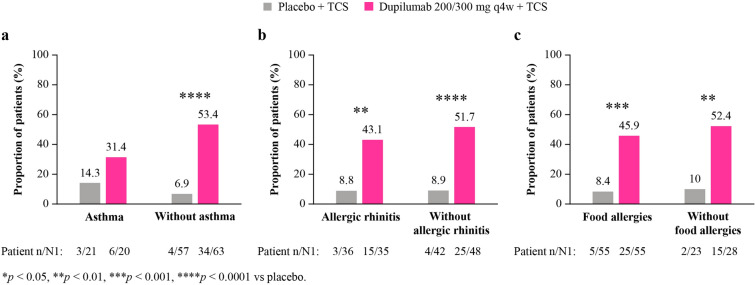
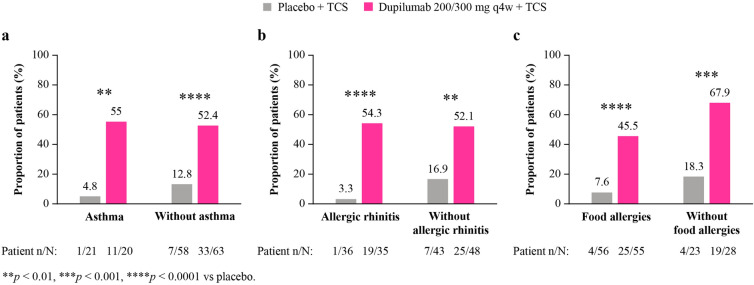
At week 16, significantly more patients receiving dupilumab versus placebo, with or without asthma and AR, achieved an Investigator's Global Assessment (IGA) score of 0/1 and a ≥ 75% improvement in Eczema Area and Severity Index (all p < 0.05). Significantly more patients receiving dupilumab versus placebo with FAs and numerically more patients without FAs achieved an IGA score of 0/1 (p = 0.0007 and p = 0.06). Numerically more patients receiving dupilumab versus placebo with asthma and significantly more patients without asthma achieved a ≥ 4-point reduction in the weekly average of daily score on the Worst Scratch/Itch Numeric Rating Scale (WSI-NRS) (p = 0.6 and p < 0.0001). Additionally, significantly more patients receiving dupilumab versus placebo with or without AR (p = 0.008 and p < 0.0001) and with or without FAs (p = 0.0002 and p = 0.004) achieved a ≥ 4-point reduction in the weekly average of daily score on the WSI-NRS. Overall safety was consistent with the known dupilumab safety profile.
Dupilumab treatment improves AD signs and symptoms in children aged 6 months to 5 years with and without type 2 comorbidities such as asthma, AR, and FAs.
ClinicalTrials.gov registration number NCT03346434.
Do type 2 comorbidities impact the response to dupilumab in children with atopic dermatitis? (MP4 103,451 KB).
特应性皮炎(AD)患者常伴有其他 2 型炎症性疾病。本研究旨在评估 2 型合并症对接受度普利尤单抗治疗的 AD 患儿的疗效和安全性的影响。
LIBERTY AD PRESCHOOL 研究的一部分 B 是一项随机、安慰剂对照试验,纳入了年龄在 6 个月至 5 岁的中重度 AD 患儿。在这项事后分析中,根据基线时有无家长报告的特定 2 型合并症,将患儿分为以下两组:哮喘、过敏性鼻炎(AR)和食物过敏(FA)。
在第 16 周时,与安慰剂组相比,接受度普利尤单抗治疗的患儿,无论是否伴有哮喘和 AR,均有更高比例的患儿达到研究者总体评估(IGA)评分 0/1 且湿疹面积和严重程度指数(EASI)改善≥75%(所有 p<0.05)。与安慰剂组相比,接受度普利尤单抗治疗的有 FA 和无 FA 的患儿,达到 IGA 评分 0/1 的比例更高(p=0.0007 和 p=0.06)。与安慰剂组相比,接受度普利尤单抗治疗的有哮喘和无哮喘的患儿,每周平均每日瘙痒数字评分量表(WSI-NRS)最严重瘙痒/搔抓评分的下降≥4 分的比例更高(p=0.6 和 p<0.0001)。此外,与安慰剂组相比,无论是否有 AR(p=0.008 和 p<0.0001)和 FA(p=0.0002 和 p=0.004),接受度普利尤单抗治疗的患儿每周平均每日 WSI-NRS 评分的下降≥4 分的比例更高。总体安全性与度普利尤单抗已知的安全性特征一致。
在伴有或不伴有 2 型合并症(如哮喘、AR 和 FA)的 6 个月至 5 岁 AD 患儿中,度普利尤单抗治疗可改善 AD 的体征和症状。
ClinicalTrials.gov 注册号 NCT03346434。
2 型合并症对接受度普利尤单抗治疗的特应性皮炎患儿的疗效有影响吗?(MP4 103,451 KB)。