Shumba Samson, Fwemba Isaac, Kaymba Violet
Department of Epidemiology & Biostatistics, School of Public Health, University of Zambia, Lusaka, Zambia.
University of Zambia School of Medicine, Lusaka, Zambia.
PLOS Glob Public Health. 2024 Oct 29;4(10):e0003213. doi: 10.1371/journal.pgph.0003213. eCollection 2024.
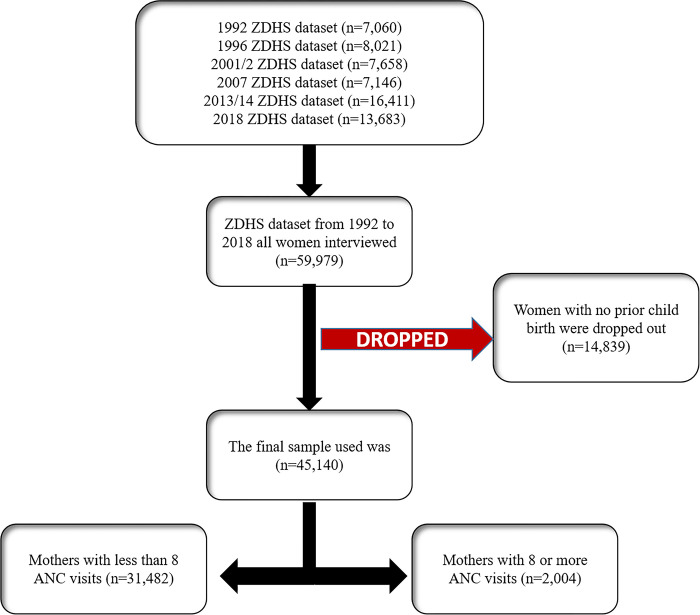
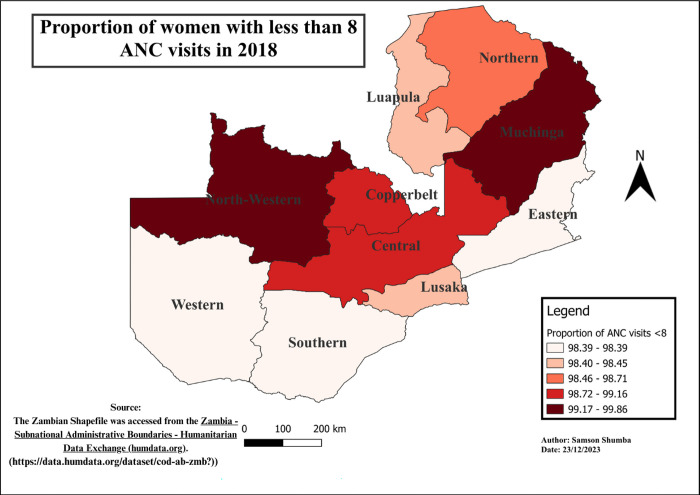
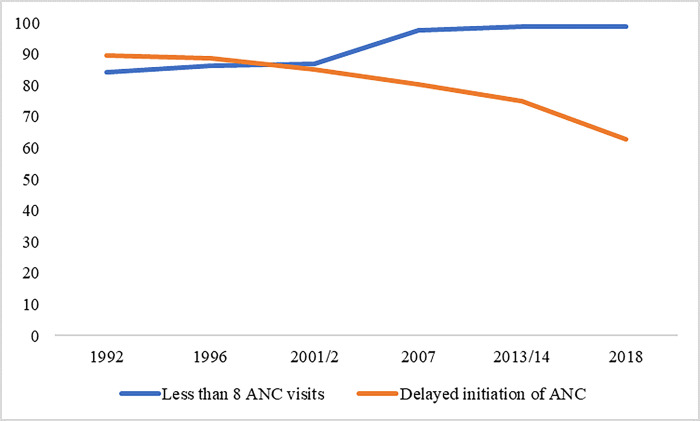
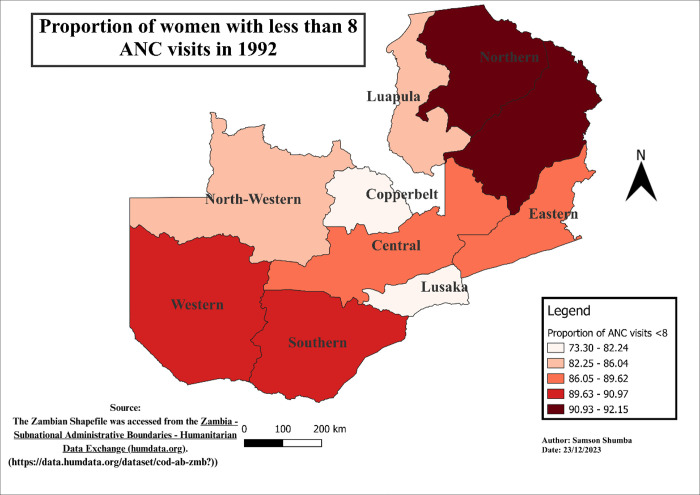
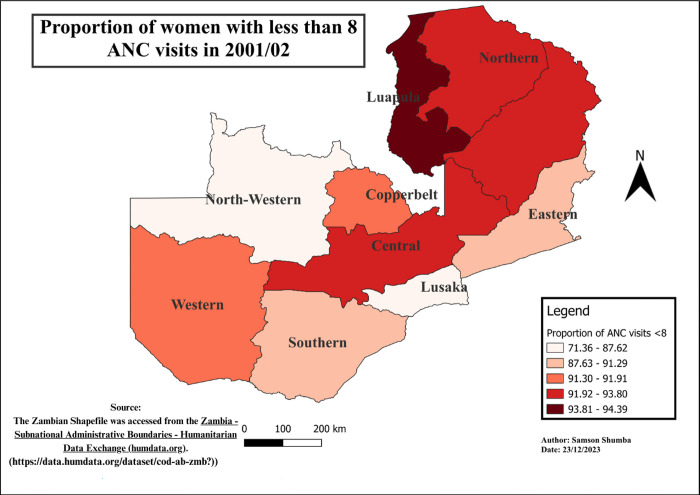
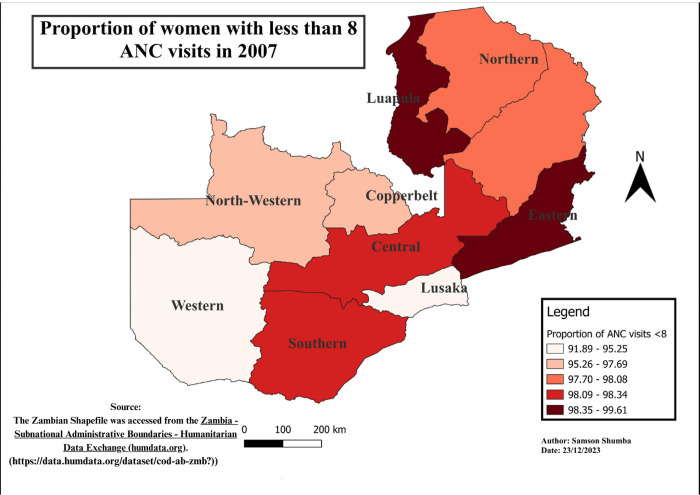
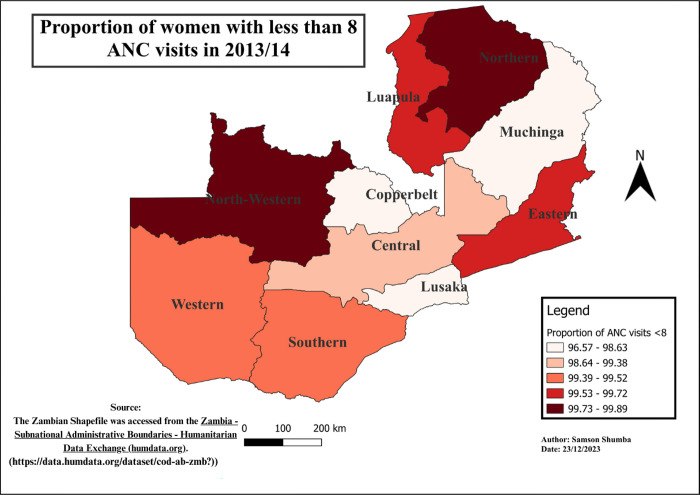
Antenatal care (ANC) plays a crucial role in preventing and detecting pregnancy risks, facilitating prompt treatment, and disseminating essential information to expectant mothers. This role is particularly vital in developing countries, where a 4.65% rise in maternal mortality rate was observed in 2022, with over 800 maternal and 7,700 perinatal deaths reported. The study aimed at investigating the spatial temporal patterns and associated factors of timing and inadequacy of antenatal care utilization in Zambia, from 1992 to 2018 using a Generalized Linear Mixed Effect Model (GLMM) approach. The study utilized the Zambia Demographic Health Survey (ZDHS) database. The relationship between dependent and independent variables was examined using the Rao-Scott Chi-square test. Predictors of inadequate utilisation of ANC were identified through the multilevel generalised linear model. Spatial effects were modeled using Quantum Geographic Information System (QGIS) version 3.34.1 to develop univariate choropleth maps. A total of 45, 140 (31, 482 women had less than 8 ANC visits and 2, 004 had 8 or more ANC visits) women with a prior childbirth were included in the study. The findings in the study revealed that among women aged 15 to 19 years in 1992, 1996 and 2013/14, the rates of inadequate antenatal care utilization (less than eight ANC visits) was 90.87%, 90.99%, and 99.63%, respectively. Lack of formal education was associated with inadequate ANC from 1992 to 2018, with percentages ranging from 91.12% to 99.64%. They were notable geospatial variations in the distribution of ANC underutilization across provinces with Luapula, Muchinga, Northwestern, Northern and Eastern recording higher proportions. Furthermore, the study showed that higher education (AOR, 0.30; 95% Confidence Interval, CI, 0.14-0.63; p = 0.001), and wealth index (AOR, 0.34; 95% CI, 0.17-0.70; p = 0.003) correlated with reduced odds of inadequate ANC utilization. In conclusion, this study highlights worrisome trends in ANC utilization in Zambia, with a significant rise in inadequacy, especially in adhering to the WHO's recommended eight ANC visits. Over the period from 1996 to 2018, there was a discernible decline in the prevalence of delayed initiation of ANC. The findings underscore a notable disparity between current ANC practices and established guidelines. Additionally, various factors predicting suboptimal ANC attendance have been identified. These insights call for targeted interventions to address the identified challenges and improve the overall quality and accessibility of ANC services in Zambia.
产前保健(ANC)在预防和检测妊娠风险、促进及时治疗以及向准妈妈传播重要信息方面发挥着关键作用。这一作用在发展中国家尤为重要,2022年这些国家的孕产妇死亡率上升了4.65%,报告了800多名孕产妇死亡和7700多例围产期死亡。该研究旨在使用广义线性混合效应模型(GLMM)方法,调查1992年至2018年赞比亚产前保健利用的时间和不足情况的时空模式及相关因素。该研究利用了赞比亚人口与健康调查(ZDHS)数据库。使用Rao-Scott卡方检验来检验自变量和因变量之间的关系。通过多层次广义线性模型确定了产前保健利用不足的预测因素。使用量子地理信息系统(QGIS)3.34.1版本对空间效应进行建模,以绘制单变量分级统计图。共有45140名有过生育经历的女性(其中31482名女性产前保健就诊次数少于8次,2004名女性产前保健就诊次数为8次或更多)被纳入该研究。研究结果显示,在1992年、1996年和2013/14年15至19岁的女性中,产前保健利用不足(少于8次产前保健就诊)的比例分别为90.87%、90.99%和99.63%。从1992年到2018年,未接受正规教育与产前保健利用不足相关,比例在91.12%至99.64%之间。产前保健利用不足的分布在各省份存在显著的地理空间差异,卢阿普拉、穆钦加、西北、北部和东部地区的比例较高。此外,该研究表明,高等教育(调整后比值比,AOR,0.30;95%置信区间,CI,0.14 - 0.63;p = 0.001)和财富指数(AOR,0.34;95% CI,0.17 - 0.70;p = 0.003)与产前保健利用不足几率的降低相关。总之,这项研究凸显了赞比亚产前保健利用方面令人担忧的趋势,利用不足情况显著增加,尤其是在遵守世界卫生组织建议的八次产前保健就诊方面。在1996年至2018年期间,产前保健延迟开始的患病率有明显下降。研究结果凸显了当前产前保健实践与既定指南之间的显著差距。此外,还确定了预测产前保健就诊不理想的各种因素。这些见解呼吁采取有针对性的干预措施,以应对已确定的挑战,并提高赞比亚产前保健服务的整体质量和可及性。