
肽诱导方解石生长加速的分子观点。
A molecular view of peptoid-induced acceleration of calcite growth.
机构信息
Physical Sciences Division, Pacific Northwest National Laboratory, Richland, WA 99352.
Department of Chemical Engineering, University of Washington, Seattle, WA 98195.
出版信息
Proc Natl Acad Sci U S A. 2024 Nov 5;121(45):e2412358121. doi: 10.1073/pnas.2412358121. Epub 2024 Oct 29.
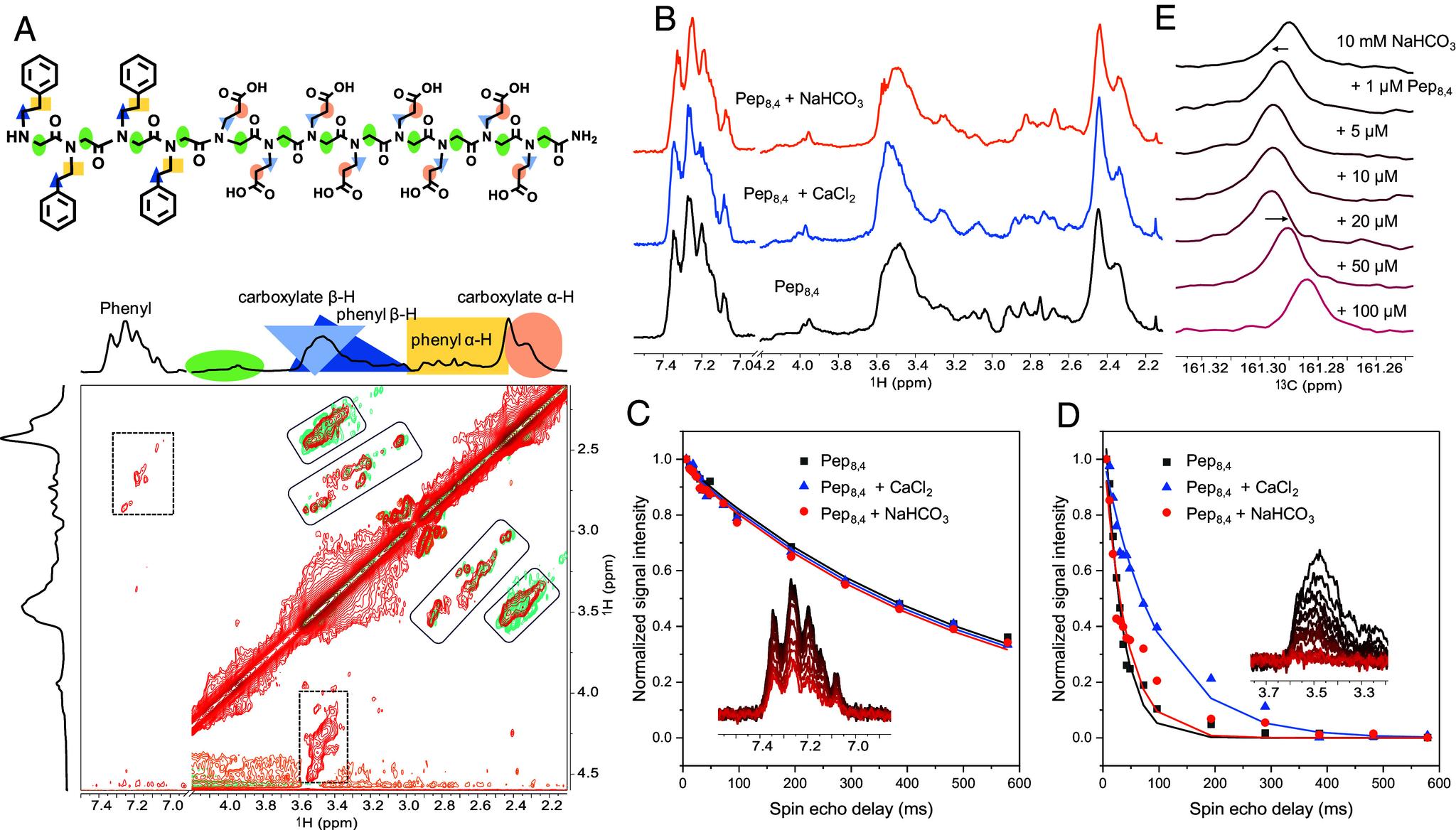
The extensive deposits of calcium carbonate (CaCO) generated by marine organisms constitute the largest and oldest carbon dioxide (CO) reservoir. These organisms utilize macromolecules like peptides and proteins to facilitate the nucleation and growth of carbonate minerals, serving as an effective method for CO sequestration. However, the precise mechanisms behind this process remain elusive. In this study, we report the use of sequence-defined peptoids, a class of peptidomimetics, to achieve the accelerated calcite step growth kinetics with the molecular level mechanistic understanding. By designing peptoids with hydrophilic and hydrophobic blocks, we systematically investigated the acceleration in step growth rate of calcite crystals using in situ atomic force microscopy (AFM), varying peptoid sequences and concentrations, CaCO supersaturations, and the ratio of Ca/ HCO. Mechanistic studies using NMR, three-dimensional fast force mapping (3D FFM), and isothermal titration calorimetry (ITC) were conducted to reveal the interactions of peptoids with Ca and HCO ions in solution, as well as the effect of peptoids on solvation and energetics of calcite crystal surface. Our results indicate the multiple roles of peptoid in facilitating HCO deprotonation, Ca desolvation, and the disruption of interfacial hydration layers of the calcite surface, which collectively contribute to a peptoid-induced acceleration of calcite growth. These findings provide guidelines for future design of sequence-specific biomimetic polymers as crystallization promoters, offering potential applications in environmental remediation (such as CO sequestration), biomedical engineering, and energy storage where fast crystallization is preferred.
海洋生物产生的大量碳酸钙 (CaCO) 沉积物构成了最大和最古老的二氧化碳 (CO) 储存库。这些生物利用多肽和蛋白质等大分子来促进碳酸盐矿物的成核和生长,是 CO 封存的有效方法。然而,这个过程的确切机制仍难以捉摸。在这项研究中,我们报告了使用序列定义的肽类拟肽,一类肽模拟物,以实现方解石晶体的加速阶跃生长动力学,并具有分子水平的机制理解。通过设计具有亲水和疏水嵌段的肽类拟肽,我们系统地研究了在原位原子力显微镜 (AFM) 中,通过改变肽类拟肽序列和浓度、CaCO 过饱和度以及 Ca/HCO 的比例,加速方解石晶体的阶跃生长速率。使用 NMR、三维快速力映射 (3D FFM) 和等温滴定量热法 (ITC) 进行的机理研究揭示了肽类拟肽与溶液中的 Ca 和 HCO 离子的相互作用,以及肽类拟肽对方解石晶体表面溶剂化和能量的影响。我们的结果表明,肽类拟肽在促进 HCO 去质子化、Ca 去溶剂化以及破坏方解石表面的界面水合层方面发挥了多种作用,这共同促成了肽类拟肽诱导的方解石生长加速。这些发现为未来作为结晶促进剂的序列特异性仿生聚合物的设计提供了指导,在环境修复(如 CO 封存)、生物医学工程和需要快速结晶的储能等领域具有潜在应用。


 Zotero 插件