Department of Neuroscience, University of Pennsylvania Perelman School of Medicine, Philadelphia, PA, 19104, USA.
Department of Biology, Indiana University, Bloomington, IN, 47405, USA.
Sci Rep. 2024 Oct 30;14(1):26051. doi: 10.1038/s41598-024-77692-0.
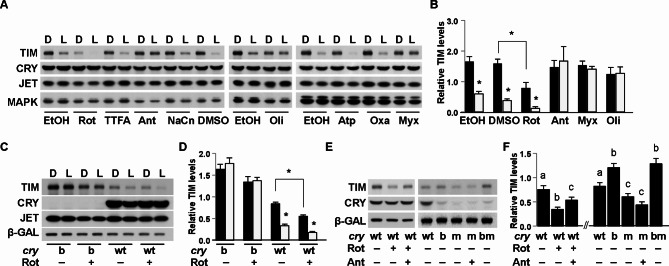
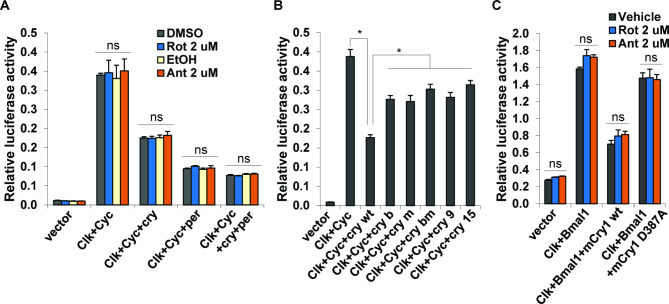
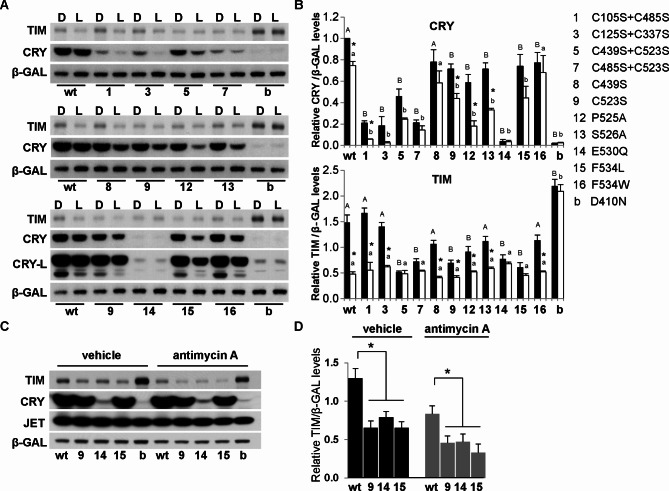
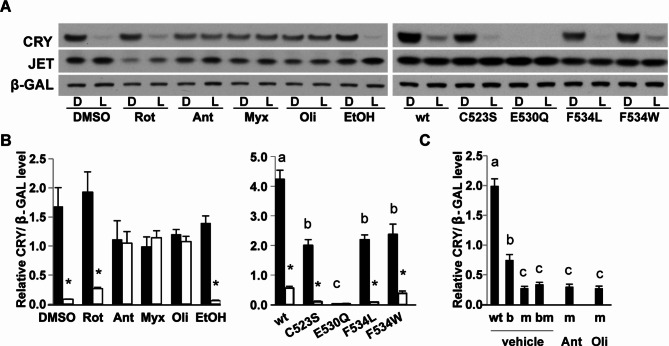
Drosophila Cryptochrome (CRY) is an essential photoreceptor that mediates the resetting of the circadian clock by light. in vitro studies demonstrated a critical role of redox cycling of the FAD cofactor for CRY activation by light. However, it is unknown if CRY responds to cellular redox environment to modulate the circadian clock. We report here that the mitochondrial respiratory chain impinges on CRY activity. Inhibition of complex III and V blocks CRY-mediated degradation of TIMELESS (TIM) in response to light, and also blocks light-induced CRY degradation. On the other hand, inhibition of complex I facilitates TIM degradation even in the dark. Mutations of critical residues of the CRY C-terminus promote TIM degradation in the dark, even in the presence of complex III and V inhibitors. We propose that complex III and V activities are important for activation of CRY in response to light. Interestingly, we found that transcriptional repressor functions of Drosophila and mammalian CRY proteins are not affected by mitochondrial inhibitors. Together these data suggest that the two functions of CRY have different sensitivity to disruptions of the mitochondrial respiratory chain: one is sensitive to mitochondrial activities that enable resetting, the other is insensitive so as to sustain the molecular oscillator.
果蝇隐花色素(CRY)是一种重要的光感受器,通过光介导生物钟的重置。体外研究表明,FAD 辅因子的氧化还原循环对于光激活 CRY 至关重要。然而,CRY 是否响应细胞氧化还原环境来调节生物钟尚不清楚。我们在此报告,线粒体呼吸链影响 CRY 的活性。抑制复合物 III 和 V 可阻止 CRY 介导的 TIMESLICE(TIM)在光下的降解,并阻止光诱导的 CRY 降解。另一方面,抑制复合物 I 即使在黑暗中也促进 TIM 的降解。CRY C 端关键残基的突变促进 TIM 在黑暗中的降解,即使存在复合物 III 和 V 抑制剂也是如此。我们提出,复合物 III 和 V 的活性对于 CRY 对光的激活很重要。有趣的是,我们发现果蝇和哺乳动物 CRY 蛋白的转录抑制功能不受线粒体抑制剂的影响。这些数据表明,CRY 的两种功能对线粒体呼吸链的破坏有不同的敏感性:一种对重置的线粒体活动敏感,另一种则不敏感,以维持分子振荡器。