Santos Alexandra F, Riggioni Carmen, Agache Ioana, Akdis Cezmi A, Akdis Mubeccel, Alvarez-Perea Alberto, Alvaro-Lozano Montserrat, Ballmer-Weber Barbara, Barni Simona, Beyer Kirsten, Bindslev-Jensen Carsten, Brough Helen A, Buyuktiryaki Betul, Chu Derek, Del Giacco Stefano, Dunn-Galvin Audrey, Eberlein Bernadette, Ebisawa Motohiro, Eigenmann Philippe, Eiwegger Thomas, Feeney Mary, Fernandez-Rivas Montserrat, Fiocchi Alessandro, Fisher Helen R, Fleischer David M, Giovannini Mattia, Gray Claudia, Hoffmann-Sommergruber Karin, Halken Susanne, O'B Hourihane Jonathan, Jones Christina J, Jutel Marek, Knol Edward F, Konstantinou George N, Lack Gideon, Lau Susanne, Mejias Andreina Marques, Marchisotto Mary Jane, Meyer Rosan, Mortz Charlotte G, Moya Beatriz, Muraro Antonella, Nilsson Caroline, de Oliveira Lucila Camargo Lopes, O'Mahony Liam, Papadopoulos Nikolaos G, Perrett Kirsten P, Peters Rachel, Podesta Marcia, Poulsen Lars K, Roberts Graham, Sampson Hugh, Schwarze Jürgen, Smith Peter, Tham Elizabeth, Untersmayr Eva, Van Ree Ronald, Venter Carina, Vickery Brian, Vlieg-Boerstra Berber, Werfel Thomas, Worm Margitta, Du Toit George, Skypala Isabel
Department of Women and Children's Health (Pediatric Allergy), School of Life Course Sciences, Faculty of Life Sciences and Medicine, King's College London, London, UK.
Peter Gorer Department of Immunobiology, School of Immunology and Microbial Sciences, King's College London, London, UK.
Allergy. 2025 Jan;80(1):14-36. doi: 10.1111/all.16345. Epub 2024 Oct 30.
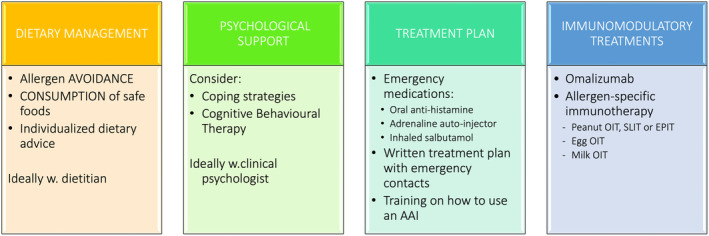
This European Academy of Allergy and Clinical Immunology (EAACI) guideline provides recommendations for the management of IgE-mediated food allergy and was developed using the Grading of Recommendations, Assessment, Development and Evaluations (GRADE) approach. Following the confirmation of IgE-mediated food allergy diagnosis, allergen avoidance and dietary advice (with support of a specialised dietitian, if possible) together with the provision of a written treatment plan, education on the recognition of allergic symptoms and prescription of medication including adrenaline using an auto-injector are essential. Patients with significant anxiety and requirement for coping strategies may benefit from support from a clinical psychologist. As immunomodulatory interventions, omalizumab is suggested for treatment of IgE-mediated food allergy in children from the age of 1 and adults; and oral allergen-specific immunotherapy is recommended for children and adolescents with peanut allergy and suggested for milk and egg allergies (generally after 4 years of age for milk and egg). Sublingual and epicutaneous immunotherapy are suggested for peanut allergy but are not yet available at the point of care. Future research into disease modifying treatments for IgE-mediated food allergy are highly needed, with standardised and patient-focused protocols and outcomes.
本欧洲变态反应与临床免疫学会(EAACI)指南为IgE介导的食物过敏管理提供了建议,并采用推荐分级、评估、制定与评价(GRADE)方法制定。在确认IgE介导的食物过敏诊断后,避免接触过敏原和提供饮食建议(如有可能,在专业营养师的支持下),同时提供书面治疗计划、开展过敏症状识别教育以及开具包括使用自动注射器注射肾上腺素在内的药物处方至关重要。有严重焦虑且需要应对策略的患者可能会从临床心理学家的支持中受益。作为免疫调节干预措施,建议使用奥马珠单抗治疗1岁及以上儿童和成人的IgE介导的食物过敏;推荐对花生过敏的儿童和青少年进行口服过敏原特异性免疫治疗,对牛奶和鸡蛋过敏者(牛奶和鸡蛋过敏一般在4岁以后)也建议进行该治疗。对于花生过敏,建议采用舌下和皮内免疫治疗,但目前在医疗点尚无法提供。迫切需要针对IgE介导的食物过敏进行疾病改善治疗的未来研究,采用标准化且以患者为中心的方案和结果。