Lohmann Rainer, Beatty Bonita, Graybill Jessica, Grigorieva Elena, Hansen Ketil Lenert, Soikkeli Anu
Graduate School of Oceanography, University of Rhode Island, Narragansett, Rhode Island 02882, United States.
College of Arts and Sciences, University of Saskatchewan, Saskatoon, Saskatchewan S7N 5A2, Canada.
Environ Health (Wash). 2023 Dec 12;2(1):3-10. doi: 10.1021/envhealth.3c00116. eCollection 2024 Jan 19.
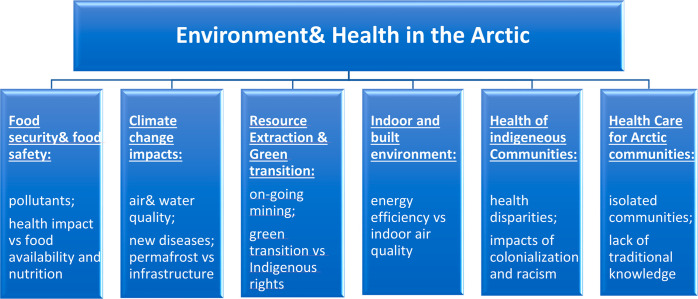
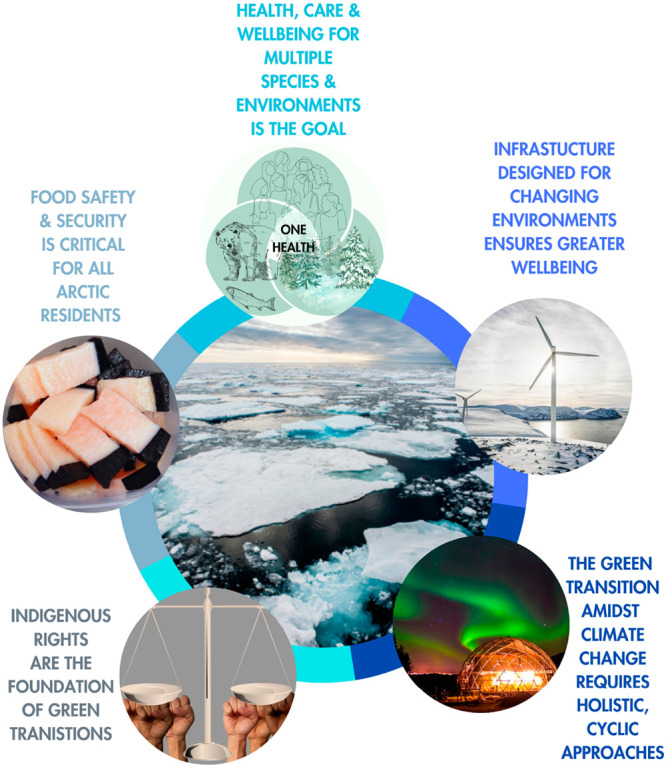
In the Arctic, environment and health are linked in myriad ways. A key emphasis has been on numerous long-lived contaminants in traditional foods, particularly marine mammals, and their well-documented impacts on human, animal and environmental health ("One health approach"). More recent concerns for Indigenous communities focus on the (side) effects of the switch to a modern, processed diet, which is accompanied by a loss of tradition and emerging health impacts. Furthermore, the availability of traditional foods is increasingly threatened by the impacts of climate change, which also causes the emergence and spread of new and old diseases, such as anthrax. Climate change, including thawing permafrost and new forest fire regimes, threatens the built environment and infrastructure. In particular, well-built, planned, and healthy housing is urgently needed, given that much time is spent indoors. Health care, particularly for remote and Indigenous communities, is sparse, and often ignores traditional knowledge and local languages. Indigenous communities in the Arctic continue to suffer from marginalization, resource colonization/extraction, and the impacts of racism. Recent examples of the green energy transition, such as in Norway, continue a pattern of ignoring Indigenous rights and lifestyles. Overall, the connection between environment and health in the Arctic is multifaceted and complex, and investigations and solutions ought to embrace an interdisciplinary and holistic approach toward improving Environmental and Human Health in the region.
在北极地区,环境与健康以多种方式相互关联。重点一直放在传统食物,特别是海洋哺乳动物中存在的多种持久性污染物,以及它们对人类、动物和环境健康的显著影响(“同一健康方法”)。最近,针对原住民社区的担忧集中在转向现代加工饮食的(副)作用上,这种转变伴随着传统的丧失和新出现的健康影响。此外,传统食物的供应日益受到气候变化影响的威胁,气候变化还导致炭疽等新老疾病的出现和传播。气候变化,包括永久冻土融化和新的森林火灾模式,威胁着建筑环境和基础设施。鉴于人们大量时间都在室内度过,尤其迫切需要建造良好、规划合理且有益健康的住房。医疗保健,特别是针对偏远和原住民社区的医疗保健,非常匮乏,而且往往忽视传统知识和当地语言。北极地区的原住民社区继续遭受边缘化、资源殖民/开采以及种族主义的影响。近期绿色能源转型的例子,比如在挪威,延续了忽视原住民权利和生活方式的模式。总体而言,北极地区环境与健康之间的联系是多方面且复杂的,调查和解决方案应该采用跨学科和整体的方法来改善该地区的环境和人类健康。