Ciavarella Andrew, Cotterill Daniel, Stott Peter, Kew Sarah, Philip Sjoukje, van Oldenborgh Geert Jan, Skålevåg Amalie, Lorenz Philip, Robin Yoann, Otto Friederike, Hauser Mathias, Seneviratne Sonia I, Lehner Flavio, Zolina Olga
Met Office Hadley Centre, FitzRoy Road, Exeter, EX1 3PB UK.
Royal Netherlands Meteorological Institute (KNMI), De Bilt, The Netherlands.
Clim Change. 2021;166(1-2):9. doi: 10.1007/s10584-021-03052-w. Epub 2021 May 6.
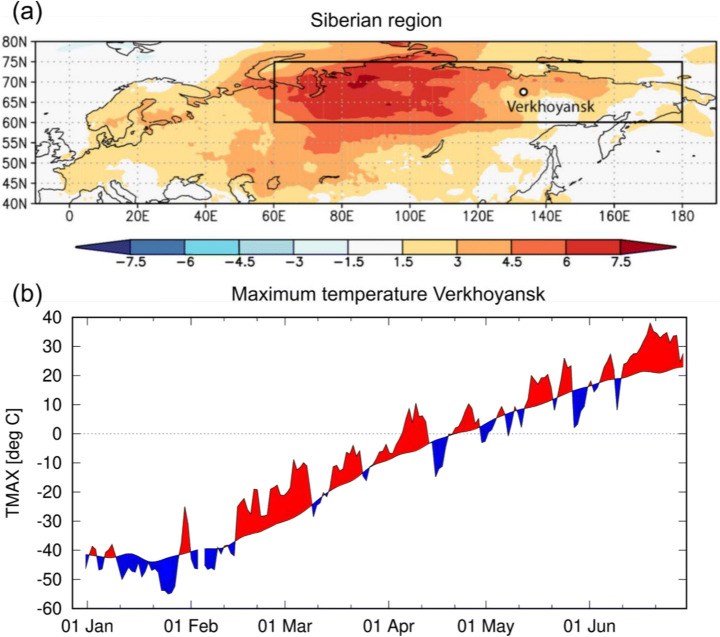
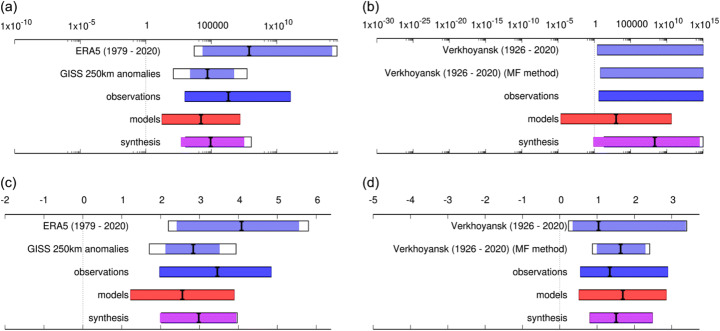
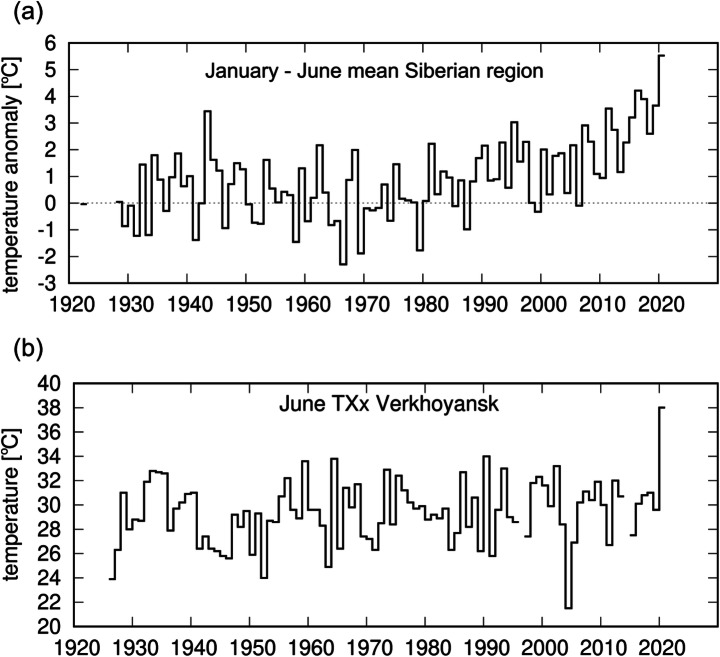
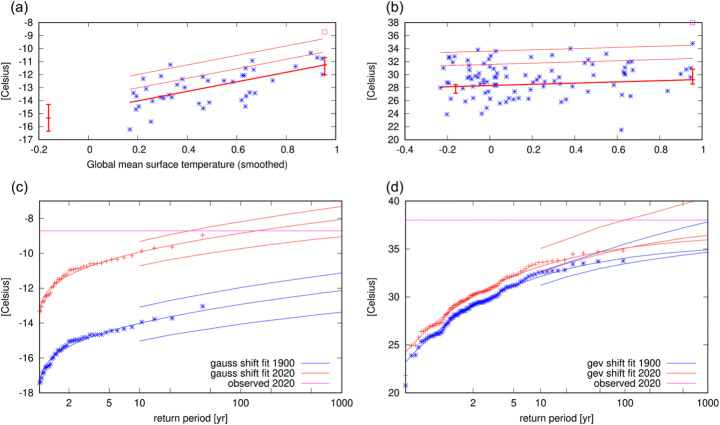
Over the first half of 2020, Siberia experienced the warmest period from January to June since records began and on the 20th of June the weather station at Verkhoyansk reported 38 °C, the highest daily maximum temperature recorded north of the Arctic Circle. We present a multi-model, multi-method analysis on how anthropogenic climate change affected the probability of these events occurring using both observational datasets and a large collection of climate models, including state-of-the-art higher-resolution simulations designed for attribution and many from the latest generation of coupled ocean-atmosphere models, CMIP6. Conscious that the impacts of heatwaves can span large differences in spatial and temporal scales, we focus on two measures of the extreme Siberian heat of 2020: January to June mean temperatures over a large Siberian region and maximum daily temperatures in the vicinity of the town of Verkhoyansk. We show that human-induced climate change has dramatically increased the probability of occurrence and magnitude of extremes in both of these (with lower confidence for the probability for Verkhoyansk) and that without human influence the temperatures widely experienced in Siberia in the first half of 2020 would have been practically impossible.
The online version contains supplementary material available at 10.1007/s10584-021-03052-w.
在2020年上半年,西伯利亚经历了自记录开始以来1月至6月最温暖的时期,6月20日,上扬斯克的气象站报告气温为38摄氏度,这是北极圈以北有记录以来的最高日最高气温。我们使用观测数据集和大量气候模型,包括专门用于归因的最新高分辨率模拟以及许多来自最新一代耦合海洋 - 大气模型CMIP6,进行了多模型、多方法分析,以研究人为气候变化如何影响这些事件发生的概率。意识到热浪的影响可能跨越时空尺度的巨大差异,我们关注2020年西伯利亚极端高温的两个指标:西伯利亚大片地区1月至6月的平均气温以及上扬斯克镇附近的日最高气温。我们表明,人为引起的气候变化显著增加了这两个指标极端情况发生的概率和强度(上扬斯克概率的置信度较低),并且如果没有人类影响,2020年上半年西伯利亚广泛经历的温度几乎是不可能出现的。
在线版本包含可在10.1007/s10584 - 021 - 03052 - w获取的补充材料。