Nunes Maria Carmo P, Bern Caryn, Clark Eva H, Teixeira Antonio L, Molina Israel
Hospital das Clínicas and Faculdade de Medicina, Universidade Federal de Minas Gerais, Belo Horizonte, MG, Brazil.
Department of Epidemiology and Biostatistics, University of California San Francisco School of Medicine, San Francisco, CA, USA.
Lancet Reg Health Am. 2024 Sep 13;37:100832. doi: 10.1016/j.lana.2024.100832. eCollection 2024 Sep.
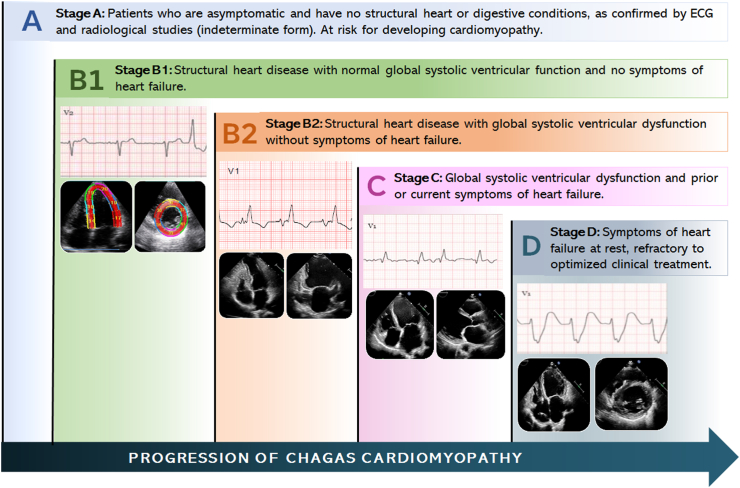
Chagas disease, the most common form of nonischaemic cardiomyopathy globally, is one of the leading causes of morbidity and mortality in Latin America. Chagas cardiomyopathy has a wide clinical spectrum and prognosis, which is primarily determined by the severity of left ventricular dysfunction. Chagas disease also affects the brain, particularly manifesting as cardioembolic strokes and cognitive impairments. Disease progression is influenced by various factors such as anti-parasite treatments, host-parasite interactions, and other determinants. This review explores Chagas disease, covering clinical presentations, the range of severity of Chagas cardiomyopathy, and neurological manifestations. We investigate factors that influence the progression of cardiomyopathy, including anti-parasitic treatments, interactions between hosts and parasites, and the influence of social determinants on the course of the disease. This review analyses key prognostic factors associated with the progression and mortality of Chagas cardiomyopathy, offering insights into this potentially fatal illness.
恰加斯病是全球最常见的非缺血性心肌病形式,是拉丁美洲发病和死亡的主要原因之一。恰加斯心肌病具有广泛的临床谱和预后,主要由左心室功能障碍的严重程度决定。恰加斯病还会影响大脑,尤其表现为心源性栓塞性中风和认知障碍。疾病进展受多种因素影响,如抗寄生虫治疗、宿主与寄生虫的相互作用以及其他决定因素。本综述探讨恰加斯病,涵盖临床表现、恰加斯心肌病的严重程度范围以及神经学表现。我们研究影响心肌病进展的因素,包括抗寄生虫治疗、宿主与寄生虫之间的相互作用以及社会决定因素对疾病进程的影响。本综述分析与恰加斯心肌病进展和死亡率相关的关键预后因素,为这种潜在致命疾病提供见解。