Health System and Population Studies Division, International Centre for Diarrhoeal Disease Research, Bangladesh (icddr,b), 68 Shaheed Tajuddin Ahmed Sarani, Mohakhali, Dhaka, 1212, Bangladesh.
Maternal and Child Health Division, International Centre for Diarrhoeal Disease Research, Bangladesh (icddr,b), 68 Shaheed Tajuddin Ahmed Sarani, Mohakhali, Dhaka, 1212, Bangladesh.
BMC Womens Health. 2023 Jun 20;23(1):320. doi: 10.1186/s12905-023-02469-y.
Early marriage is highly prevalent in Bangladesh. It is linked with a range of adverse outcomes, including maternal and child mortality. However, research on regional variations and factors associated with early marriage is scarce in Bangladesh. This study aimed to explore the geographical variations and predictors of early marriage in Bangladesh.
Data of women aged 20-24 in the Bangladesh Demographic and Health Survey 2017-18 were analysed. The occurrence of early marriage was the outcome variable. Explanatory variables were several individual-, household- and community-level factors. Geographical hot spots and cold spots of early marriage were first determined using Global Moran's I statistic. Multilevel mixed-effect Poisson regression was used to determine the association of early marriage with individual-, household-, and community-level factors.
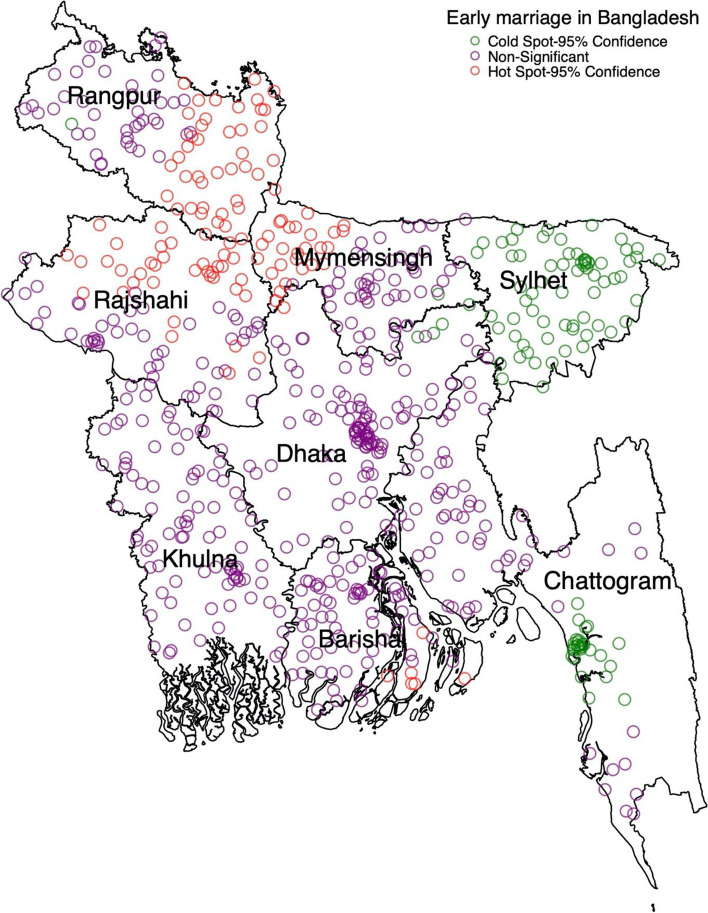
Almost 59% of women aged 20-24 reported they were married before reached 18. The hotspots of early marriage were mainly concentrated in Rajshahi, Rangpur and Barishal, and the cold spots were in Sylhet and Chattogram divisions. The prevalence of early marriage was lower among higher educated (adjusted prevalence ratio (aPR): 0.45; 95% CI: 0.40, 0.52), and non-Muslim women (aPR: 0.89; 95% CI: 0.79, 0.99) than their counterparts. Higher community-level poverty was significantly associated with early marriage (aPR, 1.16; 95% CI: 1.04, 1.29).
The study concludes that promoting girls' education, awareness-building programs about the adverse effects of early marriage and proper application of the child marriage restraint act, particularly in disadvantaged communities are recommended.
早婚在孟加拉国非常普遍。它与一系列不良后果有关,包括母婴死亡率。然而,关于早婚的区域差异和相关因素的研究在孟加拉国很少。本研究旨在探讨孟加拉国早婚的地理差异和预测因素。
本研究分析了 2017-18 年孟加拉国人口与健康调查中 20-24 岁女性的数据。早婚的发生是因变量。解释变量是个人、家庭和社区层面的几个因素。首先使用全局 Moran's I 统计量确定早婚的地理热点和冷点。使用多水平混合效应泊松回归来确定早婚与个人、家庭和社区层面因素的关联。
近 59%的 20-24 岁女性报告说,她们在 18 岁之前就已经结婚了。早婚的热点主要集中在拉杰沙希、朗布尔和巴里萨尔,冷点则在锡尔赫特和吉大港。与受教育程度较高(调整后的流行率比(aPR):0.45;95%置信区间:0.40,0.52)和非穆斯林女性(aPR:0.89;95%置信区间:0.79,0.99)相比,早婚的发生率较低。较高的社区贫困水平与早婚显著相关(aPR,1.16;95%置信区间:1.04,1.29)。
本研究得出的结论是,建议促进女孩教育、开展关于早婚不良影响的宣传活动以及适当应用儿童婚姻限制法,特别是在弱势社区。