Dove Marine Laboratory, School of Natural and Environmental Sciences, Newcastle University, Newcastle, NE1 7RU, UK.
King Abdullah University of Science and Technology (KAUST), Red Sea Research Center (RSRC), 23955-6900, Thuwal, Saudi Arabia.
Sci Rep. 2024 Oct 30;14(1):26174. doi: 10.1038/s41598-024-77621-1.
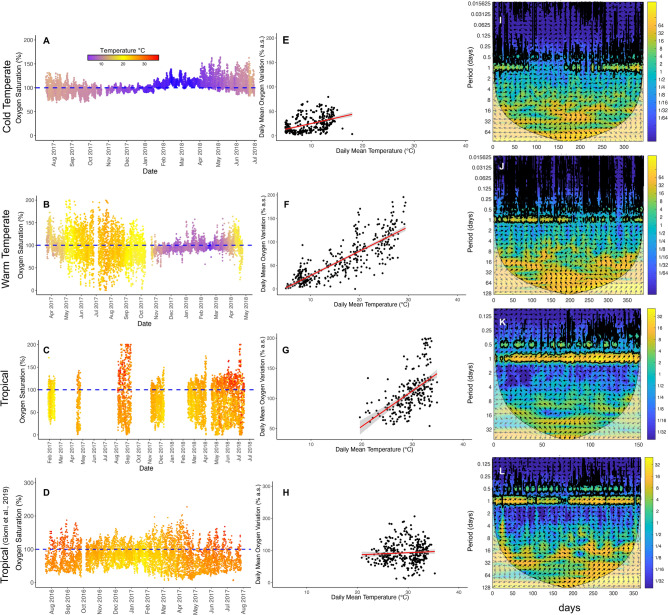
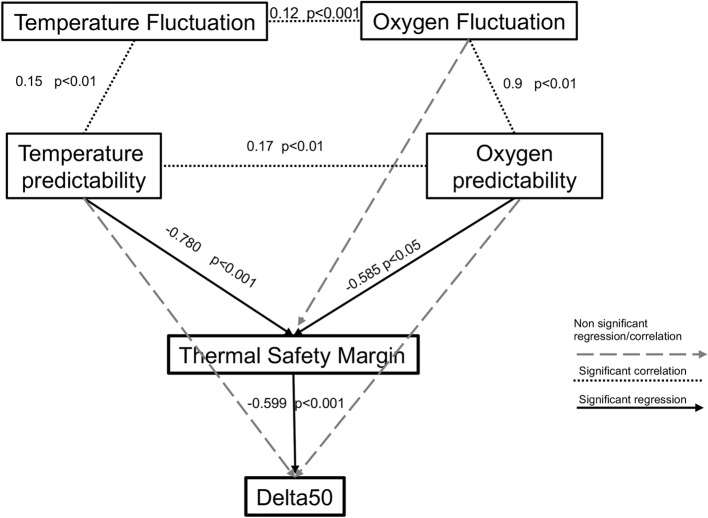
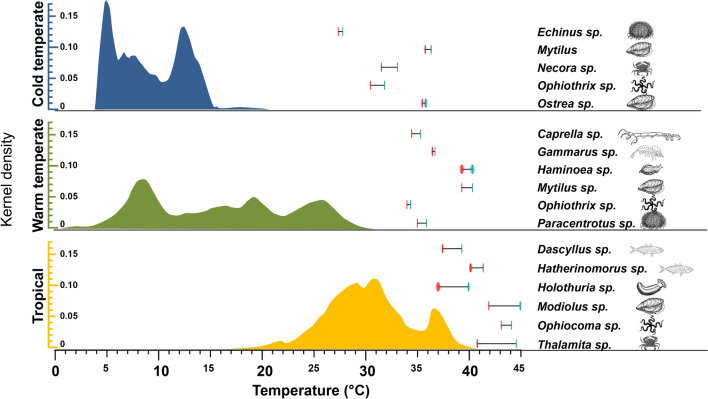
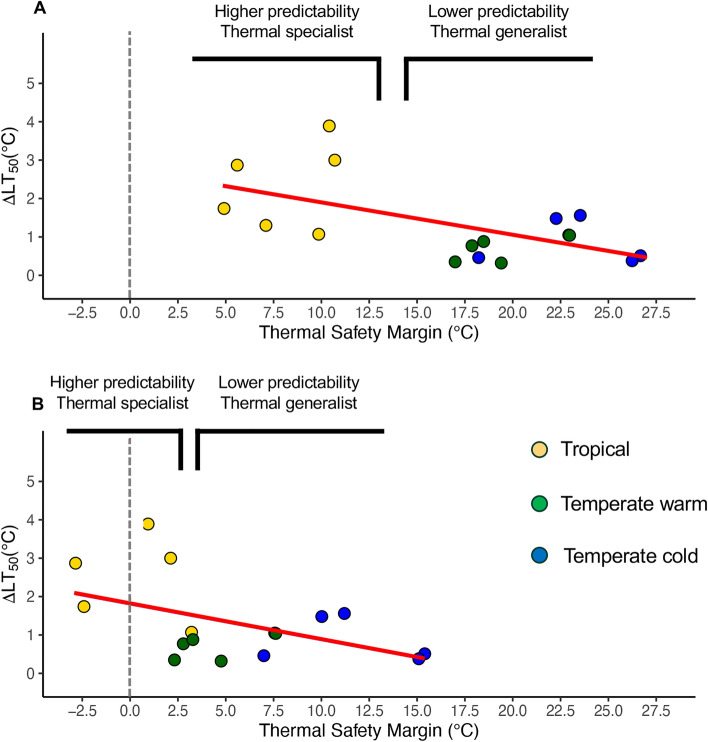
Aquatic species living in productive coastal habitats with abundant primary producers have evolved in highly dynamic diel and seasonally fluctuating environments in terms of, for example, water temperature and dissolved oxygen. However, how environmental fluctuations shape the thermal tolerance of marine species is still poorly understood. Here we hypothesize that the degree of predictability of the diel environmental fluctuations in the coastal area can explain the thermal response of marine species. To test this hypothesis, we measured the thermal tolerance of 17 species of marine ectotherm from tropical, warm temperate and cold temperate latitudes under two levels of oxygen (around saturation and at supersaturation), and relate the results to their site-specific temperature and oxygen fluctuation and their environmental predictability. We demonstrate that oxygen and temperature fluctuations at tropical latitudes have a higher predictability than those at warm and cold temperate latitudes. Further, we show that marine species that are adapted to high predictability have the potential to tune their thermal performance when exposed to oxygen supersaturation, despite being constrained within a narrow safety margin. We advocate that the predictability of the environmental fluctuation needs to be considered when measuring and forecasting the response of marine animals to global warming.
生活在生产力高的沿海栖息地、拥有丰富初级生产者的水生物种,在水温、溶解氧等方面,已经进化出高度动态的日变化和季节性波动的环境。然而,环境波动如何塑造海洋物种的耐热性,目前仍知之甚少。在这里,我们假设沿海地区日波动环境的可预测程度,可以解释海洋物种的热反应。为了验证这一假设,我们在两种氧水平(接近饱和和过饱和)下,测量了来自热带、暖温带和寒温带的 17 种海洋外温动物的耐热性,并将结果与它们特定地点的温度和氧波动及其环境可预测性联系起来。我们证明,热带地区的氧气和温度波动比暖温和寒温带地区的更具可预测性。此外,我们还表明,适应高可预测性的海洋物种,在暴露于过饱和氧气时,有可能调整其热性能,尽管它们受到狭窄的安全裕度的限制。我们主张,在测量和预测海洋动物对全球变暖的反应时,需要考虑环境波动的可预测性。