• 文献检索
  • 文档翻译
  • 深度研究
  • 学术资讯
  • Suppr Zotero 插件Zotero 插件
  • 邀请有礼
  • 套餐&价格
  • 历史记录
应用&插件
Suppr Zotero 插件Zotero 插件浏览器插件Mac 客户端Windows 客户端微信小程序
定价
高级版会员购买积分包购买API积分包
服务
文献检索文档翻译深度研究API 文档MCP 服务
关于我们
关于 Suppr公司介绍联系我们用户协议隐私条款
关注我们

Suppr 超能文献

核心技术专利:CN118964589B侵权必究
粤ICP备2023148730 号-1Suppr @ 2026

文献检索

告别复杂PubMed语法,用中文像聊天一样搜索,搜遍4000万医学文献。AI智能推荐,让科研检索更轻松。

立即免费搜索

文件翻译

保留排版,准确专业,支持PDF/Word/PPT等文件格式,支持 12+语言互译。

免费翻译文档

深度研究

AI帮你快速写综述,25分钟生成高质量综述,智能提取关键信息,辅助科研写作。

立即免费体验

异基因造血细胞移植后的克隆动力学。

Clonal dynamics after allogeneic haematopoietic cell transplantation.

机构信息

Cancer, Ageing and Somatic Mutation Programme, Wellcome Sanger Institute, Hinxton, UK.

Wellcome-MRC Cambridge Stem Cell Institute, Jeffrey Cheah Biomedical Centre, Cambridge, UK.

出版信息

Nature. 2024 Nov;635(8040):926-934. doi: 10.1038/s41586-024-08128-y. Epub 2024 Oct 30.

DOI:10.1038/s41586-024-08128-y
PMID:39478227
原文链接:https://pmc.ncbi.nlm.nih.gov/articles/PMC11602715/
Abstract

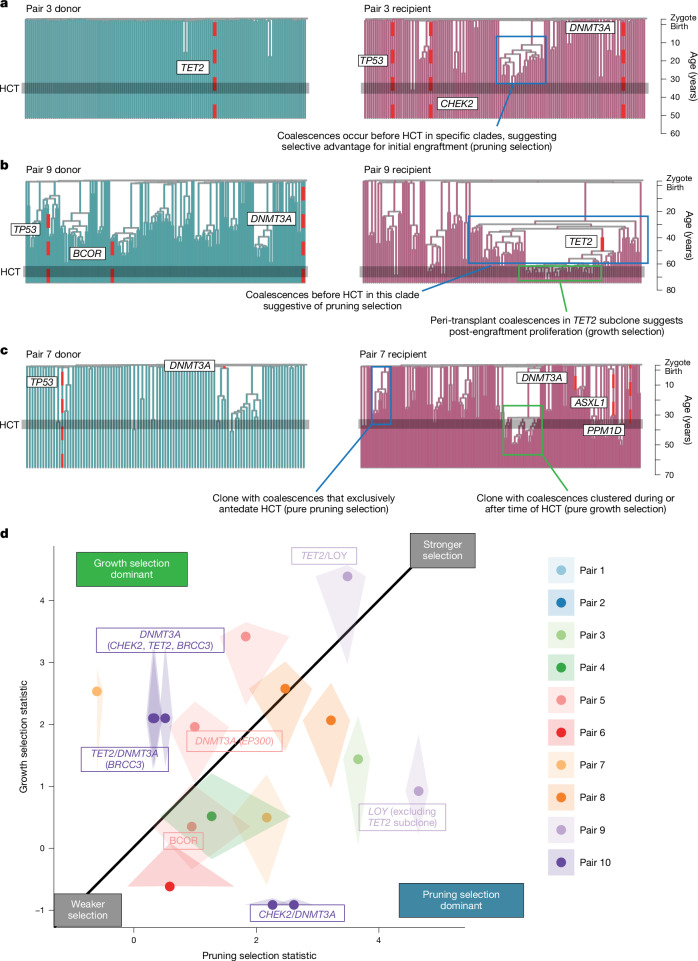
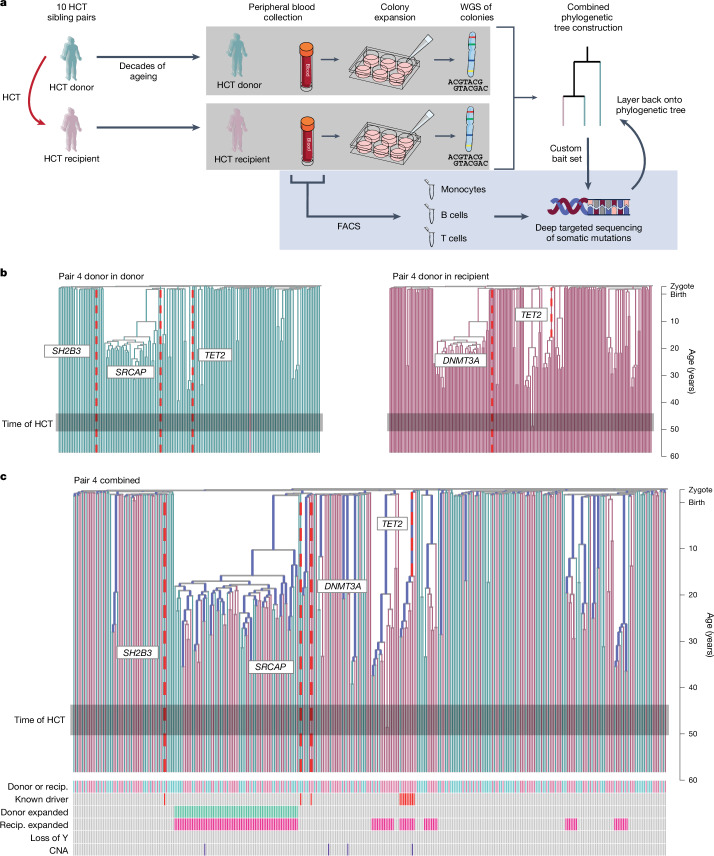
Allogeneic haematopoietic cell transplantation (HCT) replaces the stem cells responsible for blood production with those from a donor. Here, to quantify dynamics of long-term stem cell engraftment, we sequenced genomes from 2,824 single-cell-derived haematopoietic colonies of ten donor-recipient pairs taken 9-31 years after HLA-matched sibling HCT. With younger donors (18-47 years at transplant), 5,000-30,000 stem cells had engrafted and were still contributing to haematopoiesis at the time of sampling; estimates were tenfold lower with older donors (50-66 years). Engrafted cells made multilineage contributions to myeloid, B lymphoid and T lymphoid populations, although individual clones often showed biases towards one or other mature cell type. Recipients had lower clonal diversity than matched donors, equivalent to around 10-15 years of additional ageing, arising from up to 25-fold greater expansion of stem cell clones. A transplant-related population bottleneck could not explain these differences; instead, phylogenetic trees evinced two distinct modes of HCT-specific selection. In pruning selection, cell divisions underpinning recipient-enriched clonal expansions had occurred in the donor, preceding transplant-their selective advantage derived from preferential mobilization, collection, survival ex vivo or initial homing. In growth selection, cell divisions underpinning clonal expansion occurred in the recipient's marrow after engraftment, most pronounced in clones with multiple driver mutations. Uprooting stem cells from their native environment and transplanting them to foreign soil exaggerates selective pressures, distorting and accelerating the loss of clonal diversity compared to the unperturbed haematopoiesis of donors.

摘要

异基因造血细胞移植(HCT)用供者的干细胞替代负责血液生成的干细胞。在这里,为了定量分析长期干细胞植入的动力学,我们对 10 对供受者 HLA 匹配的同胞 HCT 后 9-31 年的 2824 个单细胞衍生造血集落的基因组进行了测序。在年轻的供者(移植时 18-47 岁)中,有 5000-30000 个干细胞已植入,并在采样时仍在为造血做出贡献;在年龄较大的供者(50-66 岁)中,估计值低十倍。植入的细胞对髓样、B 淋巴样和 T 淋巴样群体做出了多谱系贡献,尽管单个克隆通常偏向于一种或另一种成熟细胞类型。与匹配的供者相比,受者的克隆多样性较低,相当于额外衰老 10-15 年,这是由于干细胞克隆的扩张高达 25 倍。移植相关的种群瓶颈不能解释这些差异;相反,系统发育树表明存在两种不同的 HCT 特异性选择模式。在修剪选择中,支撑受者富集克隆扩张的细胞分裂发生在供者中,发生在移植之前-它们的选择优势来自于优先动员、采集、体外存活或初始归巢。在生长选择中,支撑克隆扩张的细胞分裂发生在受者植入后的骨髓中,在具有多个驱动突变的克隆中最为明显。从其自然环境中拔出干细胞并将其移植到异质土壤中会加剧选择压力,与供者未受干扰的造血相比,扭曲并加速了克隆多样性的丧失。
https://cdn.ncbi.nlm.nih.gov/pmc/blobs/7685/11602715/f3c093ed6854/41586_2024_8128_Fig16_ESM.jpg
https://cdn.ncbi.nlm.nih.gov/pmc/blobs/7685/11602715/2b2125be6a24/41586_2024_8128_Fig1_HTML.jpg
https://cdn.ncbi.nlm.nih.gov/pmc/blobs/7685/11602715/7556fa28d6cc/41586_2024_8128_Fig2_HTML.jpg
https://cdn.ncbi.nlm.nih.gov/pmc/blobs/7685/11602715/29dc952e920b/41586_2024_8128_Fig3_HTML.jpg
https://cdn.ncbi.nlm.nih.gov/pmc/blobs/7685/11602715/afc9682db814/41586_2024_8128_Fig4_HTML.jpg
https://cdn.ncbi.nlm.nih.gov/pmc/blobs/7685/11602715/395ea5965ecf/41586_2024_8128_Fig5_HTML.jpg
https://cdn.ncbi.nlm.nih.gov/pmc/blobs/7685/11602715/88d7fef53b6e/41586_2024_8128_Fig6_ESM.jpg
https://cdn.ncbi.nlm.nih.gov/pmc/blobs/7685/11602715/fd10d2cc0907/41586_2024_8128_Fig7_ESM.jpg
https://cdn.ncbi.nlm.nih.gov/pmc/blobs/7685/11602715/8805c9b01254/41586_2024_8128_Fig8_ESM.jpg
https://cdn.ncbi.nlm.nih.gov/pmc/blobs/7685/11602715/02520eba5e49/41586_2024_8128_Fig9_ESM.jpg
https://cdn.ncbi.nlm.nih.gov/pmc/blobs/7685/11602715/ded6b1bcf34c/41586_2024_8128_Fig10_ESM.jpg
https://cdn.ncbi.nlm.nih.gov/pmc/blobs/7685/11602715/a2feb0aefd3e/41586_2024_8128_Fig11_ESM.jpg
https://cdn.ncbi.nlm.nih.gov/pmc/blobs/7685/11602715/6ad0fd9be0a5/41586_2024_8128_Fig12_ESM.jpg
https://cdn.ncbi.nlm.nih.gov/pmc/blobs/7685/11602715/40c6c9ef6a93/41586_2024_8128_Fig13_ESM.jpg
https://cdn.ncbi.nlm.nih.gov/pmc/blobs/7685/11602715/bb2efd045bb3/41586_2024_8128_Fig14_ESM.jpg
https://cdn.ncbi.nlm.nih.gov/pmc/blobs/7685/11602715/89bfd3b74019/41586_2024_8128_Fig15_ESM.jpg
https://cdn.ncbi.nlm.nih.gov/pmc/blobs/7685/11602715/f3c093ed6854/41586_2024_8128_Fig16_ESM.jpg
https://cdn.ncbi.nlm.nih.gov/pmc/blobs/7685/11602715/2b2125be6a24/41586_2024_8128_Fig1_HTML.jpg
https://cdn.ncbi.nlm.nih.gov/pmc/blobs/7685/11602715/7556fa28d6cc/41586_2024_8128_Fig2_HTML.jpg
https://cdn.ncbi.nlm.nih.gov/pmc/blobs/7685/11602715/29dc952e920b/41586_2024_8128_Fig3_HTML.jpg
https://cdn.ncbi.nlm.nih.gov/pmc/blobs/7685/11602715/afc9682db814/41586_2024_8128_Fig4_HTML.jpg
https://cdn.ncbi.nlm.nih.gov/pmc/blobs/7685/11602715/395ea5965ecf/41586_2024_8128_Fig5_HTML.jpg
https://cdn.ncbi.nlm.nih.gov/pmc/blobs/7685/11602715/88d7fef53b6e/41586_2024_8128_Fig6_ESM.jpg
https://cdn.ncbi.nlm.nih.gov/pmc/blobs/7685/11602715/fd10d2cc0907/41586_2024_8128_Fig7_ESM.jpg
https://cdn.ncbi.nlm.nih.gov/pmc/blobs/7685/11602715/8805c9b01254/41586_2024_8128_Fig8_ESM.jpg
https://cdn.ncbi.nlm.nih.gov/pmc/blobs/7685/11602715/02520eba5e49/41586_2024_8128_Fig9_ESM.jpg
https://cdn.ncbi.nlm.nih.gov/pmc/blobs/7685/11602715/ded6b1bcf34c/41586_2024_8128_Fig10_ESM.jpg
https://cdn.ncbi.nlm.nih.gov/pmc/blobs/7685/11602715/a2feb0aefd3e/41586_2024_8128_Fig11_ESM.jpg
https://cdn.ncbi.nlm.nih.gov/pmc/blobs/7685/11602715/6ad0fd9be0a5/41586_2024_8128_Fig12_ESM.jpg
https://cdn.ncbi.nlm.nih.gov/pmc/blobs/7685/11602715/40c6c9ef6a93/41586_2024_8128_Fig13_ESM.jpg
https://cdn.ncbi.nlm.nih.gov/pmc/blobs/7685/11602715/bb2efd045bb3/41586_2024_8128_Fig14_ESM.jpg
https://cdn.ncbi.nlm.nih.gov/pmc/blobs/7685/11602715/89bfd3b74019/41586_2024_8128_Fig15_ESM.jpg
https://cdn.ncbi.nlm.nih.gov/pmc/blobs/7685/11602715/f3c093ed6854/41586_2024_8128_Fig16_ESM.jpg

相似文献

1
Clonal dynamics after allogeneic haematopoietic cell transplantation.异基因造血细胞移植后的克隆动力学。
Nature. 2024 Nov;635(8040):926-934. doi: 10.1038/s41586-024-08128-y. Epub 2024 Oct 30.
2
Pilot Study of Donor-Engrafted Clonal Hematopoiesis Evolution and Clinical Outcomes in Allogeneic Hematopoietic Cell Transplantation Recipients Using a National Registry.供者嵌合性造血的演变及其在异基因造血细胞移植受者中的临床结局的初步研究:基于国家注册库的研究
Transplant Cell Ther. 2023 Oct;29(10):640.e1-640.e8. doi: 10.1016/j.jtct.2023.07.021. Epub 2023 Jul 28.
3
Clonal hematopoiesis in donors and long-term survivors of related allogeneic hematopoietic stem cell transplantation.供者和相关异基因造血干细胞移植长期存活者中的克隆性造血。
Blood. 2020 Apr 30;135(18):1548-1559. doi: 10.1182/blood.2019003079.
4
Stem cell graft dose and composition could impact on the expansion of donor-derived clones after allogeneic hematopoietic stem cell transplantation - a virtual clinical trial.干细胞移植剂量和组成可能会影响异基因造血干细胞移植后供体来源克隆的扩增——一项虚拟临床试验。
Front Immunol. 2024 Dec 16;15:1321336. doi: 10.3389/fimmu.2024.1321336. eCollection 2024.
5
Clonal dynamics of native haematopoiesis.天然造血的克隆动力学。
Nature. 2014 Oct 16;514(7522):322-7. doi: 10.1038/nature13824. Epub 2014 Oct 5.
6
Role of Donor Clonal Hematopoiesis in Allogeneic Hematopoietic Stem-Cell Transplantation.供者克隆性造血在异基因造血干细胞移植中的作用。
J Clin Oncol. 2019 Feb 10;37(5):375-385. doi: 10.1200/JCO.2018.79.2184. Epub 2018 Nov 7.
7
Characterization of clonal dynamics using duplex sequencing in donor-recipient pairs decades after hematopoietic cell transplantation.使用双链测序技术在造血细胞移植数十年后对供受者对进行克隆动力学特征分析。
Sci Transl Med. 2024 Oct 23;16(770):eado5108. doi: 10.1126/scitranslmed.ado5108.
8
Clonal analysis of lineage fate in native haematopoiesis.对天然造血中谱系命运的克隆分析。
Nature. 2018 Jan 11;553(7687):212-216. doi: 10.1038/nature25168. Epub 2018 Jan 3.
9
The clinical implications of clonal hematopoiesis in hematopoietic cell transplantation.造血细胞移植中克隆性造血的临床意义。
Blood Rev. 2021 Mar;46:100744. doi: 10.1016/j.blre.2020.100744. Epub 2020 Aug 24.
10
Donor Clonal Hematopoiesis and Recipient Outcomes After Transplantation.供者克隆性造血与移植后受者结局
J Clin Oncol. 2022 Jan 10;40(2):189-201. doi: 10.1200/JCO.21.02286. Epub 2021 Nov 18.

引用本文的文献

1
Clonal hematopoiesis in myeloid malignancies and solid tumors.髓系恶性肿瘤和实体瘤中的克隆性造血
Nat Cancer. 2025 Jul 18. doi: 10.1038/s43018-025-01014-0.
2
Allogeneic Hematopoietic Cell Donor Selection: Contemporary Guidelines from the NMDP/CIBMTR.异基因造血细胞供体选择:来自NMDP/CIBMTR的当代指南
Transplant Cell Ther. 2025 Jul 5. doi: 10.1016/j.jtct.2025.07.004.
3
How Faithful Flt3-Cre Mouse is to Hematopoietic Lineage Tracing?Flt3-Cre 基因敲入小鼠在造血谱系追踪方面的准确性如何?

本文引用的文献

1
Functional T cells are capable of supernumerary cell division and longevity.功能性 T 细胞具有过剩的细胞分裂和长寿能力。
Nature. 2023 Feb;614(7949):762-766. doi: 10.1038/s41586-022-05626-9. Epub 2023 Jan 18.
2
The longitudinal dynamics and natural history of clonal haematopoiesis.克隆性造血的纵向动力学和自然史。
Nature. 2022 Jun;606(7913):335-342. doi: 10.1038/s41586-022-04785-z. Epub 2022 Jun 1.
3
Clonal dynamics of haematopoiesis across the human lifespan.人类生命全程中的造血克隆动力学。
Stem Cell Rev Rep. 2025 Jun 25. doi: 10.1007/s12015-025-10930-8.
4
Post-Transplant Cyclophosphamide-Based Graft-Versus-Host Disease Prophylaxis After Mismatched Unrelated Donor Peripheral Blood Stem Cell Transplantation.不匹配无关供者外周血干细胞移植后基于移植后环磷酰胺的移植物抗宿主病预防
J Clin Oncol. 2025 Jun 16:JCO2500856. doi: 10.1200/JCO-25-00856.
5
Clonal Hematopoiesis: Impact on Health and Disease.克隆性造血:对健康与疾病的影响
Hematol Oncol. 2025 Jun;43 Suppl 2(Suppl 2):e70075. doi: 10.1002/hon.70075.
6
Who owns that blood? Recontacting donors with results from genetic testing after allogeneic hematopoietic cell transplantation.那血液归谁所有?异基因造血细胞移植后向捐赠者反馈基因检测结果。
Hemasphere. 2025 Mar 17;9(3):e70107. doi: 10.1002/hem3.70107. eCollection 2025 Mar.
7
Clonal dynamics and somatic evolution of haematopoiesis in mouse.小鼠造血过程中的克隆动力学与体细胞进化
Nature. 2025 May;641(8063):681-689. doi: 10.1038/s41586-025-08625-8. Epub 2025 Mar 5.
8
How fast does leukemia progress?白血病的发展速度有多快?
Leukemia. 2025 Apr;39(4):805-809. doi: 10.1038/s41375-025-02536-3. Epub 2025 Feb 24.
9
Prolonged persistence of mutagenic DNA lesions in somatic cells.体细胞中诱变DNA损伤的长期持续存在。
Nature. 2025 Feb;638(8051):729-738. doi: 10.1038/s41586-024-08423-8. Epub 2025 Jan 15.
10
Increased Clonal Hematopoiesis in Long-term Survivors of Pediatric Hematopoietic Cell Transplantation.小儿造血细胞移植长期存活者中克隆性造血增加。
Blood Cancer Discov. 2025 Mar 4;6(2):110-118. doi: 10.1158/2643-3230.BCD-24-0136.
Nature. 2022 Jun;606(7913):343-350. doi: 10.1038/s41586-022-04786-y. Epub 2022 Jun 1.
4
Induction of APOBEC3-mediated genomic damage in urothelium implicates BK polyomavirus (BKPyV) as a hit-and-run driver for bladder cancer.诱导尿路上皮中的 APOBEC3 介导的基因组损伤提示 BK 多瘤病毒 (BKPyV) 是膀胱癌的一个一过性驱动因素。
Oncogene. 2022 Apr;41(15):2139-2151. doi: 10.1038/s41388-022-02235-8. Epub 2022 Feb 22.
5
Life histories of myeloproliferative neoplasms inferred from phylogenies.从系统发育推断骨髓增殖性肿瘤的生活史。
Nature. 2022 Feb;602(7895):162-168. doi: 10.1038/s41586-021-04312-6. Epub 2022 Jan 20.
6
Donor Clonal Hematopoiesis and Recipient Outcomes After Transplantation.供者克隆性造血与移植后受者结局
J Clin Oncol. 2022 Jan 10;40(2):189-201. doi: 10.1200/JCO.21.02286. Epub 2021 Nov 18.
7
Antiviral treatment causes a unique mutational signature in cancers of transplantation recipients.抗病毒治疗会在移植受者的癌症中产生独特的突变特征。
Cell Stem Cell. 2021 Oct 7;28(10):1726-1739.e6. doi: 10.1016/j.stem.2021.07.012. Epub 2021 Sep 7.
8
The evolution of hematopoietic cells under cancer therapy.癌症治疗下造血细胞的演变。
Nat Commun. 2021 Aug 10;12(1):4803. doi: 10.1038/s41467-021-24858-3.
9
Donor clonal hematopoiesis increases risk of acute graft versus host disease after matched sibling transplantation.供者克隆性造血会增加亲缘全相合造血干细胞移植后急性移植物抗宿主病的风险。
Leukemia. 2022 Jan;36(1):257-262. doi: 10.1038/s41375-021-01312-3. Epub 2021 Jun 16.
10
Lineage tracing of human development through somatic mutations.通过体细胞突变追踪人类发育的谱系。
Nature. 2021 Jul;595(7865):85-90. doi: 10.1038/s41586-021-03548-6. Epub 2021 May 12.