Department of Oral and Maxillofacial Surgery, University Hospital and Faculty of Medicine Carl Gustav Carus, Technische Universität Dresden, Dresden, Germany.
Institute for Medical Informatics and Biometry, Faculty of Medicine Carl Gustav Carus, Technische Universität Dresden, Dresden, Germany.
Head Face Med. 2024 Oct 30;20(1):66. doi: 10.1186/s13005-024-00470-w.
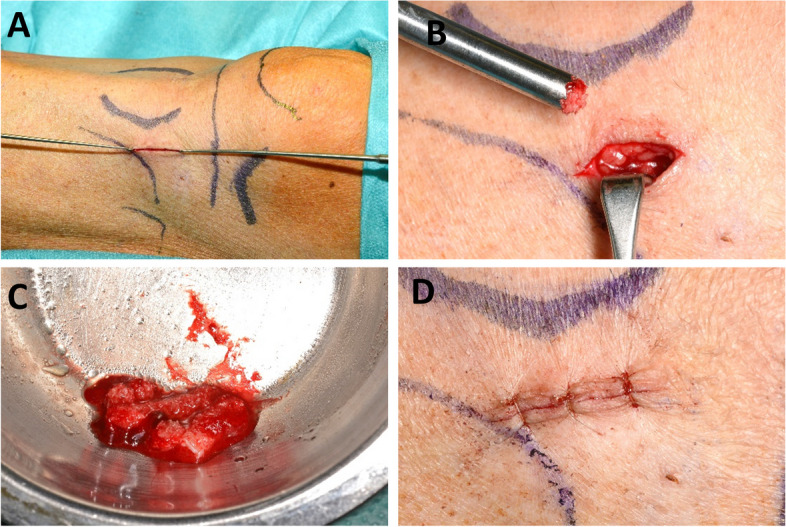
Autologous bone grafts are essential in reconstructive oral and maxillofacial surgery, and depending on the donor site, they can be associated with specific harvesting morbidities. One of the most commonly applied bone grafts is the iliac crest bone graft, irrespective of other grafts, which might be associated with an easier surgical procedure or the possibility of harvesting them under local anaesthesia. Objective of the study is the clinical evaluation of proximal tibia bone grafts regarding their eligibility for maxillofacial bone grafting.
In this retrospective study, proximal tibia bone grafts were examined with regard to associated donor and recipient site morbidity and their suitability for alveolar ridge augmentation and rhinoplasty.
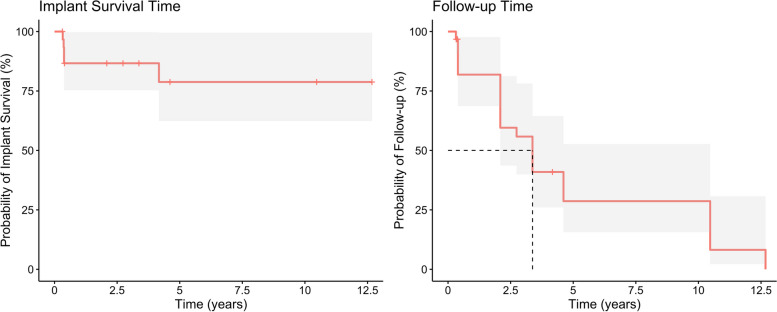
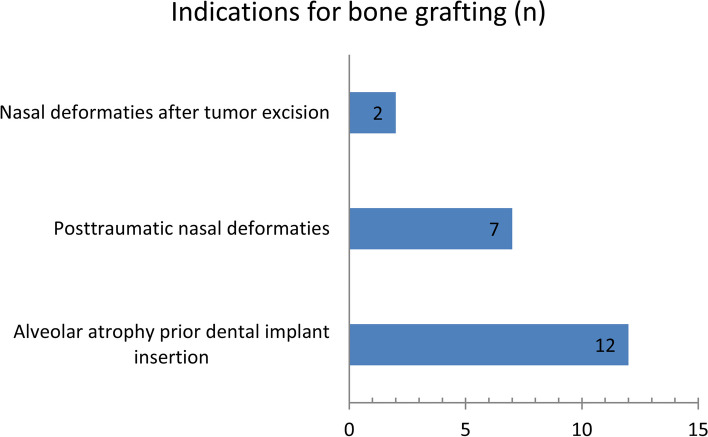
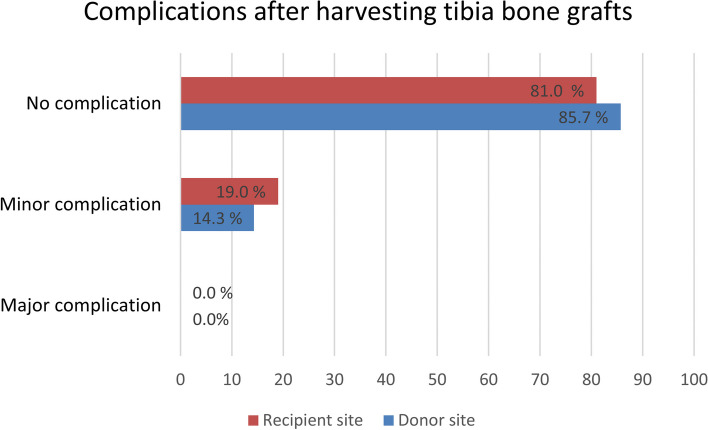
In total, 21 tibia grafts were included. Fifty-seven percent of the bone grafts were used for alveolar ridge reconstruction, and 43% were used for augmentative rhinoplasty. No significant complications occurred during or after harvesting, but in 14.3% of the patients, minor wound healing disorders were recorded at the donor site, and in 19% of the patients, they were recorded at the recipient site. Statistically, patient sex, age, nicotine and alcohol abuse and metabolic diseases had no significant influence on the complication rate. Graft harvesting under local anaesthesia and at summer temperatures was associated with significantly more complications at the harvesting site (p < 0.05). In cases of dental implant insertion into augmented sites, the implants (n = 31) were followed up for a median period of 40.5 months, during this time 86.7% of the implants survived.
The proximal tibia is a suitable donor site for harvesting autologous bone grafts for alveolar ridge augmentation or rhinoplasty because the donor site morbidity is low, and in contrast to iliac crest bone grafts, they can be harvested under local anaesthesia, which might be advantageous for outpatient surgeries.
自体骨移植在口腔颌面重建外科中至关重要,根据供体部位的不同,可能会伴有特定的采集并发症。最常应用的骨移植之一是髂嵴骨移植,与其他可能与手术过程更简单或可在局部麻醉下采集相关的移植相比,它与特定的采集并发症相关。本研究的目的是评估胫骨近端骨移植在颌面骨移植中的适用性。
在这项回顾性研究中,我们检查了胫骨近端骨移植与供体和受区相关并发症以及它们在牙槽嵴增高和鼻整形术中的适用性。
共纳入 21 例胫骨移植。57%的骨移植用于牙槽嵴重建,43%用于增强型鼻整形术。采集过程中或之后无明显并发症,但在 14.3%的患者中,供体部位记录到轻微的伤口愈合障碍,在 19%的患者中,受区部位记录到轻微的伤口愈合障碍。统计学上,患者性别、年龄、吸烟和饮酒、代谢性疾病对并发症发生率无显著影响。在局部麻醉和夏季温度下采集骨移植物与采集部位并发症发生率显著增加相关(p<0.05)。在增强部位植入牙种植体的病例中,对(n=31)植入物进行了中位 40.5 个月的随访,在此期间,86.7%的植入物存活。
胫骨近端是用于牙槽嵴增高或鼻整形术的自体骨移植的合适供体部位,因为供体部位的发病率较低,与髂嵴骨移植相比,可在局部麻醉下采集,这可能有利于门诊手术。