Sakkas Andreas, Wilde Frank, Heufelder Marcus, Winter Karsten, Schramm Alexander
Department of Oral and Plastic Maxillofacial Surgery, Military Hospital Ulm, Academic Hospital of the University of Ulm, Oberer Eselsberg 40, 89081, Ulm, Germany.
Institute of Anatomy, Medical Faculty of Leipzig University, Leipzig, Germany.
Int J Implant Dent. 2017 Dec;3(1):23. doi: 10.1186/s40729-017-0084-4. Epub 2017 Jun 1.
This study assessed the clinical outcomes of graft success rate and early implant survival rate after preprosthetic alveolar ridge reconstruction with autologous bone grafts.
A consecutive retrospective study was conducted on all patients who were treated at the military outpatient clinic of the Department of Oral and Plastic Maxillofacial Surgery at the military hospital in Ulm (Germany) in the years of 2009 until 2011 with autologous bone transplantation prior to secondary implant insertion. Intraoral donor sites (crista zygomatico-alveolaris, ramus mandible, symphysis mandible, and anterior sinus wall) and extraoral donor site (iliac crest) were used. A total of 279 patients underwent after a healing period of 3-5 months routinely computer tomography scans followed by virtual implant planning. The implants were inserted using guided oral implantation as described by Naziri et al. All records of all the consecutive patients were reviewed according to patient age, history of periodontitis, smoking status, jaw area and dental situation, augmentation method, intra- and postoperative surgical complications, and surgeon's qualifications. Evaluated was the augmentation surgical outcome regarding bone graft loss and early implant loss postoperatively at the time of prosthodontic restauration as well a follow-up period of 2 years after loading.
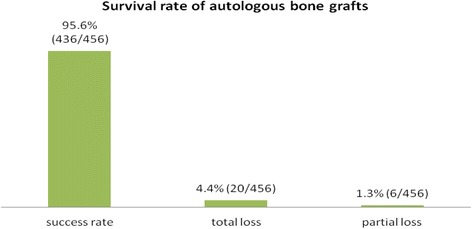
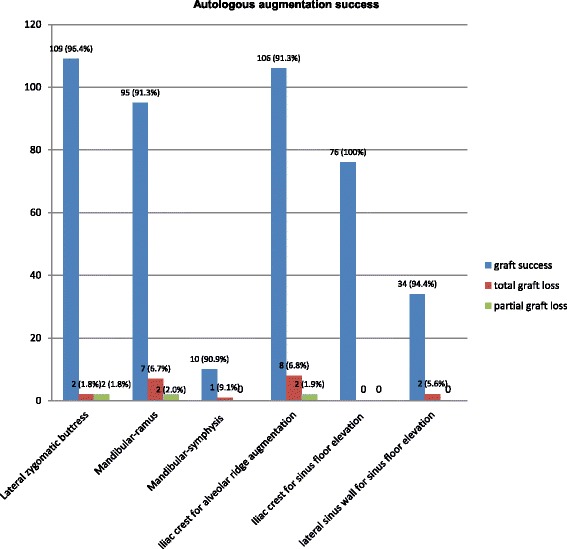
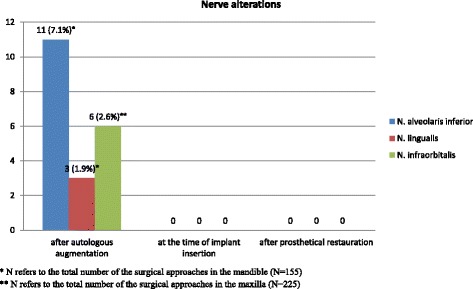
A total of 279 patients underwent 456 autologous augmentation procedures in 546 edentulous areas. One hundred thirteen crista zygomatico-alveolaris grafts, 104 ramus mandible grafts, 11 symphysis grafts, 116 grafts from the anterior superior iliac crest, and 112 sinus lift augmentations with bone scrapes from the anterior facial wall had been performed. There was no drop out or loss of follow-up of any case that had been treated in our clinical center in this 3-year period. Four hundred thirty-six (95.6%) of the bone grafts healed successfully, and 20 grafts (4.4%) in 20 patients had been lost. Fourteen out of 20 patients with total graft failure were secondarily re-augmented, and six patients wished no further harvesting procedure. In the six patients, a partial graft resorption was detected at the time of implantation and additional simultaneous augmentation during implant insertion was necessary. No long-term nerve injury occurred. Five hundred twenty-five out of 546 initially planned implants in 259 patients could be inserted into successfully augmented areas, whereas 21 implants in 20 patients due to graft loss could not be inserted. A final rehabilitation as preplanned with dental implants was possible in 273 of the 279 patients. The early implant failure rate was 0.38% concerning two out of the 525 inserted implants which had to be removed before the prosthodontic restoration. Two implants after iliac crest augmentation were lost within a period of 2 years after loading, concerning a total implant survival rate after 2 years of occlusal loading rate of 99.6% after autologous bone augmentation prior to implant insertion.
This review demonstrates the predictability of autologous bone material in alveolar ridge reconstructions prior to implant insertion, independent from donor and recipient site including even autologous bone chips for sinus elevation. Due to the low harvesting morbidity of autologous bone grafts, the clinical results of our study indicate that autologous bone grafts still remain the "gold standard" in alveolar ridge augmentation prior to oral implantation.
本研究评估了自体骨移植进行牙种植前牙槽嵴重建后的移植成功率和早期种植体存活率等临床结果。
对2009年至2011年在德国乌尔姆军事医院口腔颌面整形外科军事门诊接受二次种植前自体骨移植治疗的所有患者进行连续回顾性研究。使用了口腔内供区(颧牙槽嵴、下颌支、下颌联合和前窦壁)和口腔外供区(髂嵴)。279例患者在3至5个月的愈合期后常规进行计算机断层扫描,随后进行虚拟种植计划。按照纳齐里等人描述的方法,使用引导式口腔种植技术植入种植体。根据患者年龄、牙周炎病史、吸烟状况、颌骨区域和牙齿情况、植骨方法、术中和术后手术并发症以及外科医生资质,对所有连续患者的记录进行审查。评估了植骨手术结果,包括术后在修复时的骨移植丢失和早期种植体丢失情况,以及加载后2年的随访期情况。
279例患者在546个无牙区接受了456次自体植骨手术。进行了113次颧牙槽嵴移植、104次下颌支移植、11次下颌联合移植、116次取自髂前上嵴的移植以及112次使用前壁骨屑进行的上颌窦提升植骨。在这3年期间,本临床中心治疗的任何病例均无失访或随访丢失情况。436例(95.6%)骨移植成功愈合,20例患者中的20次移植(4.4%)失败。20例移植完全失败患者中有14例再次进行了植骨,6例患者不希望进一步进行取骨手术。在这6例患者中,植入时检测到部分移植骨吸收,植入种植体时需要额外同时进行植骨。未发生长期神经损伤。259例患者中最初计划的546颗种植体中有525颗能够成功植入已成功植骨的区域,而20例患者中的21颗种植体由于移植骨丢失无法植入。279例患者中有273例最终按计划用牙种植体进行了修复。在修复前必须拔除的525颗已植入种植体中有2颗早期种植体失败,失败率为0.38%。髂嵴植骨后有2颗种植体在加载后2年内丢失,植入前自体骨移植后2年咬合加载后的总种植体存活率为99.6%。
本综述表明自体骨材料在种植前牙槽嵴重建中具有可预测性,与供区和受区无关,包括用于上颌窦提升的自体骨屑。由于自体骨移植的取骨并发症发生率低,我们的研究临床结果表明,自体骨移植在口腔种植前牙槽嵴增高术中仍然是“金标准”。