Department of Information, Medical Support Center, The General Hospital of Western Theater Command, PLA, Chengdu, China.
School of Public Health, Southwest Medical University, Luzhou, China.
Front Public Health. 2024 Sep 11;12:1428384. doi: 10.3389/fpubh.2024.1428384. eCollection 2024.
Prior studies have demonstrated a prevalent occurrence of depression among the middle-aged and older Chinese individuals with chronic diseases. Nevertheless, there is limited research on the specific subgroups of depression trajectories within this population and the factors influencing these subgroups.
To explore the changing trajectory and influencing factors of depression in the middle-aged and older individuals with chronic disease in China, and provide the data reference for the health management of the older adult population in China.
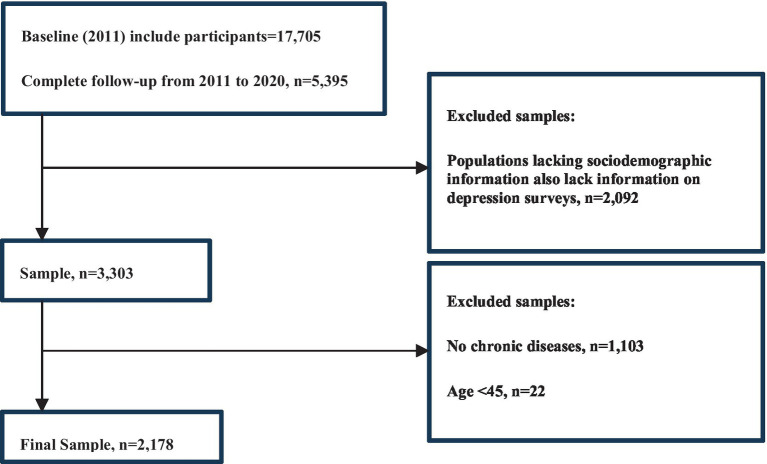
A longitudinal cohort study was conducted using the data from the China Health and Retirement Longitudinal Study (CHARLS) in 2011, 2013, 2015, 2018, and 2020. A total of 2,178 participants with complete data were included. The level of depression was evaluated using the Center for Epidemiologic Studies Depression Scale (CESD-10). The Latent Class Mixed Models (LCMM) were employed to estimate trajectories of depressive symptoms. The Kruskal-Wallis test and the Pearson test were used to determine the significant factors affecting trajectory grouping. Subsequently, the multinomial logistic regression model was utilized to perform a multifactorial analysis of the variables impacting the trajectory subgroup of change in depressive symptoms.
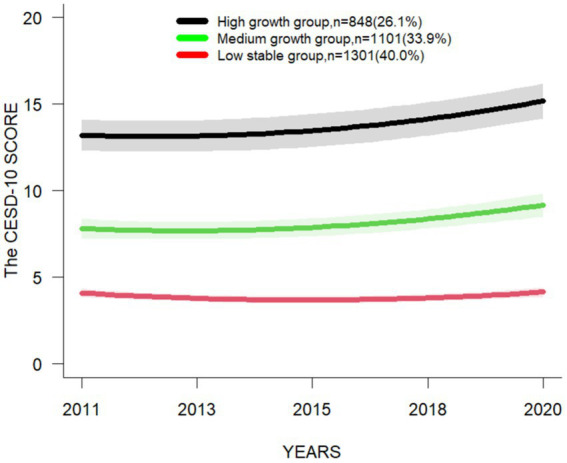
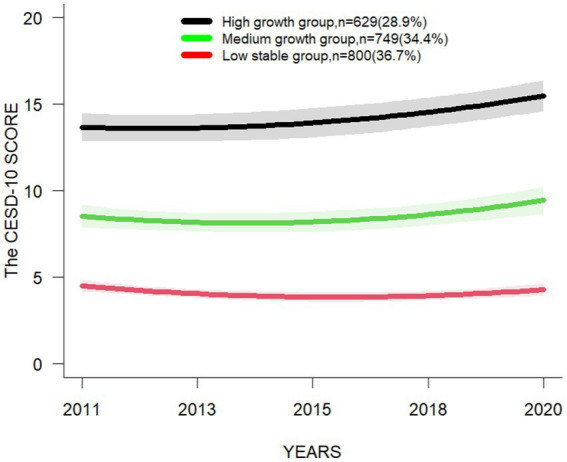
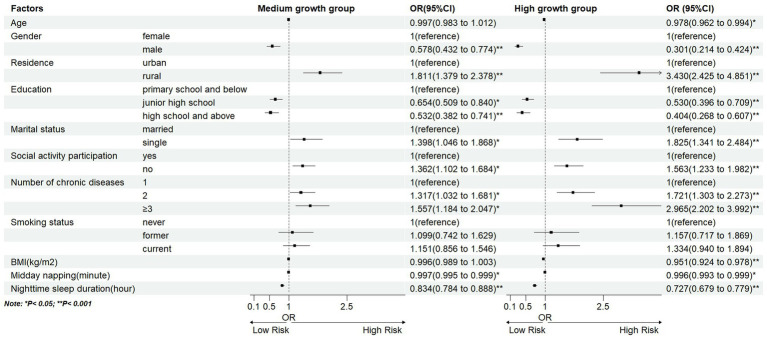
The LCMM-analysis revealed three distinct subgroups of depression trajectories: the "Low stable group" comprising 36.7% of the sample, the "Medium growth group" comprising 34.4% of the sample, and the "High growth group" comprising 28.9% of the sample. Among the baseline characteristics of different depression trajectory subgroups, there were significant differences in gender, residence, education, marital status, social activity participation, number of chronic diseases, smoking status, BMI, midday napping (minutes) and nighttime sleep duration (hours). Through multiple logistic regression analysis, our findings demonstrate that among the middle-aged and older Chinese individuals with chronic diseases, the following individuals should be the key groups for the prevention and treatment of depressive symptoms: Those who are young, female, residing in rural areas, having primary school education and below, being single, not participating in social activities, suffering from multiple chronic diseases, and having shorter naps and sleeping at night.
There is heterogeneity in the subgroups of depression trajectories among the Chinese middle-aged and older individuals with chronic diseases. The focus should be on the distinct characteristics of various trajectories of depression within the realm of health management.
先前的研究表明,患有慢性病的中国中老年人群中普遍存在抑郁症状。然而,对于该人群中抑郁轨迹的特定亚组以及影响这些亚组的因素,相关研究仍然有限。
探讨中国中老年慢性病患者抑郁的变化轨迹及其影响因素,为中国老年人群的健康管理提供数据参考。
采用中国健康与养老追踪调查(CHARLS)2011 年、2013 年、2015 年、2018 年和 2020 年的数据进行纵向队列研究。共纳入 2178 名资料完整的研究对象。采用流行病学研究中心抑郁量表(CESD-10)评估抑郁水平。采用潜在类别混合模型(LCMM)估计抑郁症状轨迹。采用 Kruskal-Wallis 检验和 Pearson 检验确定影响轨迹分组的显著因素。随后,采用多因素逻辑回归模型对影响抑郁症状变化轨迹亚组的变量进行多因素分析。
LCMM 分析显示,抑郁轨迹存在 3 个不同的亚组:“低稳定组”占样本的 36.7%,“中增长组”占样本的 34.4%,“高增长组”占样本的 28.9%。不同抑郁轨迹亚组的基线特征中,性别、居住地、教育程度、婚姻状况、社会活动参与度、慢性疾病数量、吸烟状况、BMI、午睡(分钟)和夜间睡眠时间(小时)存在显著差异。通过多因素逻辑回归分析,我们发现,在中国患有慢性病的中老年人群中,以下人群应成为预防和治疗抑郁症状的重点人群:年龄较小、女性、居住在农村地区、受教育程度为小学及以下、单身、不参加社会活动、患有多种慢性疾病、午睡时间较短和夜间睡眠时间较短的人群。
中国中老年慢性病患者的抑郁轨迹亚组存在异质性。在健康管理领域,应关注抑郁各轨迹的不同特征。