Department of Information, Medical Support Center, The General Hospital of Western Theater Command, Chengdu, Sichuan, China.
School of Public Health, Southwest Medical University, Luzhou, Sichuan, China.
Front Public Health. 2023 Jul 20;11:1176669. doi: 10.3389/fpubh.2023.1176669. eCollection 2023.
With the aging of the Chinese population, the prevalence of depression and chronic diseases is continually growing among middle-aged and older adult people. This study aimed to investigate the association between chronic diseases and depression in this population.
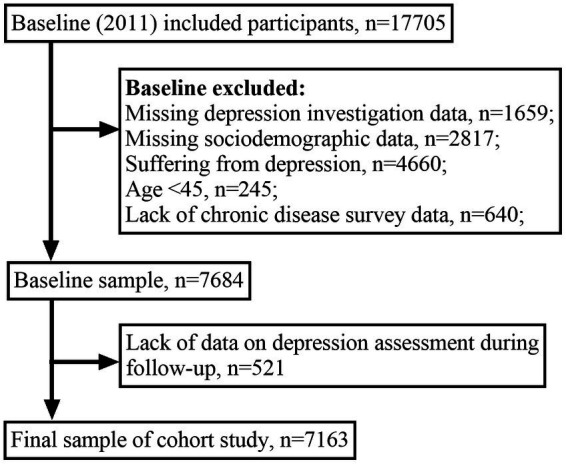
Data from the China Health and Retirement Longitudinal Study (CHARLS) 2011-2018 longitudinal survey, a 7-years follow-up of 7,163 participants over 45 years old, with no depression at baseline (2011). The chronic disease status in our study was based on the self-report of the participants, and depression was defined by the 10-item Center for Epidemiologic Studies Depression Scale (CES-D-10). The relationship between baseline chronic disease and depression was assessed by the Kaplan-Meier method and Cox proportional hazards regression models.
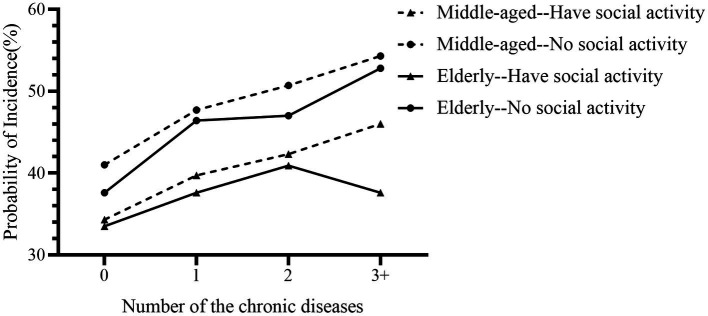
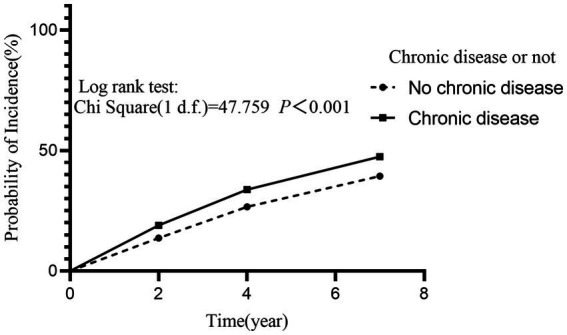
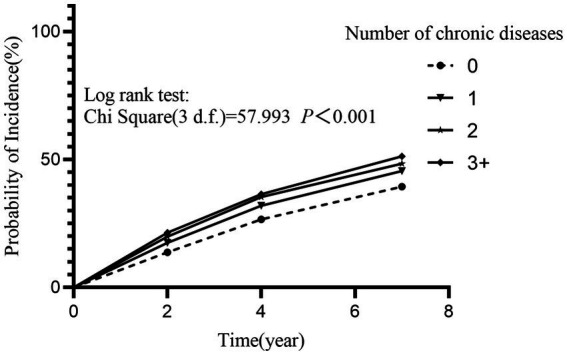
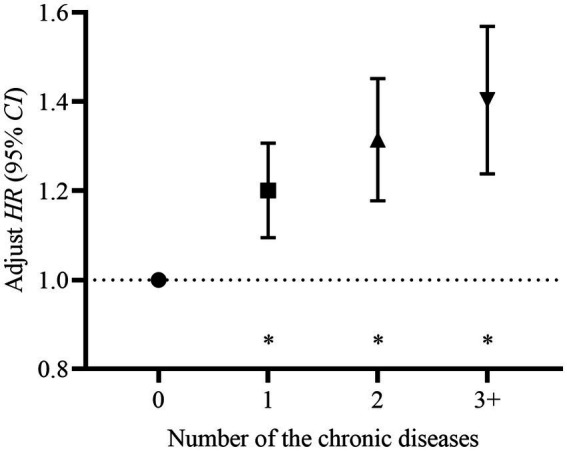
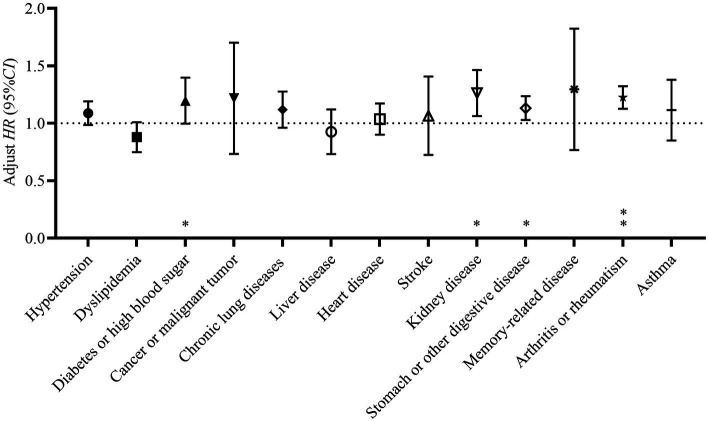
After 7-years follow-up, 41.2% (2,951/7163, 95% :40.1, 42.3%) of the participants reported depression. The analysis showed that participants with chronic diseases at baseline had a higher risk of depression and that such risk increased significantly with the number of chronic diseases suffered (1 chronic disease: = 1.197; 2 chronic diseases: = 1.310; 3 and more chronic diseases: = 1.397). Diabetes or high blood sugar ( = 1.185), kidney disease ( = 1.252), stomach or other digestive diseases ( = 1.128), and arthritis or rheumatism ( = 1.221) all significantly increased the risk of depression in middle-aged and older adult Chinese.
The present study found that suffering from different degrees of chronic diseases increased the risk of depression in middle-aged and older adult people, and these findings may benefit preventing depression and improving the quality of mental health in this group.
随着中国人口老龄化,中年和老年人的抑郁和慢性病患病率不断上升。本研究旨在调查该人群中慢性病与抑郁之间的关系。
数据来自中国健康与养老追踪调查(CHARLS)2011-2018 年的纵向调查,该调查对 7163 名 45 岁以上且基线时无抑郁的参与者进行了 7 年的随访。我们的研究中的慢性病状况是基于参与者的自我报告,抑郁是通过 10 项流行病学研究中心抑郁量表(CES-D-10)来定义的。采用 Kaplan-Meier 方法和 Cox 比例风险回归模型评估基线慢性病与抑郁之间的关系。
在 7 年的随访后,41.2%(2951/7163,95%CI:40.1,42.3%)的参与者报告有抑郁。分析表明,基线时患有慢性病的参与者患抑郁的风险较高,且随着所患慢性病数量的增加,这种风险显著增加(1 种慢性病: = 1.197;2 种慢性病: = 1.310;3 种及以上慢性病: = 1.397)。糖尿病或高血糖( = 1.185)、肾脏疾病( = 1.252)、胃部或其他消化系统疾病( = 1.128)和关节炎或风湿病( = 1.221)均显著增加了中年和老年中国人患抑郁的风险。
本研究发现,患有不同程度的慢性病会增加中年和老年人群患抑郁的风险,这些发现可能有助于预防该人群的抑郁,并改善其心理健康质量。