Srivastav Saurabh, Singh Shrikesh, Khan Tanvir Roshan
Department of Paediatric Surgery, Dr RML Institute of Medical Sciences, Lucknow, Uttar Pradesh, India.
J Indian Assoc Pediatr Surg. 2024 Sep-Oct;29(5):511-516. doi: 10.4103/jiaps.jiaps_24_24. Epub 2024 Sep 9.
Thoracoscopic surgery is an increasingly popular surgical technique for the repair of congenital diaphragmatic hernias. We performed a meta-analysis to compare the efficacy, safety of thoracoscopic surgery and the conventional open surgical approach for congenital diaphragmatic hernia in neonates.
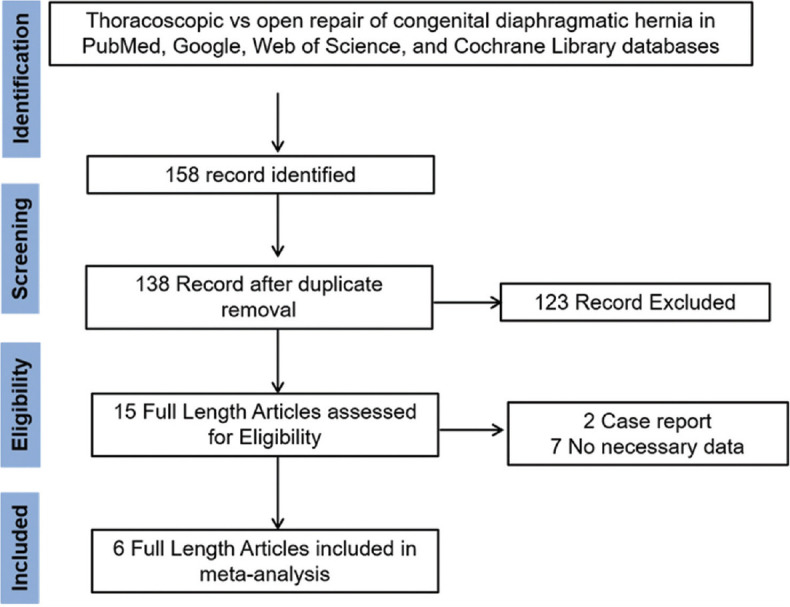
A systematic search of electronic databases such as PubMed, Google, and Web of Science was performed to identify studies comparing thoracoscopic surgery and open surgery for congenital diaphragmatic hernia. A total of 6 studies with 3348 patients were found. Parameters such as operation time, hospital stay, recurrence rate, postoperative mortality, and postoperative complications were pooled and compared by meta-analysis.
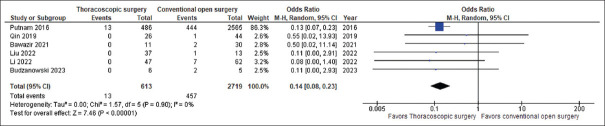
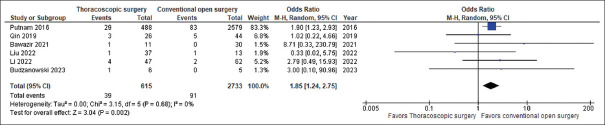
Of the 3348 children with congenital diaphragmatic hernia included in the 6 studies, 615 underwent thoracoscopic surgery and 2733 underwent open surgery. All studies were nonrandomized controlled trials. The operation times were shorter for thoracoscopic surgery than for open surgery in three studies, but there was no significant difference (standard mean difference = 1.25, confidence interval [CI] = [-0.48-2.98], = 0.16). In the thoracoscopic surgery group, the rate of postoperative deaths was significantly lower (95% CI = 1.24-2.75), but the occurrence of recurrences was more frequent (95% CI = 0.08-0.23). The hospital stay varied significantly across studies. There was a statistically significant difference (standard mean difference = -1.47, CI = [-2.24--0.70], < 0.001) in the overall effect between the groups. The complication rate was significantly lower with thoracoscopic surgery compared to open surgery (odds ratio = 0.26, CI = [0.10-0.66], = 0.004) for the overall effect between the groups. The thoracoscopic procedure, however, was planned for milder and stable cases.
Thoracoscopic repair of congenital diaphragmatic hernia in neonates is associated with a shorter length of hospital stay, fewer complications, and less postoperative mortality than traditional open repair. However, the rate of recurrence was found to be higher in those who underwent thoracoscopic surgery.
胸腔镜手术是一种越来越受欢迎的用于修复先天性膈疝的外科技术。我们进行了一项荟萃分析,以比较胸腔镜手术与传统开放手术治疗新生儿先天性膈疝的疗效和安全性。
对PubMed、谷歌和科学网等电子数据库进行系统检索,以确定比较胸腔镜手术和开放手术治疗先天性膈疝的研究。共找到6项研究,涉及3348例患者。通过荟萃分析汇总并比较手术时间、住院时间、复发率、术后死亡率和术后并发症等参数。
在这6项研究纳入的3348例先天性膈疝患儿中,615例行胸腔镜手术,2733例行开放手术。所有研究均为非随机对照试验。三项研究中胸腔镜手术的手术时间比开放手术短,但差异无统计学意义(标准均差 = 1.25,置信区间[CI] = [-0.48 - 2.98],P = 0.16)。胸腔镜手术组术后死亡率显著较低(95%CI = 1.24 - 2.75),但复发发生率更高(95%CI = 0.08 - 0.23)。各研究间住院时间差异显著。两组间总体效应有统计学显著差异(标准均差 = -1.47,CI = [-2.24 - -0.70],P < 0.001)。胸腔镜手术组的并发症发生率显著低于开放手术组(优势比 = 0.26,CI = [0.10 - 0.66],P = 0.004)。然而,胸腔镜手术适用于病情较轻且稳定的病例。
与传统开放修复相比,新生儿先天性膈疝的胸腔镜修复术住院时间更短、并发症更少、术后死亡率更低。然而,接受胸腔镜手术的患者复发率更高。