Endocrinology and Female Infertility Unit, Arash Women's Hospital, Tehran University of Medical Sciences, Tehran, Iran.
Department of Endocrinology and Female Infertility, Reproductive Biomedicine Research Center, Royan Institute for Reproductive Biomedicine, ACECR, Tehran, Tehran, Iran.
BMC Womens Health. 2024 Nov 1;24(1):584. doi: 10.1186/s12905-024-03429-w.
Theoretically, endocrine fluctuations occurring during infertility treatments, including ovulation induction (OI) and assisted reproductive techniques (ART), could be associated with an increased risk of benign breast diseases (BBDs). To date, no studies have been conducted on this association. Therefore, the present study investigated the association between different types of infertility treatments and BBDs.
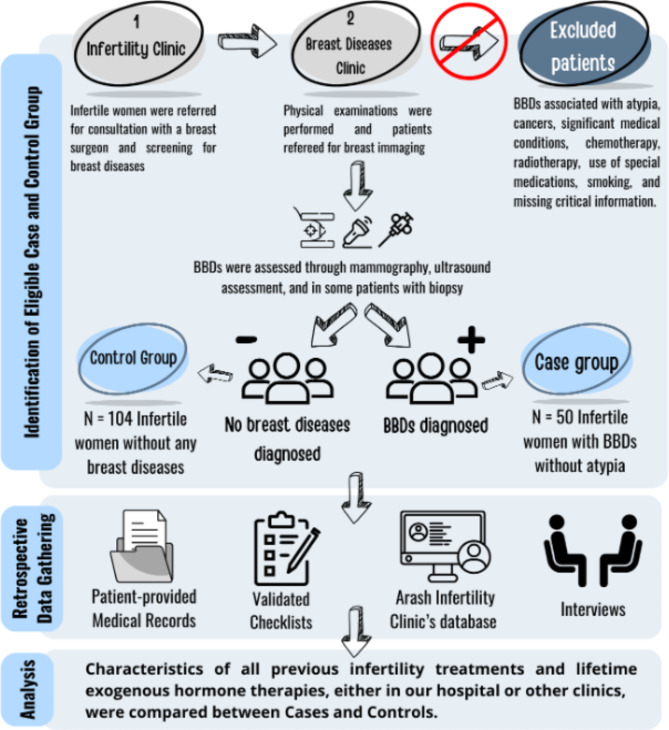
This case‒control study was conducted in Arash Women's Hospital, Tehran, Iran. The case group included infertile women diagnosed with BBDs without atypia, and the control group included infertile women without breast disease. Breast imaging studies (mammography/ultrasound) were performed for BBD screening, and the diagnosis was confirmed by histopathological examination. Study variables were collected retrospectively from medical records, hospital databases, and questionnaires.
Finally, 154 infertile women, including 50 cases (BBDs) and 104 controls (no BBDs), were compared. Our data showed that 66% of cases and 61.4% of controls had undergone at least one course of infertility treatment. There was no association between BBD risk and previous infertility treatments (OR = 1.21; 95% CI = 0.59-2.46), ART (OR = 1.14; 95% CI = 0.90-1.44), or OI cycles (OR = 1.13; 95% CI = 0.98-1.32). Stratification by confounding variables did not change these results.
It seems that there is no association between BBDs in infertile women and the type, duration, or number of prior infertility treatments; however, considering the small sample size of the study, the clinical significance of this finding should not be neglected. Therefore, we consider it essential to carry out more extensive, detailed, and prospective studies to distinguish the association of BBDs with different infertility treatments and medications.
理论上,不孕治疗过程中发生的内分泌波动,包括促排卵(OI)和辅助生殖技术(ART),可能与良性乳腺疾病(BBD)的风险增加有关。迄今为止,尚未对此相关性进行研究。因此,本研究调查了不同类型的不孕治疗与 BBD 之间的关系。
这项病例对照研究在伊朗德黑兰的 Arash 妇女医院进行。病例组包括患有非典型 BBD 的不孕妇女,对照组包括无乳房疾病的不孕妇女。对 BBD 进行乳房影像学检查(乳房 X 线照相术/超声),并通过组织病理学检查确认诊断。研究变量从病历、医院数据库和问卷调查中回顾性收集。
最终比较了 154 名不孕妇女,其中 50 例(BBD)和 104 例对照(无 BBD)。我们的数据显示,66%的病例和 61.4%的对照至少接受过一次不孕治疗。BBD 风险与先前的不孕治疗(OR=1.21;95%CI=0.59-2.46)、ART(OR=1.14;95%CI=0.90-1.44)或 OI 周期(OR=1.13;95%CI=0.98-1.32)无关。对混杂变量进行分层并未改变这些结果。
似乎不孕妇女的 BBD 与治疗类型、持续时间或先前不孕治疗的次数之间没有关联;然而,考虑到研究的样本量较小,不应忽视这一发现的临床意义。因此,我们认为开展更广泛、详细和前瞻性的研究以区分不同不孕治疗和药物与 BBD 的关联至关重要。