Vascular Medicine Unit, CHU Rennes, 2 Rue Henri Le Guilloux, Rennes, 35033, France.
CHU Rennes, Inserm, CIC 1414 (Clinical Investigation Center), Rennes, F-35000, France.
BMC Cardiovasc Disord. 2024 Nov 1;24(1):611. doi: 10.1186/s12872-024-04289-w.
Patients with symptomatic lower extremity artery disease (LEAD) should have an optimal management in terms of lipid goal [i.e. controlled LDL-cholesterol (LDLc)] and medical treatment (triple therapy with an antiplatelet agent, a statin and an angiotensin-converting enzyme inhibitor or a angiotensin-receptor antagonist). Prevalence of LEAD patients with a LDLc < 0.55 g/l is unknown. Aims of this study were to: (i) describe the prevalence of patients with a LDLc < 0.55 g/l, (ii) describe the prevalence of patients with an optimal medical treatment; (iii) compare this management between patients with a vascular surgery history and those without a vascular surgery history; and (iv) evaluate the number of patients eligible for new lipid-lowering therapies according to FOURIER and REDUCE-IT criteria.
In this single-center retrospective study, prevalence is expressed as numbers and percentages. Comparison of the number of well managed patients between LEAD patients with a vascular surgery history and those without was performed. Number of patients who would be eligible for FOURIER and REDUCE-IT studies were calculated.
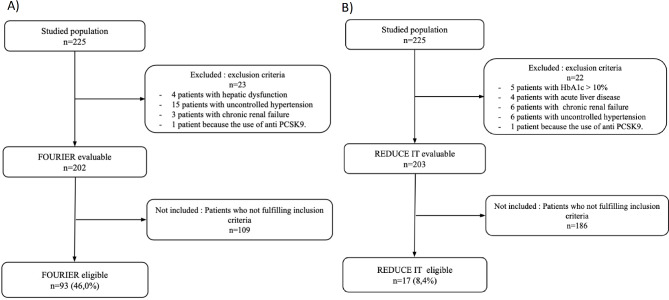
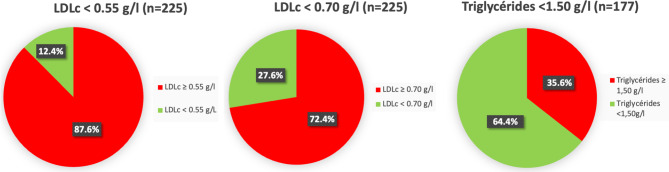
Among the LEAD patients included in the analysis (n = 225), only 12.4% (n = 28) had a LDLc < 0.55 g/L. The prevalence of patients who received the optimal medical treatment was 50.7% (n = 114). There was no statistical difference in the prevalence of patients with and without vascular surgery history achieving the LDLc goal (n = 9 (10.6%) vs. n = 19 (13.6%); p = not significant). Ninety-three patients (46.0%) would be eligible for EVOLOCUMAB treatment according to the Fourier study design whereas 17 patients (8.4%) would be eligible for treatment with ICOSAPENT ETHYL according to the REDUCE-IT study design.
A majority of LEAD patients did not reach the LDLc goals. LEAD patients with a vascular surgery history did not experience a better management whereas they had a more consistent follow-up.
下肢动脉疾病(LEAD)症状患者的血脂目标(即控制 LDL 胆固醇(LDLc))和药物治疗(抗血小板药物、他汀类药物和血管紧张素转换酶抑制剂或血管紧张素受体拮抗剂的三联治疗)应达到最佳管理。患有 LDLc<0.55g/l 的 LEAD 患者的患病率尚不清楚。本研究的目的是:(i)描述 LDLc<0.55g/l 的患者的患病率,(ii)描述接受最佳药物治疗的患者的患病率;(iii)比较有血管手术史和无血管手术史的患者的管理情况;(iv)根据 FOURIER 和 REDUCE-IT 标准评估符合新降脂治疗条件的患者数量。
在这项单中心回顾性研究中,患病率以数字和百分比表示。比较有血管手术史和无血管手术史的 LEAD 患者中治疗良好的患者数量。计算符合 FOURIER 和 REDUCE-IT 研究标准的患者数量。
在纳入分析的 LEAD 患者中(n=225),仅有 12.4%(n=28)的 LDLc<0.55g/L。接受最佳药物治疗的患者比例为 50.7%(n=114)。有血管手术史和无血管手术史的患者达到 LDLc 目标的比例无统计学差异(n=9(10.6%)与 n=19(13.6%);p=不显著)。根据 FOURIER 研究设计,93 名患者(46.0%)符合 EVOLOCUMAB 治疗标准,根据 REDUCE-IT 研究设计,17 名患者(8.4%)符合 ICOSAPENT ETHYL 治疗标准。
大多数 LEAD 患者未达到 LDLc 目标。有血管手术史的 LEAD 患者的管理并没有更好,尽管他们的随访更一致。