Department of Hospital Pharmacy, Erasmus University Medical Center, Rotterdam, the Netherlands.
Department of Medical Oncology, Erasmus University Medical Center, Rotterdam, Netherlands.
BMC Health Serv Res. 2024 Oct 31;24(1):1322. doi: 10.1186/s12913-024-11719-0.
Recent studies have underscored the potential of innovative administration methods to mitigate the capacity burden on healthcare systems, without compromising the quality of care. This study assessed and compared the resource utilization and associated costs of two distinct administration modes of immune checkpoint inhibitors: the innovative elastomeric pump and conventional intravenous infusion. This comparison can inform sustainable healthcare practices and healthcare decision-making to optimize treatment efficiency in an era of escalating healthcare demands.
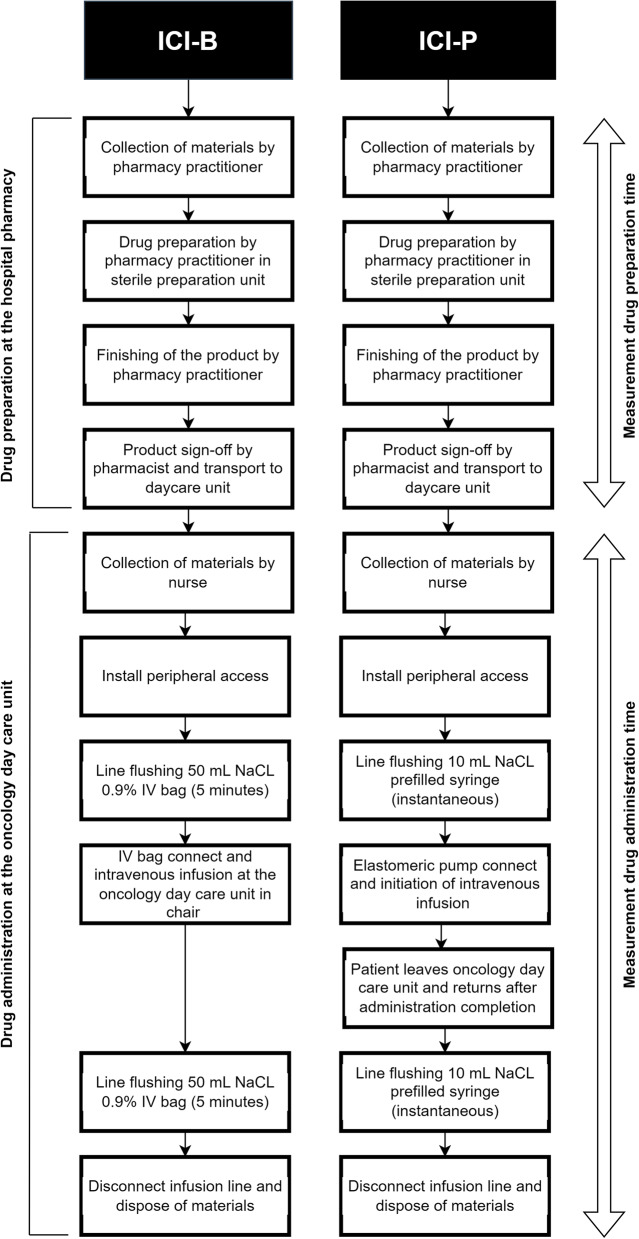
In this micro-costing study, data on resource use and time allocation for drug preparation and administration were collected using an observational, non-interventional study design. Data were registered at the oncology daycare unit and hospital pharmacy. Cost categories included drug acquisition, disposable materials, healthcare professional time for drug administration, drug preparation, and patient time spent at the oncology day care unit.
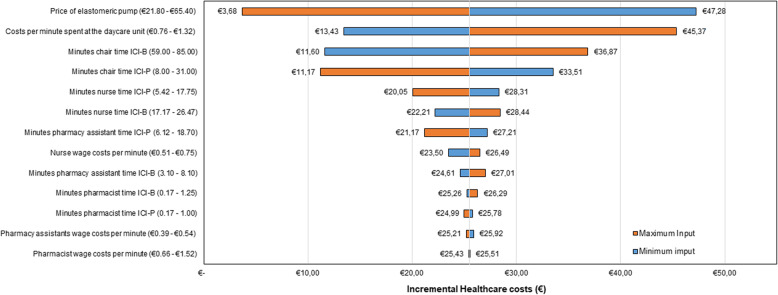
Drug administration through the elastomeric pump resulted in substantially lower healthcare costs when compared to conventional infusion, particularly due to reduced labor and chair time. The elastomeric pump reduced the total chair time by 78% and nurse time by 55%. Total average costs (excluding drug costs) were €103,47 and €77.99 for conventional infusion and the elastomeric pump, respectively, showcasing potential savings of €25.48 (P < 0.001) per administration.
This study demonstrated that the elastomeric pump not only offers substantial cost savings but also enhances the treatment capacity of the oncology day care unit. These findings support the adoption of the elastomeric pump in clinical settings as a cost-saving and efficient alternative to conventional infusion.
This study has been registered in the National Trial Register (NTR), with the reference number NTR NL9473. Registration date: 05-05-2021.
最近的研究强调了创新的管理方法在减轻医疗系统容量负担的同时,保持医疗质量的潜力。本研究评估并比较了两种不同的免疫检查点抑制剂管理模式(创新型弹性泵和传统静脉输注)的资源利用和相关成本。这种比较可以为可持续的医疗保健实践和医疗保健决策提供信息,以在医疗保健需求不断增长的时代优化治疗效率。
在这项微观成本研究中,使用观察性、非干预性研究设计收集了药物准备和管理过程中资源利用和时间分配的数据。数据在肿瘤日间护理病房和医院药房进行登记。成本类别包括药物采购、一次性材料、医疗保健专业人员给药时间、药物准备和患者在肿瘤日间护理病房的时间。
与传统输注相比,弹性泵给药可显著降低医疗保健成本,特别是由于减少了劳动力和椅时间。弹性泵使总椅时间减少了 78%,护士时间减少了 55%。不包括药物成本在内,传统输注和弹性泵的总平均成本分别为€103.47 和€77.99,每次给药可节省潜在成本€25.48(P<0.001)。
本研究表明,弹性泵不仅可以节省大量成本,还可以提高肿瘤日间护理病房的治疗能力。这些发现支持在临床环境中采用弹性泵作为传统输注的经济高效替代方案。
本研究已在国家试验注册中心(NTR)注册,参考号为 NTR NL9473。注册日期:2021 年 5 月 5 日。