Eli Lilly and Company, Indianapolis, IN, United States.
Evidera Inc, Montreal, QC, Canada.
Front Immunol. 2024 Oct 17;15:1425478. doi: 10.3389/fimmu.2024.1425478. eCollection 2024.
Several current therapies for autoimmune diseases do not provide sustained remission. Therapies that focus on the restoration of homeostasis within the immune system (i.e., immune resolution) could overcome the limitations of current therapies and provide more durable remission. However, there is no established consensus on appropriate clinical trial designs and endpoints to evaluate such therapies. Therefore, we conducted a systematic literature review (SLR) focusing on five index diseases (asthma, atopic dermatitis, rheumatoid arthritis, systemic lupus erythematosus [SLE], and ulcerative colitis) to explore published literature on 1) expert opinion on immune-resolution outcomes that should be measured in clinical trials; and 2) quantification of immune resolution in previous clinical trials.
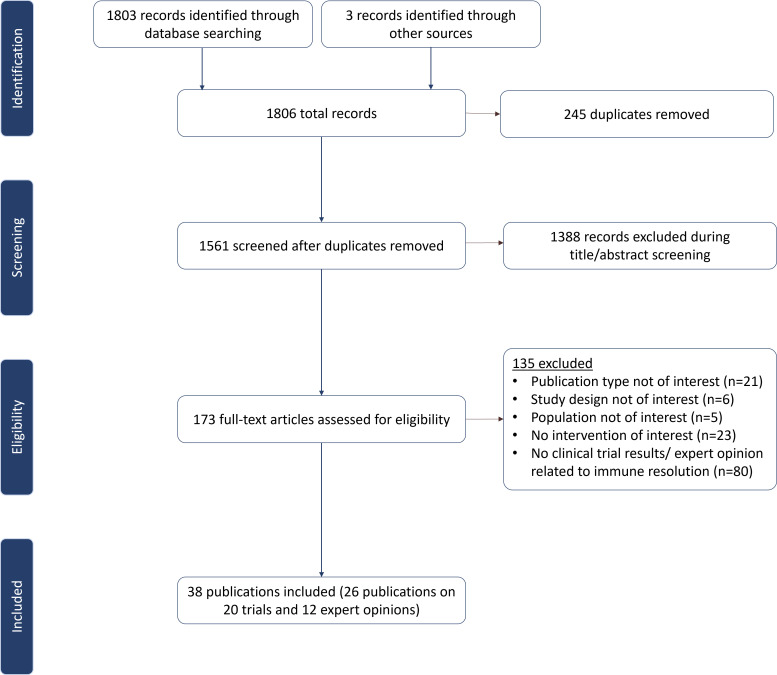
The SLR was conducted in accordance with the Preferred Reporting Items for Systematic Reviews and Meta-Analyses (PRISMA) guidelines. Embase and MEDLINE databases were systematically searched (2013-2023) for published English language articles. Conference proceedings (2020-2022) from American Academy of Dermatology, American College of Rheumatology, Digestive Disease Week, European Alliance of Associations for Rheumatology, and European Academy of Dermatology and Venereology were searched to include relevant abstracts. The study protocol was registered in PROSPERO (CRD42023406489).
The SLR included 26 publications on 20 trials and 12 expert opinions. Expert opinions generally lacked specific recommendations on the assessment of immune resolution in clinical trials and instead suggested targets or biomarkers for future therapies. The targets included thymic stromal lymphopoietin () in asthma; T helper (Th)2 and Th22 cells and their respective cytokines (interleukin [IL]-4R and IL-22) in atopic dermatitis; inhibitory/regulatory molecules involved in T-cell modulation, and protein tyrosine phosphatase, non-receptor type 22 () in rheumatoid arthritis; low-dose IL-2 therapy in SLE; and pro-resolution mediators in ulcerative colitis and asthma. In the interventional studies, direct biomarker assessments of immune resolution were the number/proportion of regulatory T-cells (Treg) and the ratio Th17/Treg in SLE and rheumatoid arthritis; the number of T follicular helper cells (Tfh), Th1, Th2, Th17, and Th22 in atopic dermatitis, rheumatoid arthritis, and SLE; and mucosal proinflammatory gene signatures (tumor necrosis factor [], interleukin 1 alpha [], regenerating family member 1 alpha [], , interleukin 1 beta [], and leukocyte immunoglobulin-like receptors A []) in ulcerative colitis. Several studies reported a statistically significant relationship between clinical remission and immune-resolution biomarkers, suggesting a link between T-cell homeostasis, cytokine production, and disease activity in autoimmune diseases.
Existing literature does not offer clear guidance on the evaluation of immune resolution in interventional studies. Further research and consensus are needed to assess a treatment's ability to induce long-term remission or low disease activity.
https://www.crd.york.ac.uk/prospero/display_record.php?ID=CRD42023406489, identifier CRD42023406489.
目前有几种治疗自身免疫性疾病的方法无法提供持续缓解。专注于恢复免疫系统内稳态(即免疫缓解)的治疗方法可能克服当前治疗方法的局限性,并提供更持久的缓解。然而,目前还没有关于评估此类治疗方法的适当临床试验设计和终点的既定共识。因此,我们进行了一项系统文献回顾(SLR),重点关注五种索引疾病(哮喘、特应性皮炎、类风湿关节炎、系统性红斑狼疮[系统性红斑狼疮]和溃疡性结肠炎),以探讨已发表文献中的以下内容:1)专家关于临床试验中应测量的免疫缓解结局的意见;2)先前临床试验中免疫缓解的定量。
该 SLR 是按照系统评价和荟萃分析的首选报告项目(PRISMA)指南进行的。对 Embase 和 MEDLINE 数据库进行了系统搜索(2013-2023 年),以获取已发表的英文文章。还搜索了美国皮肤病学会、美国风湿病学会、消化疾病周、欧洲风湿病联盟和欧洲皮肤病学会和性病学会的会议记录(2020-2022 年),以纳入相关摘要。该研究方案已在 PROSPERO(CRD42023406489)中注册。
该 SLR 包括 20 项试验的 26 篇出版物和 12 篇专家意见。专家意见普遍缺乏临床试验中免疫缓解评估的具体建议,而是为未来的治疗方法提出了目标或生物标志物。这些目标包括哮喘中的胸腺基质淋巴细胞生成素(TSLP);特应性皮炎中的辅助性 T 细胞(Th)2 和 Th22 细胞及其各自的细胞因子(白细胞介素[IL]-4R 和 IL-22);调节 T 细胞调节的抑制/调节分子和蛋白酪氨酸磷酸酶、非受体型 22(PTN)在类风湿关节炎中;低剂量白细胞介素-2 治疗在系统性红斑狼疮中的应用;以及溃疡性结肠炎和哮喘中的促解决介质。在干预性研究中,免疫缓解的直接生物标志物评估是调节性 T 细胞(Treg)的数量/比例和系统性红斑狼疮和类风湿关节炎中的 Th17/Treg 比值;T 滤泡辅助细胞(Tfh)、Th1、Th2、Th17 和 Th22 的数量在特应性皮炎、类风湿关节炎和系统性红斑狼疮中;以及溃疡性结肠炎中的黏膜前炎症基因特征(肿瘤坏死因子[TNF]-α、白细胞介素 1α[IL-1α]、再生家族成员 1α[REG1A]、白细胞介素 1β[IL-1β]和白细胞免疫球蛋白样受体 A [LILRA4])。几项研究报告了临床缓解与免疫缓解生物标志物之间存在统计学显著关系,这表明自身免疫性疾病中 T 细胞稳态、细胞因子产生和疾病活动之间存在联系。
现有文献并未提供评估干预性研究中免疫缓解的明确指导。需要进一步研究和达成共识,以评估治疗方法诱导长期缓解或低疾病活动的能力。
https://www.crd.york.ac.uk/prospero/display_record.php?ID=CRD42023406489,标识符 CRD42023406489。