Ghahremani Arekhloo Negin, Wang Huxi, Parvizi Hossein, Tanwear Asfand, Zuo Siming, McKinlay Michael, Garcia Nuñez Carlos, Nazarpour Kianoush, Heidari Hadi
Neuranics Limited, Glasgow, United Kingdom.
Microelectronics Lab, James Watt School of Engineering, University of Glasgow, Glasgow, United Kingdom.
Front Med Technol. 2024 Oct 17;6:1457535. doi: 10.3389/fmedt.2024.1457535. eCollection 2024.
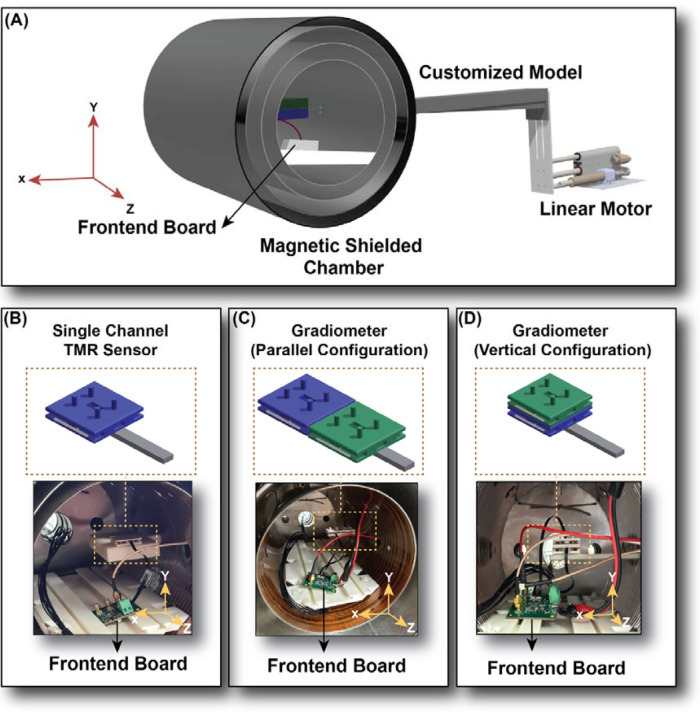
Motion artifacts can be a significant noise source in biomagnetic measurements when magnetic sensors are not separated from the signal source. In ambient environments, motion artifacts can be up to ten times stronger than the desired signals, varying with environmental conditions. This study evaluates the variability of these artifacts and the effectiveness of a gradiometer in reducing them in such settings. To achieve these objectives, we first measured the single channel output in varying magnetic field conditions to observe the effect of homogeneous and gradient background fields. Our analysis revealed that the variability in motion artifact within an ambient environment is primarily influenced by the gradient magnetic field rather than the homogeneous one. Subsequently, we configured a gradiometer in parallel and vertical alignment with the direction of vibration (X-axis). Our findings indicated that in a gradient background magnetic field ranging from 1 nT/mm to 10 nT/mm, the single-channel sensor output exhibited a change of 164.97 pT per mm unit increase, while the gradiometer output showed a change of only 0.75 pT/mm within the same range. Upon repositioning the gradiometer vertically (Y direction), perpendicular to the direction of vibration, the single-channel output slope increased to 196.85 pT, whereas the gradiometer output only increased by 1.06 pT/mm for the same range. Our findings highlight the influence of ambient environments on motion artifacts and demonstrate the potential of gradiometers to mitigate these effects. In the future, we plan to record biomagnetic signals both inside and outside the shielded room to compare the efficacy of different gradiometer designs under varying environmental conditions.
当磁传感器未与信号源分离时,运动伪影可能成为生物磁测量中的一个重要噪声源。在周围环境中,运动伪影可能比所需信号强十倍,且会随环境条件而变化。本研究评估了这些伪影的变异性以及梯度仪在此类环境中减少伪影的有效性。为实现这些目标,我们首先在不同磁场条件下测量了单通道输出,以观察均匀背景场和梯度背景场的影响。我们的分析表明,周围环境中运动伪影的变异性主要受梯度磁场而非均匀磁场的影响。随后,我们将梯度仪配置为与振动方向(X轴)平行和垂直对齐。我们的研究结果表明,在1 nT/mm至10 nT/mm的梯度背景磁场中,单通道传感器输出每增加1 mm单位变化164.97 pT,而梯度仪输出在相同范围内仅变化0.75 pT/mm。将梯度仪垂直重新定位(Y方向),即垂直于振动方向时,单通道输出斜率增加到196.85 pT,而梯度仪输出在相同范围内仅增加1.06 pT/mm。我们的研究结果突出了周围环境对运动伪影的影响,并证明了梯度仪减轻这些影响的潜力。未来,我们计划在屏蔽室内外记录生物磁信号,以比较不同梯度仪设计在不同环境条件下的效果。