Billot Anne, Jhingan Niharika, Varkanitsa Maria, Blank Idan, Ryskin Rachel, Kiran Swathi, Fedorenko Evelina
Department of Neurology, Massachusetts General Hospital & Harvard Medical School; Boston, MA 02114.
Center for Brain Science, Harvard University, Cambridge, MA 02138.
bioRxiv. 2024 Oct 24:2024.10.23.619954. doi: 10.1101/2024.10.23.619954.
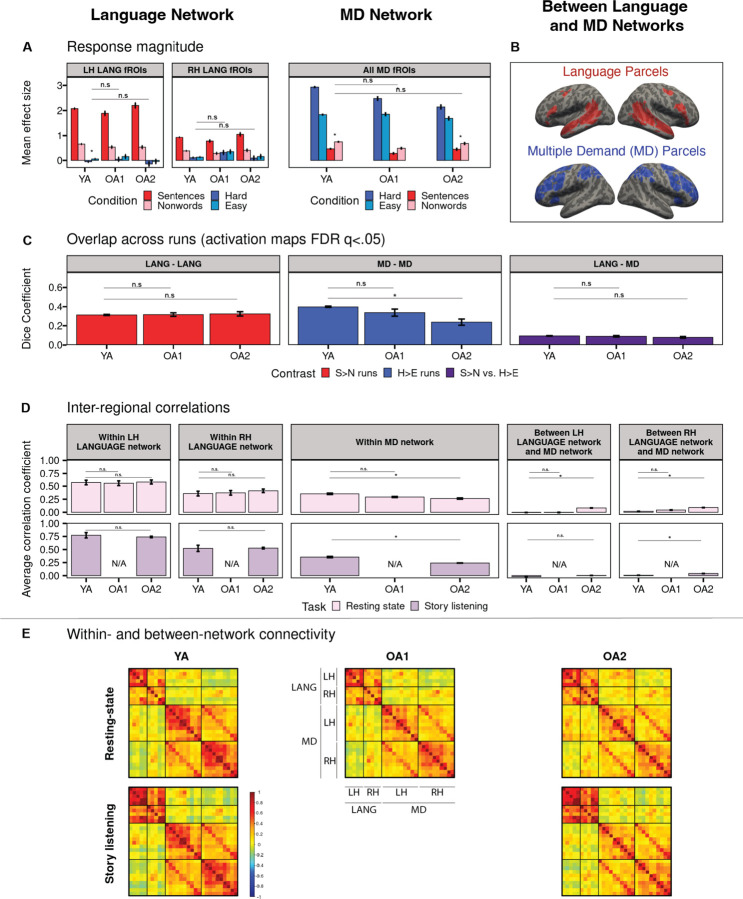
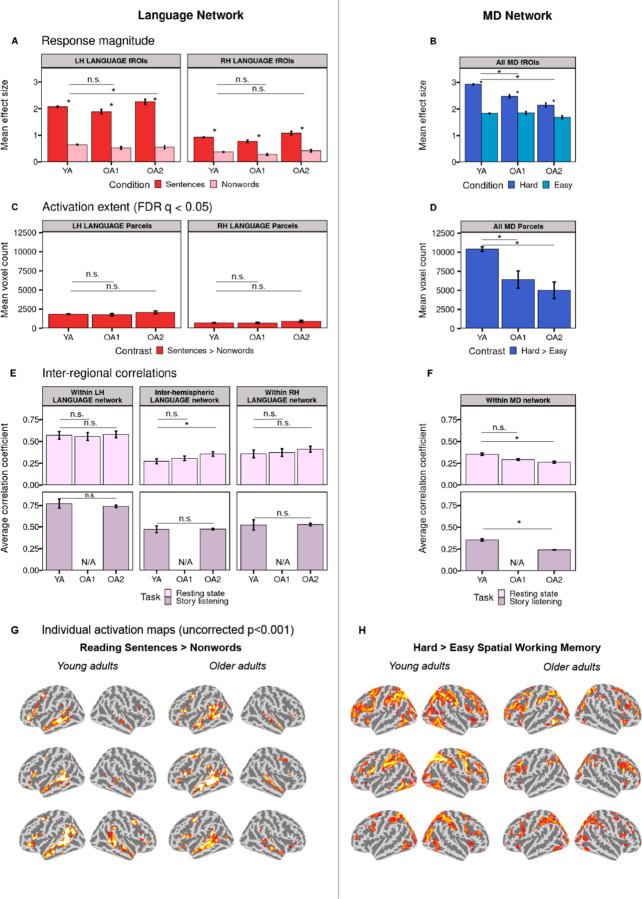
Healthy aging is associated with structural and functional brain changes. However, cognitive abilities differ from one another in how they change with age: whereas executive functions, like working memory, show age-related decline, aspects of linguistic processing remain relatively preserved (Hartshorne et al., 2015). This heterogeneity of the cognitive-behavioral landscape in aging predicts differences among brain networks in whether and how they should change with age. To evaluate this prediction, we used individual-subject fMRI analyses ('precision fMRI') to examine the language-selective network (Fedorenko et al., 2024) and the Multiple Demand (MD) network, which supports executive functions (Duncan et al., 2020), in older adults (n=77) relative to young controls (n=470). In line with past claims, relative to young adults, the MD network of older adults shows weaker and less spatially extensive activations during an executive function task and reduced within-network functional synchronization. However, in stark contrast to the MD network, we find remarkable preservation of the language network in older adults. Their language network responds to language as strongly and selectively as in younger adults, and is similarly lateralized and internally synchronized. In other words, the language network of older adults looks indistinguishable from that of younger adults. Our findings align with behavioral preservation of language skills in aging and suggest that some networks remain young-like, at least on standard measures of function and connectivity.
健康衰老与大脑结构和功能的变化有关。然而,认知能力随年龄变化的方式各不相同:执行功能,如工作记忆,会出现与年龄相关的衰退,而语言处理的某些方面则相对保持不变(哈茨霍恩等人,2015年)。衰老过程中认知行为格局的这种异质性预示着大脑网络在是否以及如何随年龄变化方面存在差异。为了评估这一预测,我们使用个体受试者功能磁共振成像分析(“精准功能磁共振成像”),在老年成年人(n = 77)相对于年轻对照组(n = 470)中,研究语言选择网络(费多连科等人,2024年)和支持执行功能的多重需求(MD)网络(邓肯等人,2020年)。与过去的说法一致,相对于年轻人,老年成年人的MD网络在执行功能任务期间表现出较弱且空间范围较小的激活,并且网络内功能同步性降低。然而,与MD网络形成鲜明对比的是,我们发现老年成年人的语言网络得到了显著保留。他们的语言网络对语言的反应与年轻人一样强烈且具有选择性,并且在大脑半球的分布和内部同步性方面也相似。换句话说,老年成年人的语言网络与年轻人的语言网络看起来没有区别。我们的研究结果与衰老过程中语言技能的行为保留情况相符,并表明至少在功能和连通性的标准测量方面,一些网络仍保持年轻状态。