Rankovic Sanela, Carr Kenneth D, Decarreau Justin, Skotheim Rebecca, Kibler Ryan D, Ols Sebastian, Lee Sangmin, Chun Jung-Ho, Tooley Marti R, Dauparas Justas, Eisenach Helen E, Glögl Matthias, Weidle Connor, Borst Andrew J, Baker David, King Neil P
Department of Biochemistry, University of Washington, Seattle, WA, USA.
Institute for Protein Design, University of Washington, Seattle, WA, USA.
bioRxiv. 2024 Dec 21:2024.10.18.619149. doi: 10.1101/2024.10.18.619149.
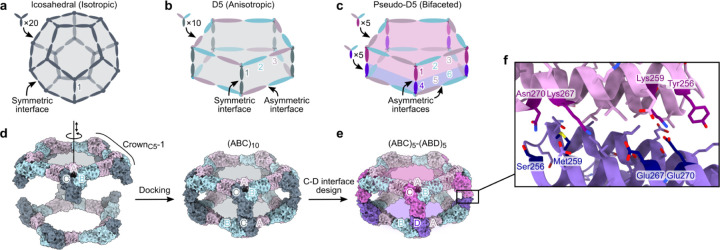
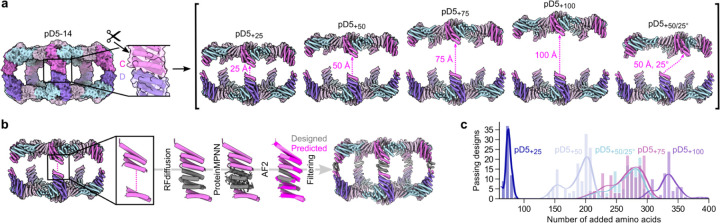
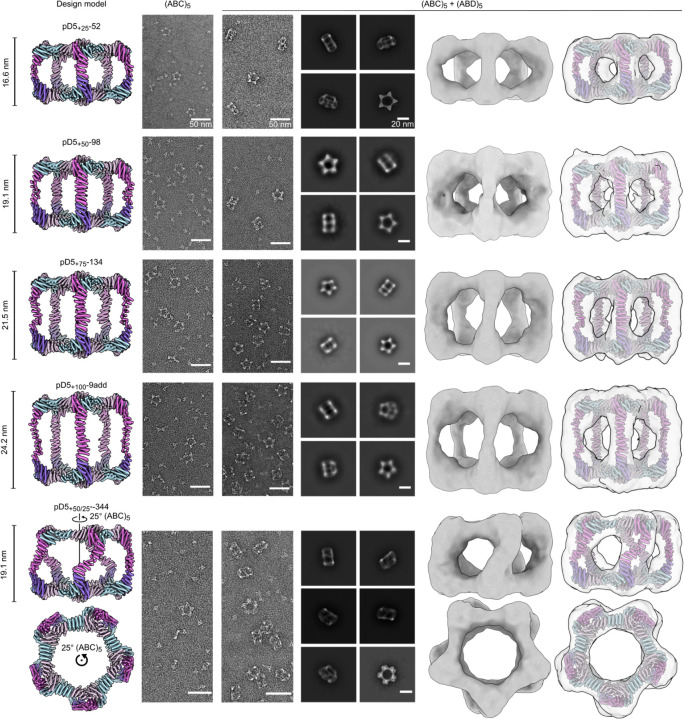
Recent advances in computational methods have led to considerable progress in the design of self-assembling protein nanoparticles. However, nearly all nanoparticles designed to date exhibit strict point group symmetry, with each subunit occupying an identical, symmetrically related environment. This limits the structural diversity that can be achieved and precludes anisotropic functionalization. Here, we describe a general computational strategy for designing multi-component bifaceted protein nanomaterials with two distinctly addressable sides. The method centers on docking pseudosymmetric heterooligomeric building blocks in architectures with dihedral symmetry and designing an asymmetric protein-protein interface between them. We used this approach to obtain an initial 30-subunit assembly with pseudo-D5 symmetry, and then generated an additional 15 variants in which we controllably altered the size and morphology of the bifaceted nanoparticles by designing extensions to one of the subunits. Functionalization of the two distinct faces of the nanoparticles with protein minibinders enabled specific colocalization of two populations of polystyrene microparticles coated with target protein receptors. The ability to accurately design anisotropic protein nanomaterials with precisely tunable structures and functions could be broadly useful in applications that require colocalizing two or more distinct target moieties.
计算方法的最新进展已在自组装蛋白质纳米颗粒的设计方面取得了显著进展。然而,几乎所有迄今为止设计的纳米颗粒都呈现出严格的点群对称性,每个亚基都占据相同的、对称相关的环境。这限制了能够实现的结构多样性,并排除了各向异性功能化。在此,我们描述了一种通用的计算策略,用于设计具有两个明显可寻址面的多组分双面蛋白质纳米材料。该方法的核心是将伪对称异源寡聚构建块对接至具有二面角对称性的结构中,并在它们之间设计一个不对称的蛋白质-蛋白质界面。我们使用这种方法获得了一个具有伪D5对称性的初始30亚基组装体,然后生成了另外15个变体,其中我们通过设计一个亚基的延伸部分来可控地改变双面纳米颗粒的大小和形态。用蛋白质微型结合剂对纳米颗粒的两个不同面进行功能化,使得涂有靶蛋白受体的两组聚苯乙烯微粒能够特异性共定位。精确设计具有精确可调结构和功能的各向异性蛋白质纳米材料的能力,在需要将两个或更多不同靶标部分共定位的应用中可能会有广泛的用途。