Infections and Immunoepidemiology Branch, Division of Cancer Epidemiology and Genetics, National Cancer Institute, Bethesda, Maryland, United States of America.
Division of Cancer Control and Population Sciences, National Cancer Institute, Rockville, Maryland, United States of America.
PLoS One. 2024 Nov 1;19(11):e0307746. doi: 10.1371/journal.pone.0307746. eCollection 2024.
Incidence of hepatocellular carcinoma (HCC) had been increasing steadily among older Americans but plateaued in 2015-2017. Chronic infection with hepatitis B virus (HBV) or hepatitis C virus (HCV) are important causes of HCC. The impact of improved treatments for these infections on recent trends in HCC incidence is unclear.
To examine the relationship between use of antiviral therapy for chronic viral hepatis and HCC incidence in older Americans.
We used 2007-2017 data from the Surveillance, Epidemiology, and End Results-Medicare database to estimate age-standardized incidence rates and average annual percent changes (AAPCs) for viral hepatitis-attributable HCC among individuals ≥66 years. We analyzed data from Medicare Part D to determine the frequency of HBV and HCV treatment utilization in this population.
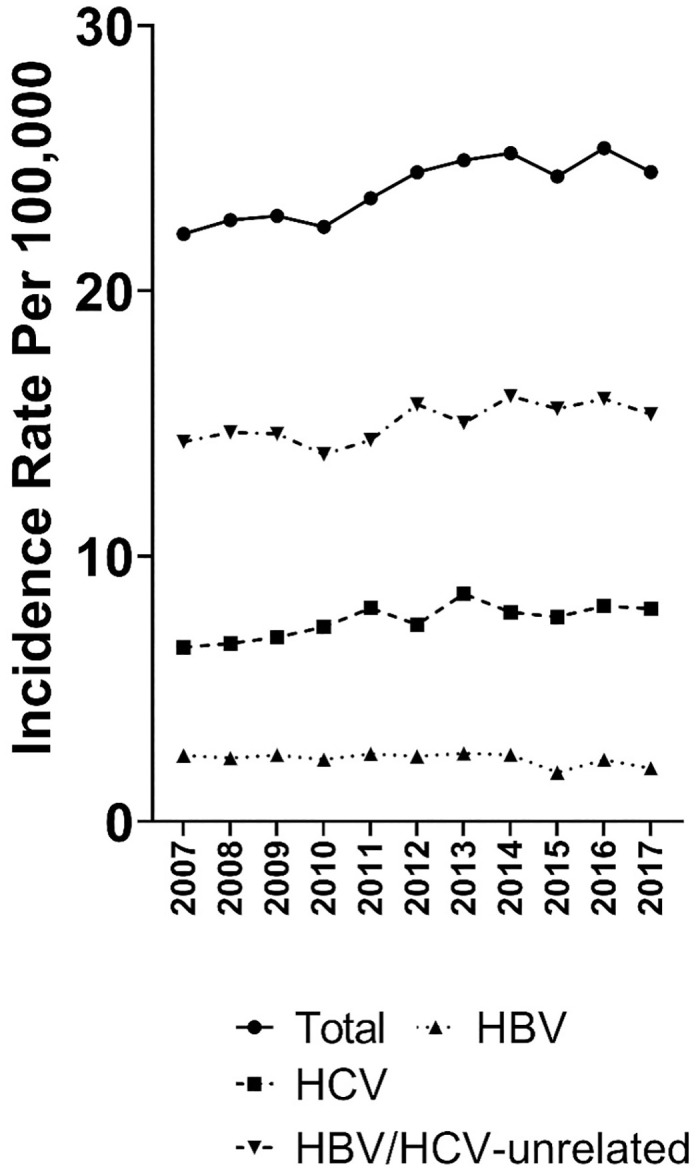
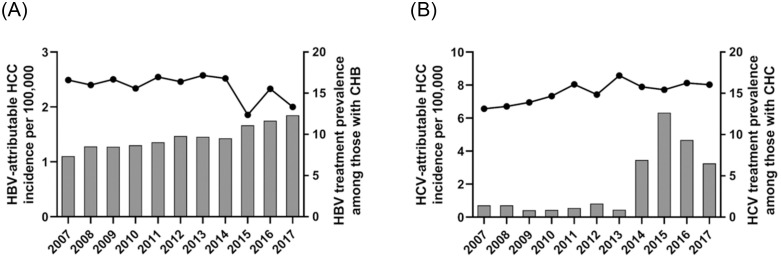
Overall HCC incidence increased 10.5%, from 22.2/100,000 in 2007 to 24.5/100,000 in 2017 (AAPC, 1.3%). During that time, HBV-attributable HCC rates decreased from 2.5 to 2.0/100,000 (AAPC, -1.6%), while HCV-attributable HCC rose from 6.6 to 8.0/100,000 (AAPC, 2.0%). HBV treatment among patients with HBV infection increased by 66% (2007, 7.4%; 2015, 12.3%). Treatment for HCV was stable at <2% during 2006-2013 but rose to 6.9% in 2014 and 12.7% in 2015, coinciding with the introduction of direct acting antiviral agents for HCV.
A decreased incidence of HBV-attributable HCC corresponded with an increased uptake in treatment for that infection. Despite a marked increase in the effectiveness and frequency of HCV treatment in 2014 and 2015, HCV-attributable HCC had not begun to fall as of 2017.
在美国老年人中,肝细胞癌(HCC)的发病率一直在稳步上升,但在 2015-2017 年达到了顶峰。慢性乙型肝炎病毒(HBV)或丙型肝炎病毒(HCV)感染是 HCC 的重要病因。这些感染的治疗方法的改进对 HCC 发病率的近期趋势的影响尚不清楚。
研究美国老年人中慢性病毒性肝炎抗病毒治疗与 HCC 发病率之间的关系。
我们使用了 2007-2017 年 Surveillance, Epidemiology, and End Results-Medicare 数据库的数据,以估计≥66 岁人群中与病毒性肝炎相关的 HCC 的年龄标准化发病率和平均年百分比变化(AAPC)。我们分析了 Medicare Part D 的数据,以确定该人群中 HBV 和 HCV 治疗的频率。
总体 HCC 发病率增加了 10.5%,从 2007 年的 22.2/100,000 增至 2017 年的 24.5/100,000(AAPC,1.3%)。在此期间,HBV 相关 HCC 发病率从 2.5 降至 2.0/100,000(AAPC,-1.6%),而 HCV 相关 HCC 从 6.6 升至 8.0/100,000(AAPC,2.0%)。HBV 感染患者的 HBV 治疗增加了 66%(2007 年为 7.4%;2015 年为 12.3%)。2006-2013 年期间,HCV 治疗稳定在<2%,但在 2014 年和 2015 年上升至 6.9%和 12.7%,这与直接作用抗病毒药物治疗 HCV 的引入同时发生。
HBV 相关 HCC 发病率的下降与该感染治疗率的上升相对应。尽管 2014 年和 2015 年 HCV 治疗的有效性和频率显著增加,但截至 2017 年,HCV 相关 HCC 尚未开始下降。