• 文献检索
  • 文档翻译
  • 深度研究
  • 学术资讯
  • Suppr Zotero 插件Zotero 插件
  • 邀请有礼
  • 套餐&价格
  • 历史记录
应用&插件
Suppr Zotero 插件Zotero 插件浏览器插件Mac 客户端Windows 客户端微信小程序
定价
高级版会员购买积分包购买API积分包
服务
文献检索文档翻译深度研究API 文档MCP 服务
关于我们
关于 Suppr公司介绍联系我们用户协议隐私条款
关注我们

Suppr 超能文献

核心技术专利:CN118964589B侵权必究
粤ICP备2023148730 号-1Suppr @ 2026

文献检索

告别复杂PubMed语法,用中文像聊天一样搜索,搜遍4000万医学文献。AI智能推荐,让科研检索更轻松。

立即免费搜索

文件翻译

保留排版,准确专业,支持PDF/Word/PPT等文件格式,支持 12+语言互译。

免费翻译文档

深度研究

AI帮你快速写综述,25分钟生成高质量综述,智能提取关键信息,辅助科研写作。

立即免费体验

在大多数种族群体中,肝细胞癌的发病率正在下降:SEER-22,2000-2019。

Decreasing incidence of hepatocellular carcinoma among most racial groups: SEER-22, 2000-2019.

机构信息

Infections and Immunoepidemiology Branch, Division of Cancer Epidemiology and Genetics, National Cancer Institute, Bethesda, Maryland, USA.

Division of Gastroenterology and Hepatology, Perelman School of Medicine at the University of Pennsylvania, Philadelphia, Pennsylvania, USA.

出版信息

Cancer Med. 2023 Oct;12(19):19960-19967. doi: 10.1002/cam4.6537. Epub 2023 Sep 30.

DOI:10.1002/cam4.6537
PMID:37776201
原文链接:https://pmc.ncbi.nlm.nih.gov/articles/PMC10587941/
Abstract

BACKGROUND

Hepatocellular carcinoma (HCC) incidence was rising in the United States. Previously, using data collected by the Surveillance, Epidemiology, and End Results (SEER) Program through 2017, we found that overall incidence had begun to decline, although not in Black and American Indian/Alaska Native (AI/AN) populations. Utilizing expanded SEER data encompassing ~50% of the population, we examined secular trends and demographic differences in HCC incidence through 2019.

METHODS

We included cases of HCC diagnosed in adults aged ≥20 years residing in SEER-22 registry areas. We examined case counts, incidence rates (per 100,000 person-years), annual percent changes (APCs), and calendar years when APCs changed significantly.

RESULTS

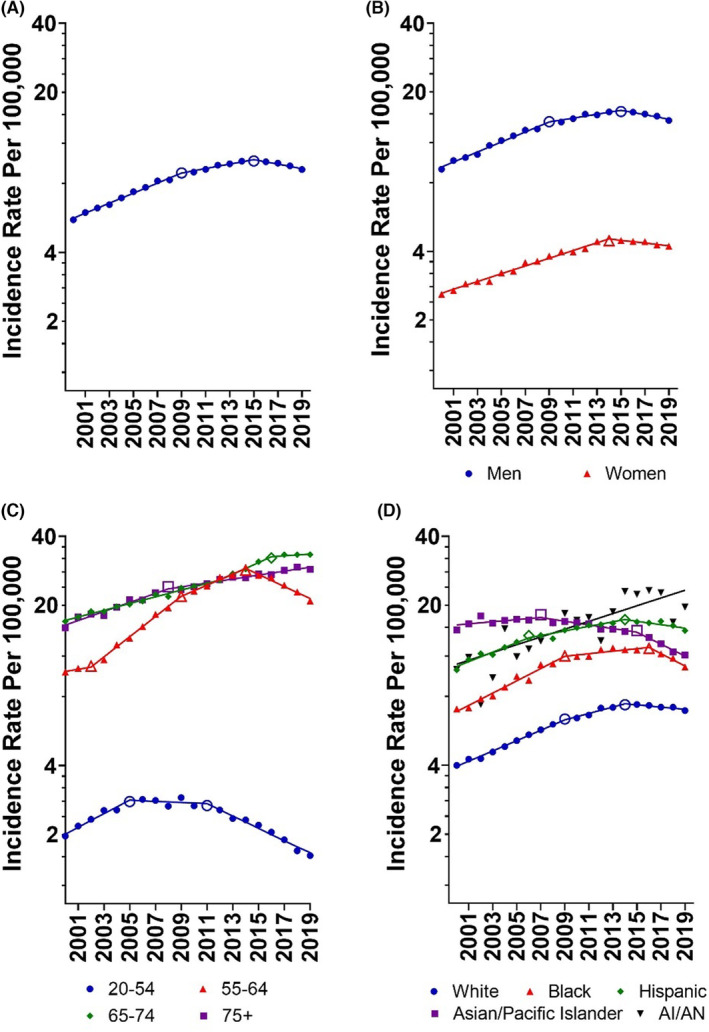
HCC incidence increased from 5.56 in 2000 to 8.89 in 2009 (APC, 5.17%), then rose more slowly during 2009-2015 (APC, 2.28%). After peaking at 10.03 in 2015, incidence fell to 9.20 in 2019 (APC, -2.26%). In Asian/Pacific Islanders (A/PI), the decline began in 2007 and accelerated in 2015 (APCs: 2007-2015, -1.84%; 2015-2019, -5.80%). In 2014, incidence began to fall in the White (APC: 2014-2019, -1.11%) and Hispanic populations (APC: 2014-2019, -1.72%). In 2016, rates began to fall in Black individuals (APC: 2016-2019, -6.05%). In the AI/AN population, incidence was highest in 2017, although the subsequent decline was not statistically significant. In 2019, population-specific rates were: White, 6.94; Black, 10.74; A/PI, 12.11; AI/AN, 14.56; Hispanic, 15.48.

CONCLUSION

HCC incidence is now decreasing in most US racial/ethnic populations, including among Black individuals. The onset of decline differed among racial/ethnic groups and wide disparities in HCC rates remain.

摘要

背景

在美国,肝细胞癌 (HCC) 的发病率一直在上升。此前,我们利用监测、流行病学和最终结果 (SEER) 计划在 2017 年之前收集的数据发现,总体发病率已经开始下降,尽管黑人和美洲印第安人/阿拉斯加原住民 (AI/AN) 人群的发病率没有下降。利用涵盖约 50%人口的扩展 SEER 数据,我们通过 2019 年检查了 HCC 发病率的长期趋势和人口统计学差异。

方法

我们纳入了年龄≥20 岁、居住在 SEER-22 登记地区的成年人中诊断为 HCC 的病例。我们检查了病例数、发病率(每 10 万人年)、年百分比变化 (APC),以及 APC 发生显著变化的日历年份。

结果

HCC 的发病率从 2000 年的 5.56 上升到 2009 年的 8.89(APC 为 5.17%),然后在 2009-2015 年期间缓慢上升(APC 为 2.28%)。在 2015 年达到 10.03 的峰值后,发病率在 2019 年下降到 9.20(APC 为-2.26%)。在亚洲/太平洋岛民 (A/PI) 中,下降始于 2007 年,并在 2015 年加速(APC:2007-2015 年,-1.84%;2015-2019 年,-5.80%)。2014 年,白人(APC:2014-2019 年,-1.11%)和西班牙裔(APC:2014-2019 年,-1.72%)人群的发病率开始下降。2016 年,黑人的发病率开始下降(APC:2016-2019 年,-6.05%)。在美洲原住民/阿拉斯加原住民人群中,发病率在 2017 年最高,尽管随后的下降没有统计学意义。2019 年,特定人群的发病率为:白人,6.94;黑人,10.74;亚洲/太平洋岛民,12.11;美洲原住民/阿拉斯加原住民,14.56;西班牙裔,15.48。

结论

现在,美国大多数种族/族裔人群的 HCC 发病率都在下降,包括黑人。下降的开始在不同种族/族裔群体之间有所不同,HCC 发病率仍存在巨大差距。
https://cdn.ncbi.nlm.nih.gov/pmc/blobs/13db/10587941/d18f2ef2bf02/CAM4-12-19960-g001.jpg

相似文献

1
Decreasing incidence of hepatocellular carcinoma among most racial groups: SEER-22, 2000-2019.在大多数种族群体中,肝细胞癌的发病率正在下降:SEER-22,2000-2019。
Cancer Med. 2023 Oct;12(19):19960-19967. doi: 10.1002/cam4.6537. Epub 2023 Sep 30.
2
Racial/ethnic disparities in hepatocellular carcinoma incidence and mortality rates in the United States, 1992-2018.美国 1992-2018 年肝细胞癌发病率和死亡率的种族/民族差异。
Hepatology. 2022 Sep;76(3):589-598. doi: 10.1002/hep.32394. Epub 2022 Apr 22.
3
Disparities in Hepatocellular Carcinoma Incidence, Stage, and Survival: A Large Population-Based Study.肝细胞癌发病率、分期和生存率的差异:一项大型基于人群的研究。
Cancer Epidemiol Biomarkers Prev. 2021 Jun;30(6):1193-1199. doi: 10.1158/1055-9965.EPI-20-1088. Epub 2021 Mar 18.
4
Trends in the Incidence of Early-Onset Colorectal Adenocarcinoma Among Black and White US Residents Aged 40 to 49 Years, 2000-2017.2000-2017 年美国 40-49 岁黑人和白人居民中早发性结直肠腺癌的发病率趋势。
JAMA Netw Open. 2021 Nov 1;4(11):e2130433. doi: 10.1001/jamanetworkopen.2021.30433.
5
Changing hepatocellular carcinoma incidence and liver cancer mortality rates in the United States.美国肝细胞癌发病率和肝癌死亡率的变化。
Am J Gastroenterol. 2014 Apr;109(4):542-53. doi: 10.1038/ajg.2014.11. Epub 2014 Feb 11.
6
Hepatocellular Carcinoma Incidence Is Decreasing Among Younger Adults in the United States.美国年轻人中肝细胞癌的发病率正在下降。
Clin Gastroenterol Hepatol. 2020 Jan;18(1):242-248.e5. doi: 10.1016/j.cgh.2019.04.043. Epub 2019 Apr 28.
7
Trends in hepatocellular carcinoma stage by racial/ethnic group in the United States, 1992-2019.1992 - 2019年美国不同种族/族裔群体肝细胞癌分期的趋势
JHEP Rep. 2023 Jul 29;5(11):100868. doi: 10.1016/j.jhepr.2023.100868. eCollection 2023 Nov.
8
State-Level HCC Incidence and Association With Obesity and Physical Activity in the United States.美国州级肝细胞癌发病率及其与肥胖和身体活动的关联
Hepatology. 2021 Sep;74(3):1384-1394. doi: 10.1002/hep.31811. Epub 2021 Jun 11.
9
Disparities in Hepatocellular Carcinoma Incidence in California: An Update.加利福尼亚州肝细胞癌发病率的差异:最新研究。
Cancer Epidemiol Biomarkers Prev. 2020 Jan;29(1):79-87. doi: 10.1158/1055-9965.EPI-19-0560. Epub 2019 Nov 12.
10
Hepatocellular carcinoma incidence, mortality, and survival trends in the United States from 1975 to 2005.1975年至2005年美国肝细胞癌的发病率、死亡率及生存趋势
J Clin Oncol. 2009 Mar 20;27(9):1485-91. doi: 10.1200/JCO.2008.20.7753. Epub 2009 Feb 17.

引用本文的文献

1
Trends in Incidence of Hepatocellular Carcinoma Between 2000 and 2020: A Surveillance, Epidemiology, and End Results (SEER)-Based Analysis.2000年至2020年间肝细胞癌发病率的趋势:一项基于监测、流行病学和最终结果(SEER)的分析。
Cureus. 2025 May 20;17(5):e84487. doi: 10.7759/cureus.84487. eCollection 2025 May.
2
Differences in Hepatocellular Carcinoma Incidence Trends Across US Census Divisions, 2001 to 2021.2001年至2021年美国人口普查分区肝细胞癌发病率趋势的差异
Cancers (Basel). 2025 Apr 24;17(9):1431. doi: 10.3390/cancers17091431.
3
Rural-Urban Disparities in Hepatocellular Carcinoma Deaths Are Driven by Hepatitis C-Related Hepatocellular Carcinoma.

本文引用的文献

1
Cancer statistics, 2023.癌症统计数据,2023 年。
CA Cancer J Clin. 2023 Jan;73(1):17-48. doi: 10.3322/caac.21763.
2
Vital Signs: Hepatitis C Treatment Among Insured Adults - United States, 2019-2020.生命体征:2019-2020 年美国参保成年人中的丙型肝炎治疗。
MMWR Morb Mortal Wkly Rep. 2022 Aug 12;71(32):1011-1017. doi: 10.15585/mmwr.mm7132e1.
3
Racial/ethnic disparities in hepatocellular carcinoma incidence and mortality rates in the United States, 1992-2018.美国 1992-2018 年肝细胞癌发病率和死亡率的种族/民族差异。
肝细胞癌死亡的城乡差异由丙型肝炎相关的肝细胞癌所致。
Am J Gastroenterol. 2025 Apr 11. doi: 10.14309/ajg.0000000000003487.
4
Racial disparities in cancer risk among MSM with HIV in the United States.美国感染艾滋病毒的男男性行为者在癌症风险方面的种族差异。
AIDS. 2025 May 1;39(6):728-736. doi: 10.1097/QAD.0000000000004125. Epub 2025 Apr 3.
5
Hepatocellular carcinoma national burden across different geographical regions in the United States between 2001 and 2020.2001年至2020年美国不同地理区域肝细胞癌的全国负担
World J Methodol. 2024 Dec 20;14(4):95598. doi: 10.5662/wjm.v14.i4.95598.
6
Trends in hepatocellular carcinoma and viral hepatitis treatment in older Americans.美国老年人肝细胞癌和病毒性肝炎治疗趋势。
PLoS One. 2024 Nov 1;19(11):e0307746. doi: 10.1371/journal.pone.0307746. eCollection 2024.
7
From past to pandemic: Health disparities in US hepatobiliary cancer mortality before and during COVID-19: Editorial on "Burden of mortality from hepatocellular carcinoma and biliary tract cancers by race and ethnicity and sex in US, 2018-2023".从过去到疫情:新冠疫情之前及期间美国肝胆癌死亡率的健康差异:关于“2018 - 2023年美国肝细胞癌和胆管癌按种族、族裔和性别划分的死亡率负担”的社论
Clin Mol Hepatol. 2025 Jan;31(1):286-289. doi: 10.3350/cmh.2024.0597. Epub 2024 Aug 5.
8
Burden of mortality from hepatocellular carcinoma and biliary tract cancers by race and ethnicity and sex in US, 2018-2023.2018-2023 年美国按种族、民族和性别划分的肝癌和胆道癌死亡率负担。
Clin Mol Hepatol. 2024 Oct;30(4):756-770. doi: 10.3350/cmh.2024.0318. Epub 2024 Jun 24.
Hepatology. 2022 Sep;76(3):589-598. doi: 10.1002/hep.32394. Epub 2022 Apr 22.
4
Declining disease burden of HCC in the United States, 1992-2017: A population-based analysis.1992-2017 年美国 HCC 疾病负担下降:基于人群的分析。
Hepatology. 2022 Sep;76(3):576-588. doi: 10.1002/hep.32355. Epub 2022 Feb 10.
5
Declining US Hepatocellular Carcinoma Rates, 2014-2017.2014-2017 年美国肝细胞癌发病率下降。
Clin Gastroenterol Hepatol. 2022 Feb;20(2):e330-e334. doi: 10.1016/j.cgh.2021.02.011. Epub 2021 Feb 4.
6
Recent Decline in Hepatocellular Carcinoma Rates in the United States.美国肝细胞癌发病率近期呈下降趋势。
Gastroenterology. 2020 Apr;158(5):1503-1505.e2. doi: 10.1053/j.gastro.2019.12.030. Epub 2020 Jan 19.
7
Hepatitis C Virus Infection in Indigenous Populations in the United States and Canada.美国和加拿大的土著人群中的丙型肝炎病毒感染。
Epidemiol Rev. 2019 Jan 31;41(1):158-167. doi: 10.1093/epirev/mxz015.
8
Prevalence of Viremic Hepatitis C Virus Infection by Age, Race/Ethnicity, and Birthplace and Disease Awareness Among Viremic Persons in the United States, 1999-2016.1999-2016 年美国不同年龄、种族/族裔、出生地的血源传播丙型肝炎病毒感染者流行率以及血源传播丙型肝炎病毒感染者的疾病知晓率。
J Infect Dis. 2020 Jan 14;221(3):408-418. doi: 10.1093/infdis/jiz479.
9
Chronic Hepatitis B Prevalence Among Foreign-Born and U.S.-Born Adults in the United States, 1999-2016.1999-2016 年美国出生和外国出生的成年人慢性乙型肝炎患病率。
Hepatology. 2020 Feb;71(2):431-443. doi: 10.1002/hep.30831. Epub 2019 Aug 13.
10
Incidence of hepatocellular carcinoma among older Americans attributable to hepatitis C and hepatitis B: 2001 through 2013.2001 年至 2013 年期间归因于丙型肝炎和乙型肝炎的美国老年人群中肝细胞癌的发病率。
Cancer. 2019 Aug 1;125(15):2621-2630. doi: 10.1002/cncr.32129. Epub 2019 Apr 12.