Guarneiri Liana L, Adams Caryn G, Garcia-Jackson Bibiana, Koecher Katie, Wilcox Meredith L, Maki Kevin C
Midwest Biomedical Research, Addison, IL, United States.
Bell Institute of Health and Nutrition, General Mills Inc, Minneapolis, MN, United States.
Adv Nutr. 2024 Dec;15(12):100332. doi: 10.1016/j.advnut.2024.100332. Epub 2024 Oct 31.
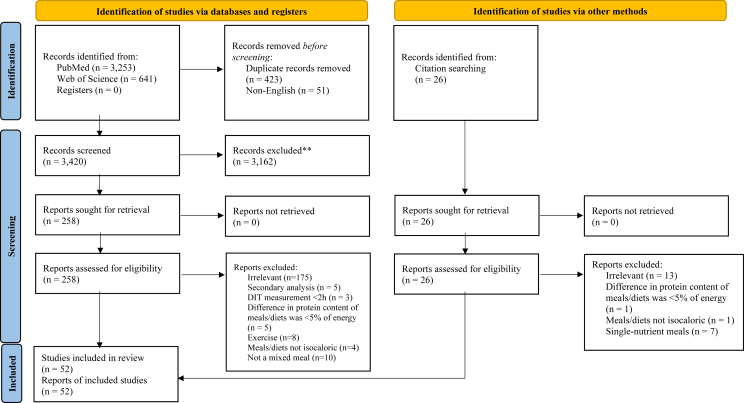
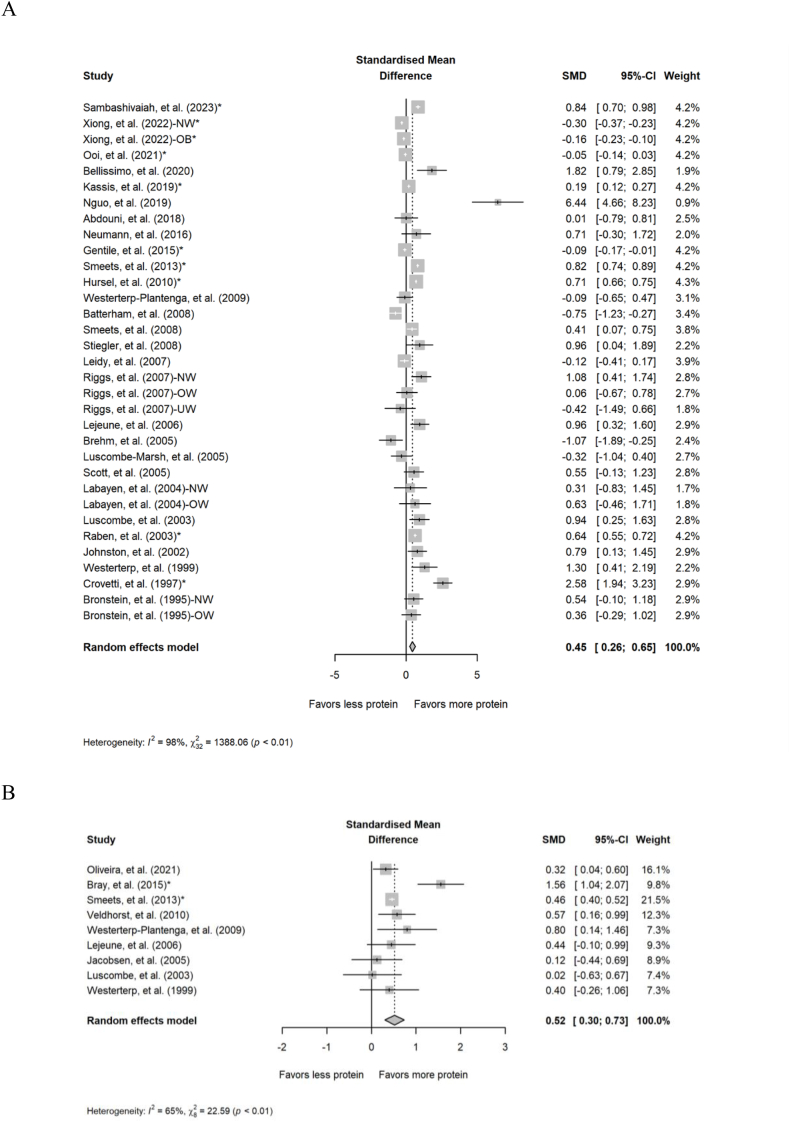
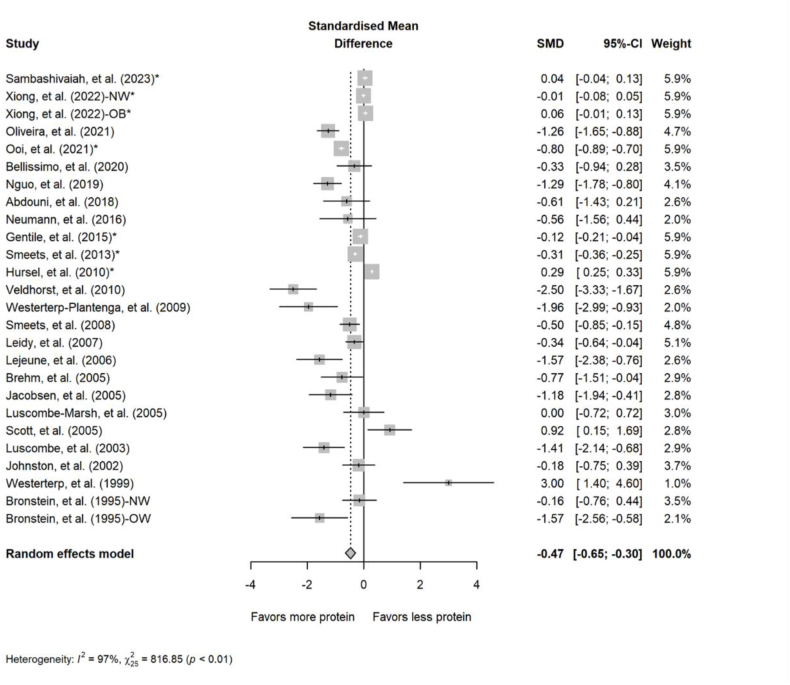
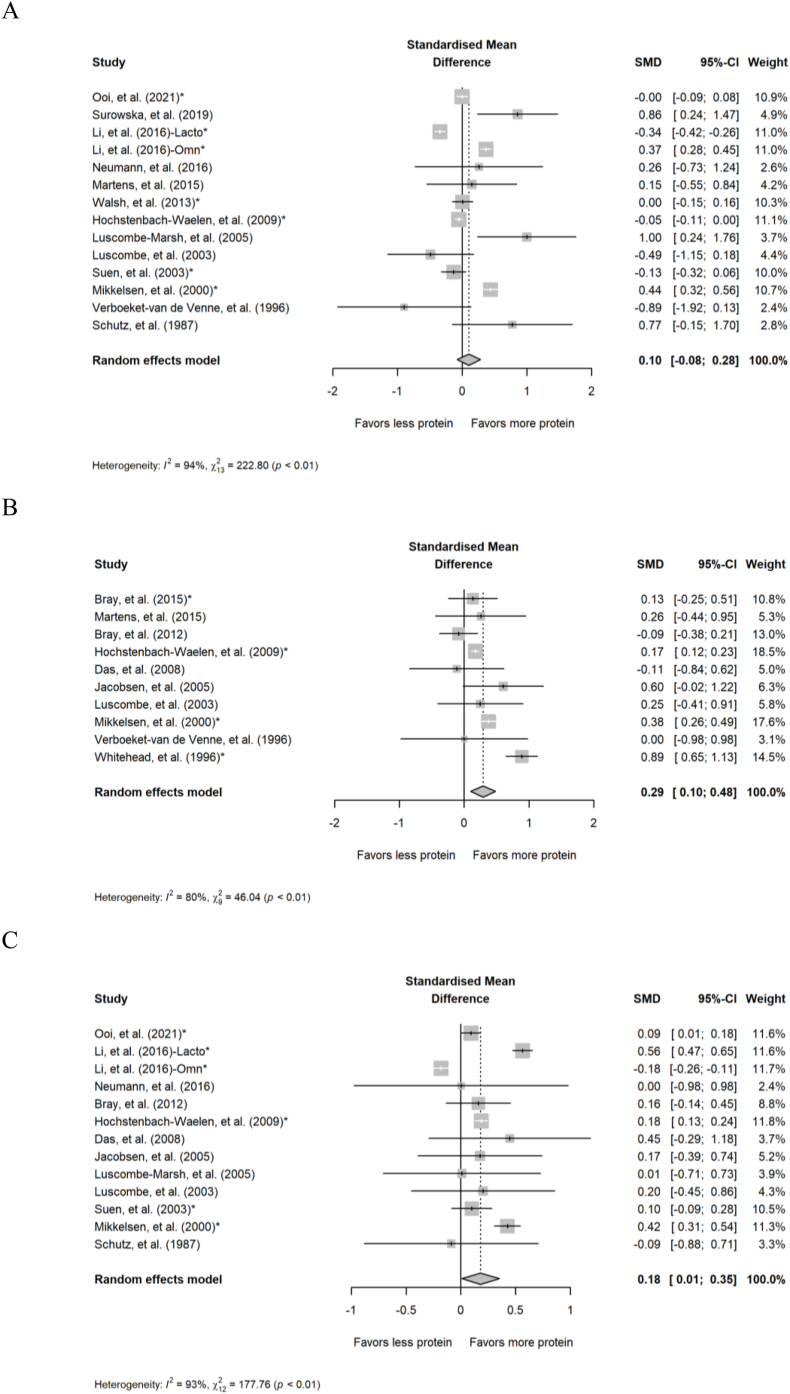
Protein is the most thermogenic macronutrient, but it is unclear how different amounts and types of protein impact diet-induced thermogenesis (DIT). The purpose of this meta-analysis was to compare the impact of isocaloric meals/diets containing different amounts or types of protein on energy metabolism. Databases were searched in June 2024 for studies that compare DIT or total daily energy expenditure (TDEE) in response to isocaloric acute meals or longer-term diets containing different amounts or types of protein. After identifying 3894 records, 52 studies were included. Standardized mean difference (SMD) estimates and 95% confidence intervals (CIs) were calculated for each outcome. In acute studies, intake of higher compared with lower-protein meals resulted in greater DIT (SMD: 0.45; 95% CI: 0.26, 0.65; P < 0.001) and TDEE (SMD: 0.52; 95% CI: 0.30, 0.73; P < 0.001). Notably, the subgroup analysis indicated that this effect on DIT was statistically significant for studies involving participants with normal weight but not overweight/obesity, although it is not clear if this finding was a true effect or because of study design characteristics. In chronic studies (ranging from 4 d to 1 y), intake of higher compared with lower-protein diets resulted in greater TDEE (SMD: 0.29; 95% CI: 0.10, 0.48; P = 0.003) and resting energy expenditure (SMD: 0.18; 95% CI: 0.01, 0.35; P = 0.039), but no differences in DIT (SMD: 0.10; 95% CI: -0.08, 0.28; P = 0.27). There was no evidence that different types of protein impacted energy metabolism. Higher protein meals/diets increase components of energy expenditure. This trial was registered at the International Prospective Register of Systematic Reviews (https://www.crd.york.ac.uk/prospero; PROSPERO 2023) as CRD42023389642.
蛋白质是产热效应最强的宏量营养素,但不同数量和类型的蛋白质如何影响饮食诱导的产热(DIT)尚不清楚。本荟萃分析的目的是比较含有不同数量或类型蛋白质的等热量餐食/饮食对能量代谢的影响。2024年6月检索了多个数据库,以查找比较DIT或每日总能量消耗(TDEE)对含有不同数量或类型蛋白质的等热量急性餐食或长期饮食反应的研究。在识别出3894条记录后,纳入了52项研究。为每个结果计算标准化平均差(SMD)估计值和95%置信区间(CI)。在急性研究中,与低蛋白餐相比,高蛋白餐的摄入导致更高的DIT(SMD:0.45;95%CI:0.26,0.65;P<0.001)和TDEE(SMD:0.52;95%CI:0.30,0.73;P<0.001)。值得注意的是,亚组分析表明,对于涉及正常体重而非超重/肥胖参与者的研究,这种对DIT的影响具有统计学意义,尽管尚不清楚这一发现是真实效应还是由于研究设计特征。在慢性研究(4天至1年)中,与低蛋白饮食相比,高蛋白饮食的摄入导致更高的TDEE(SMD:0.29;95%CI:0.10,0.48;P = 0.003)和静息能量消耗(SMD:0.18;95%CI:0.01,0.35;P = 0.039),但DIT无差异(SMD:0.10;95%CI:-0.08,0.28;P = 0.27)。没有证据表明不同类型的蛋白质会影响能量代谢。高蛋白餐食/饮食会增加能量消耗的组成部分。该试验已在国际系统评价前瞻性注册库(https://www.crd.york.ac.uk/prospero;PROSPERO 2023)注册,注册号为CRD42023389642。