Department of Physiotherapy, Medical College, University of Information Technology and Management in Rzeszow, Rzeszow, Poland.
College of Applied Informatics, University of Information Technology and Management in Rzeszow, Rzeszow, Poland.
Sci Rep. 2024 Nov 2;14(1):26404. doi: 10.1038/s41598-024-78253-1.
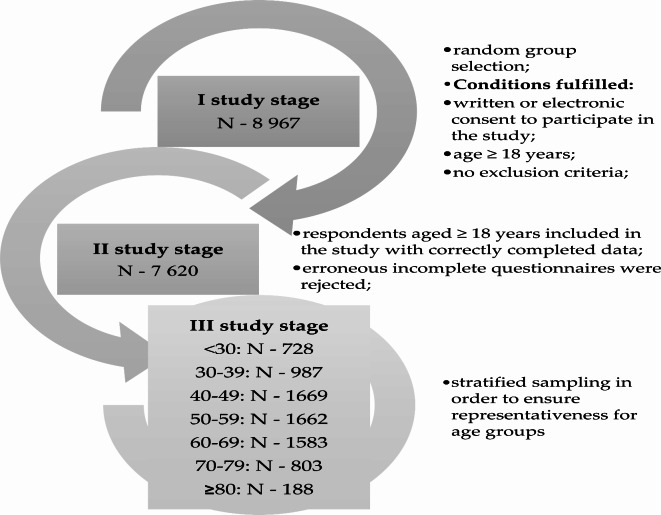
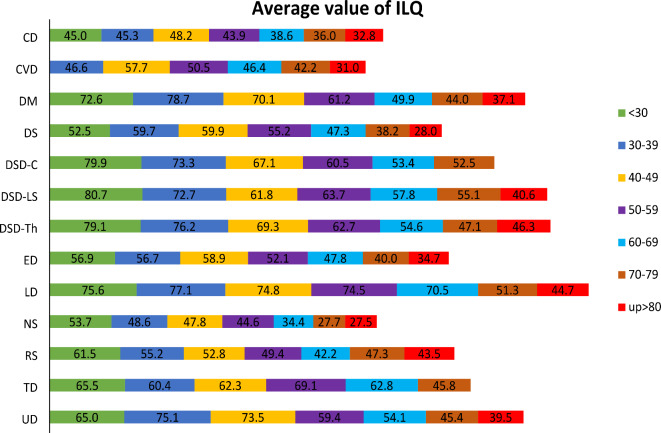
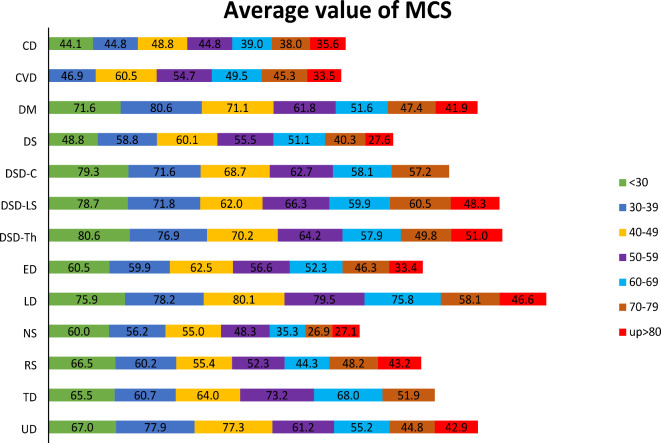
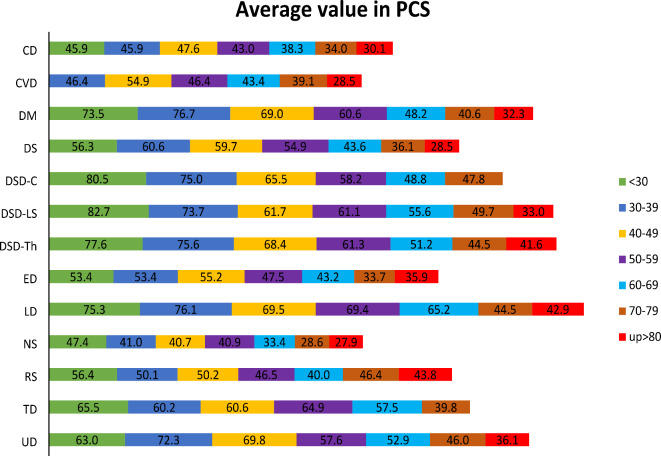
Background Age is a non-modifiable risk factor important in the etiology of many diseases. The ageing process of the body absolutely contributes to the degeneration of body tissues and the loss of function and the associated health-related quality of life (HR-QoL). Purpose Effect of age on HR-QoL among patients of 13 disease units. Matherial and methods The study was conducted among 7620 patients. The following age groups were included in the analysis: <30 years old, 30-39 years old, 40-49 years old, 50-59 years, 60-69 years, 70-79 years, and ≥ 80 years. The criterion for inclusion in the group was: age ≥ 18 years, written consent to participate in the study, treatment for chronic disease (at least 2 years), absence of other diseases and/or coexisting chronic symptoms. The SF-36 (Physical Component Summary (PCS); Mental Component Summary (MCS); Index of Life Quality (ILQ)) questionnaire was used to assess HR-QoL. Results The chance of having a better HR-QoL at 60-69 years of age decreases 3-fold (OR = 0.33) in MCS compared to the youngest group of patients. As far as PCS is concerned, there is a 5-fold lower chance of better HR-QoL (OR = 0.20). However, in the oldest group of patients, the chance of better HR-QoL in the MCS dimension is more than 12 times lower, and in PCS the chance of better HR-QoL is 33 times lower. A significant correlation between quality of life and age was confirmed. The level of PCS (R=-0.60), MCS (R=-0.50) and ILQ (R=-0.58) decreases with age. Cancer diseases (CD), regardless of the patient's age, showed the strongest association with HRQoL among the 13 analyzed disease entities. The average level of HRQoL was the lowest. A decreased level of HRQoL was noted in patients with cardiovascular disease (CVD) aged 30-39 years. The highest HR-QoL was noted in the group of patients aged 40-49 years for both CD and CVD, in later years HR-QoL decreased in patients with CD and CVD. The chance of better HR-QoL decreases with age. After the age of 60, the highest decrease in HR-QoL is observed in both MCS and PCS. In all age groups, there is more often a chance of better HR-QoL in the MCS dimension than in PCS.
年龄是许多疾病病因学中一个不可改变的风险因素。人体的衰老过程绝对导致身体组织的退化和功能丧失以及相关的健康相关生活质量(HR-QoL)。
探讨年龄对 13 个疾病单位患者 HR-QoL 的影响。
该研究纳入了 7620 名患者。将以下年龄组纳入分析:<30 岁、30-39 岁、40-49 岁、50-59 岁、60-69 岁、70-79 岁和≥80 岁。纳入标准为:年龄≥18 岁、书面同意参加研究、慢性疾病治疗(至少 2 年)、无其他疾病和/或并存的慢性症状。使用 SF-36(身体成分综合摘要(PCS);心理成分综合摘要(MCS);生活质量指数(ILQ))问卷评估 HR-QoL。
与最年轻的患者组相比,60-69 岁患者的 MCS 更好 HR-QoL 的可能性降低了 3 倍(OR=0.33)。就 PCS 而言,更好 HR-QoL 的可能性降低了 5 倍(OR=0.20)。然而,在最年长的患者组中,MCS 维度更好 HR-QoL 的可能性降低了 12 倍以上,PCS 维度更好 HR-QoL 的可能性降低了 33 倍。确认了生活质量与年龄之间的显著相关性。PCS(R=-0.60)、MCS(R=-0.50)和 ILQ(R=-0.58)的水平随年龄而降低。
癌症疾病(CD),无论患者年龄大小,在 13 种分析疾病实体中与 HRQoL 的关联最强。平均 HRQoL 水平最低。心血管疾病(CVD)30-39 岁患者 HRQoL 水平下降。CD 和 CVD 患者 40-49 岁年龄组 HR-QoL 最高,此后 CD 和 CVD 患者 HR-QoL 下降。更好 HR-QoL 的可能性随年龄增长而降低。60 岁后,MCS 和 PCS 的 HR-QoL 下降幅度最大。在所有年龄组中,MCS 维度的 HR-QoL 改善机会往往大于 PCS。
年龄对 HR-QoL 有显著影响。随着年龄的增长,更好的 HR-QoL 的可能性降低。60 岁后,MCS 和 PCS 的 HR-QoL 下降幅度最大。在所有年龄组中,MCS 维度的 HR-QoL 改善机会往往大于 PCS。