Department of General Surgery, Tianjin Jinghai District Hospital, Tianjin, China.
Department of Esophageal Cancer, Tianjin Medical University Cancer Institute and Hospital, Tianjin, China.
Sci Rep. 2024 Nov 2;14(1):26402. doi: 10.1038/s41598-024-78122-x.
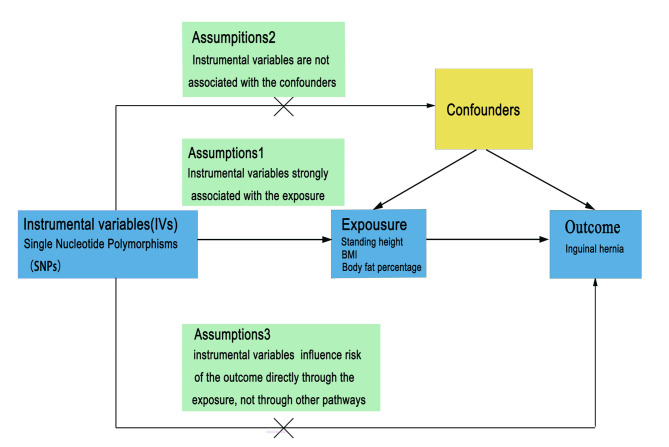
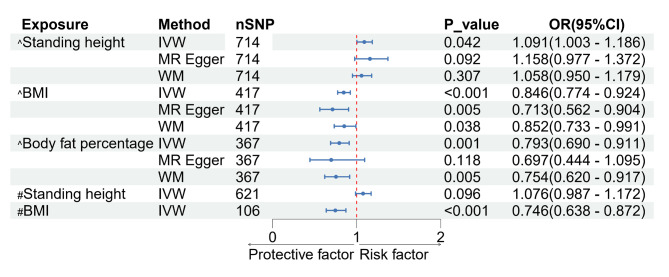
Observational studies have suggested links between standing height, BMI, body fat percentage, and inguinal hernia risk, but with inconsistent results. We conducted Mendelian randomization (MR) method to investigate their causal relationships. Independent SNPs associated with standing height, BMI, and body fat percentage were extracted from GWAS data as instrumental variables (IVs). Two-sample MR initially explored causal relationships between these factors and inguinal hernia risk. Multivariable Mendelian randomization (MVMR) assessed the direct causal effects of exposures on inguinal hernia. Positive findings from the MVMR analysis were independently validated. The inverse-variance weighted Methods (IVW), weighted median(WM), and MR-Egger were used for the MR estimates. Sensitivity analyses were used to examine the stability and reliability of the results. Two-sample MR analysis revealed a suggestive causal association between height and inguinal hernia (OR = 1.091, 95% CI = 1.003-1.186, P = 0.042). BMI (OR = 0.846, 95% CI = 0.774-0.924, P < 0.001) and body fat percentage (OR = 0.793, 95% CI = 0.690-0.911, P = 0.001) were significantly protective factors. After MVMR adjustment, BMI (OR = 0.746,95%CI = 0.638-0.872, P < 0.001) remained protective. Independent validation yielded consistent result. Genetically predicted BMI is a significant protective factor for inguinal hernia, providing valuable guidance for individualized prevention strategies.
观察性研究表明,身高、BMI(体重指数)、体脂百分比与腹股沟疝风险之间存在关联,但结果不一致。我们采用孟德尔随机化(MR)方法来探究它们之间的因果关系。从 GWAS 数据中提取与身高、BMI 和体脂百分比相关的独立 SNP 作为工具变量(IVs)。两样本 MR 最初探索了这些因素与腹股沟疝风险之间的因果关系。多变量孟德尔随机化(MVMR)评估了暴露因素对腹股沟疝的直接因果效应。MVMR 分析的阳性结果通过独立验证得到了验证。采用逆方差加权法(IVW)、加权中位数(WM)和 MR-Egger 进行 MR 估计。敏感性分析用于检验结果的稳定性和可靠性。两样本 MR 分析表明,身高与腹股沟疝之间存在提示性因果关联(OR=1.091,95%CI=1.003-1.186,P=0.042)。BMI(OR=0.846,95%CI=0.774-0.924,P<0.001)和体脂百分比(OR=0.793,95%CI=0.690-0.911,P=0.001)是显著的保护因素。经过 MVMR 调整后,BMI(OR=0.746,95%CI=0.638-0.872,P<0.001)仍然具有保护作用。独立验证得出了一致的结果。遗传预测 BMI 是腹股沟疝的显著保护因素,为个体化预防策略提供了有价值的指导。