Burgess Stephen, Bowden Jack, Fall Tove, Ingelsson Erik, Thompson Simon G
From the aCardiovascular Epidemiology Unit, Department of Public Health and Primary Care, University of Cambridge, Cambridge, United Kingdom; bMedical Research Council Integrative Epidemiology Unit, School of Social and Community Medicine, University of Bristol, Bristol, United Kingdom; and cDepartment of Medical Sciences, Molecular Epidemiology, Uppsala University, Uppsala, Sweden.
Epidemiology. 2017 Jan;28(1):30-42. doi: 10.1097/EDE.0000000000000559.
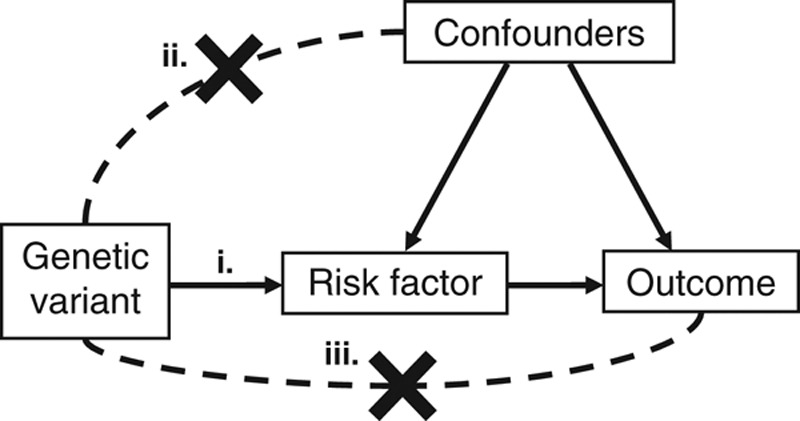
Mendelian randomization investigations are becoming more powerful and simpler to perform, due to the increasing size and coverage of genome-wide association studies and the increasing availability of summarized data on genetic associations with risk factors and disease outcomes. However, when using multiple genetic variants from different gene regions in a Mendelian randomization analysis, it is highly implausible that all the genetic variants satisfy the instrumental variable assumptions. This means that a simple instrumental variable analysis alone should not be relied on to give a causal conclusion. In this article, we discuss a range of sensitivity analyses that will either support or question the validity of causal inference from a Mendelian randomization analysis with multiple genetic variants. We focus on sensitivity analyses of greatest practical relevance for ensuring robust causal inferences, and those that can be undertaken using summarized data. Aside from cases in which the justification of the instrumental variable assumptions is supported by strong biological understanding, a Mendelian randomization analysis in which no assessment of the robustness of the findings to violations of the instrumental variable assumptions has been made should be viewed as speculative and incomplete. In particular, Mendelian randomization investigations with large numbers of genetic variants without such sensitivity analyses should be treated with skepticism.
由于全基因组关联研究的规模和覆盖范围不断扩大,以及与风险因素和疾病结局的遗传关联汇总数据的可得性不断提高,孟德尔随机化研究正变得更加强大且易于实施。然而,在孟德尔随机化分析中使用来自不同基因区域的多个遗传变异时,所有遗传变异都满足工具变量假设的可能性极小。这意味着不能仅仅依靠简单的工具变量分析来得出因果结论。在本文中,我们讨论了一系列敏感性分析,这些分析将支持或质疑基于多个遗传变异的孟德尔随机化分析得出的因果推断的有效性。我们重点关注对确保稳健因果推断最具实际相关性的敏感性分析,以及那些可以使用汇总数据进行的分析。除了工具变量假设的合理性得到强有力的生物学理解支持的情况外,未对研究结果对工具变量假设违背的稳健性进行评估的孟德尔随机化分析应被视为推测性的和不完整的。特别是,没有进行此类敏感性分析的大量遗传变异的孟德尔随机化研究应受到质疑。