Flinders Health and Medical Research Institute, College of Medicine and Public Health, Flinders University, Adelaide, South Australia.
School of Public Health, College of Medicine and Health Sciences, Arba Minch University, Arba Minch, Ethiopia.
Sci Rep. 2024 Nov 3;14(1):26519. doi: 10.1038/s41598-024-77728-5.
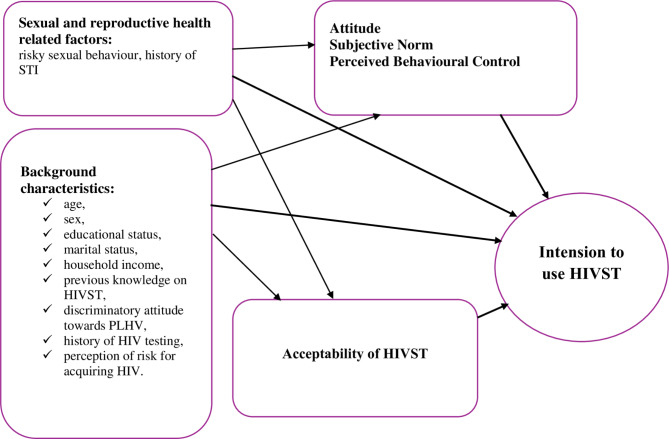
In sub-Saharan Africa, young people are at high risk of HIV infection, representing nearly 4 out of 5 new infections. HIV self-testing (HIVST), a new and proactive testing scheme that involves self-collection of a specimen and interpretation of results, is deemed potentially helpful for increasing testing amongst population groups like young people who do not frequently use routine testing services. This study assessed young people's intention to use HIVST in urban areas of southern Ethiopia drawing on the Theory of Planned Behaviour. A community-based cross-sectional study was conducted with 634 participants aged 15-24 years from six town administrations of two zones in January to February 2023. The participation rate was 634/636 yielding 99.7%. The OraQuick HIVST kit was demonstrated to young people recruited in a door-to-door survey with a face-to-face interview using an electronic questionnaire in a mobile phone-based application. Intention to use HIVST was measured from a 6-point Likert scale with scores of agreements ranging from 1 to 6. Descriptive statistics and ordinal logistic regression analysis were done using STATA version 18. Most of the participants agreed that they would use HIVST if it was available (86.3% agreeing or strongly agreeing). Interestingly, young people who perceived themselves at some to high risk were 0.51 times less likely to be in the higher order of intention to use when HIVST is available to them than those who perceived themselves at no to low risk. Intention to use HIVST increased by a factor of 1.29, 1.84 and 2.35 for every one-unit increase on the mean favourable attitude, perceived behavioural control, and acceptability scores, respectively. The majority of young people intended to use HIVST. Young people's perceived behavioural control, and acceptability of HIVST affected their intention to use. Intention and subsequent use of HIVST can be enhanced through an understanding of the role of risk perception and positive attitude, confidence to perform and acceptance of the test. Implementation studies are required to examine the actual uptake of HIVST among young people.
在撒哈拉以南非洲,年轻人感染艾滋病毒的风险很高,几乎占新感染人数的 4/5。HIV 自我检测(HIVST)是一种新的、主动的检测方案,涉及自行采集样本和解释结果,被认为对于增加年轻人等不经常使用常规检测服务的人群的检测可能有帮助。本研究基于计划行为理论,评估了埃塞俄比亚南部城市地区年轻人使用 HIVST 的意愿。这是一项基于社区的横断面研究,2023 年 1 月至 2 月期间,从两个地区的六个城镇行政区域招募了 634 名 15-24 岁的参与者。参与率为 634/636,达到 99.7%。OraQuick HIVST 试剂盒在通过挨家挨户调查招募的年轻人中进行了演示,使用基于移动电话应用程序的电子问卷进行面对面访谈。使用 6 点李克特量表测量使用 HIVST 的意愿,同意程度从 1 到 6 不等。使用 STATA 版本 18 进行描述性统计和有序逻辑回归分析。大多数参与者表示,如果 HIVST 可用,他们会使用(86.3%表示同意或强烈同意)。有趣的是,与那些认为自己没有到低风险的人相比,那些认为自己处于某种高风险的人在 HIVST 可用时,他们使用 HIVST 的意愿处于较高顺序的可能性低 0.51 倍。每增加一个单位的有利态度、感知行为控制和可接受性得分,使用 HIVST 的意愿就会分别增加 1.29、1.84 和 2.35 倍。大多数年轻人打算使用 HIVST。年轻人对 HIVST 的感知行为控制和可接受性影响了他们的使用意愿。通过了解风险感知和积极态度、执行信心和对测试的接受程度,可以增强对 HIVST 的意愿和随后的使用。需要实施研究来检验年轻人实际接受 HIVST 的情况。