
在马拉维的产前护理中,向伴侣发放有无经济激励措施的艾滋病毒自检试剂盒,并向艾滋病毒感染的索引患者发放:一项三臂、整群随机对照试验。
Partner-delivered HIV self-test kits with and without financial incentives in antenatal care and index patients with HIV in Malawi: a three-arm, cluster-randomised controlled trial.
作者信息
Choko Augustine T, Fielding Katherine, Johnson Cheryl C, Kumwenda Moses K, Chilongosi Richard, Baggaley Rachel C, Nyirenda Rose, Sande Linda A, Desmond Nicola, Hatzold Karin, Neuman Melissa, Corbett Elizabeth L
机构信息
TB-HIV Group, Malawi-Liverpool-Wellcome Clinical Research Programme, Chichiri, Blantyre, Malawi.
Department of Infectious Disease Epidemiology and MRC Tropical Epidemiology Group, London School of Hygiene & Tropical Medicine, London, UK.
出版信息
Lancet Glob Health. 2021 Jul;9(7):e977-e988. doi: 10.1016/S2214-109X(21)00175-3.
BACKGROUND
Secondary distribution of HIV self-testing (HIVST) kits by patients attending clinic services to their partners could improve the rate of HIV diagnosis. We aimed to investigate whether secondary administration of HIVST kits, with or without an additional financial incentive, via women receiving antenatal care (ANC) or via people newly diagnosed with HIV (ie, index patients) could improve the proportion of male partners tested or the number of people newly diagnosed with HIV.
METHODS
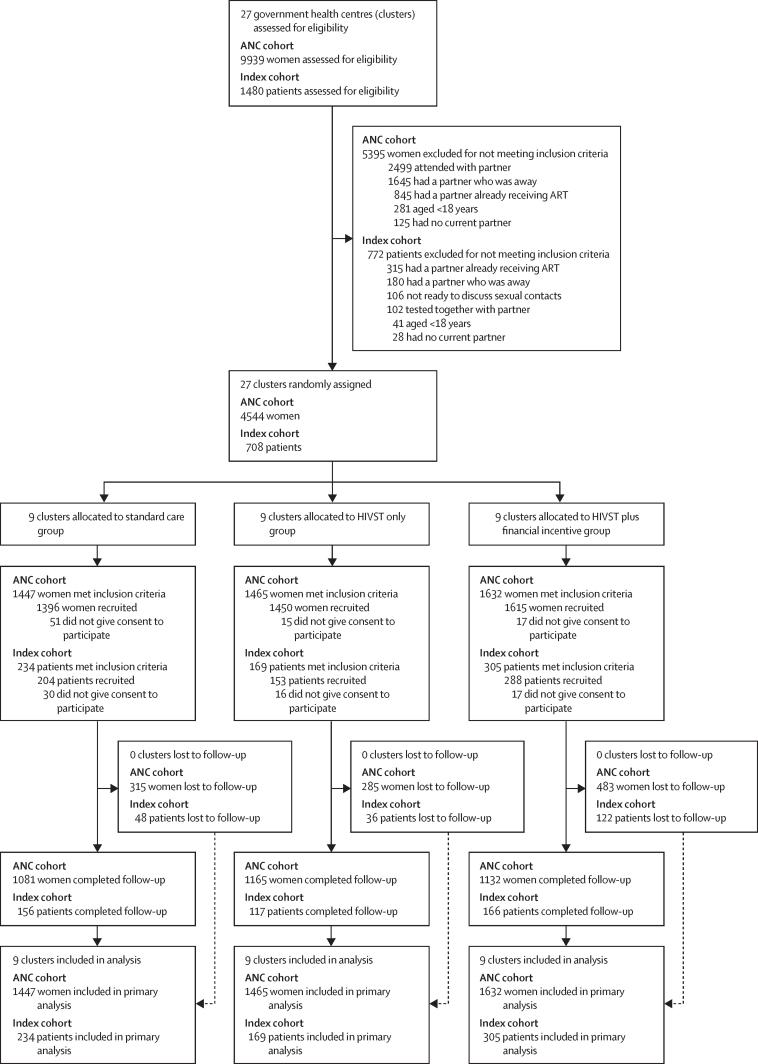
We did a three-arm, open-label, pragmatic, cluster-randomised trial of 27 health centres (clusters), eligible if they were a government primary health centre providing ANC, HIV testing, and ART services, across four districts of Malawi. We recruited women (aged ≥18 years) attending their first ANC visit and whose male partner was available, not already taking ART, and not already tested for HIV during this pregnancy (ANC cohort), and people (aged ≥18 years) with newly diagnosed HIV during routine clinic HIV testing who had at least one sexual contact not already known to be HIV-positive (index cohort). Centres were randomly assigned (1:1:1), using a public selection of computer-generated random allocations, to enhanced standard of care (including an invitation for partners to attend HIV testing services), HIVST only, or HIVST plus a US$10 financial incentive for retesting. The primary outcome for the ANC cohort was the proportion of male partners reportedly tested, as ascertained by interview with women in this cohort at day 28. The primary outcome for the index cohort was the geometric mean number of new HIV-positive people identified per facility within 28 days of enrolment, as measured by observed HIV test results. Cluster-level summaries compared intervention with standard of care by intention to treat. This trial is registered with ClinicalTrials.gov, NCT03705611.
FINDINGS
Between Sept 8, 2018, and May 2, 2019, nine clusters were assigned to each trial arm, resulting in 4544 eligible women in the ANC cohort (1447 [31·8%] in the standard care group, 1465 [32·2%] in the HIVST only group, and 1632 [35·9%] in HIVST plus financial incentive group) and 708 eligible patients in the index cohort (234 [33·1%] in the standard care group, 169 [23·9%] in the HIVST only group, and 305 [42·9%] in the HIVST plus financial incentive group). 4461 (98·2%) of 4544 eligible women in the ANC cohort and 645 (91·1%) of 708 eligible patients in the index cohort were recruited, of whom 3378 (75·7%) in the ANC cohort and 439 (68·1%) in the index cohort were interviewed after 28 days. In the ANC cohort, the mean proportion of reported partner testing per cluster was 35·0% (SD 10·0) in the standard care group, 73·0% in HIVST only group (13·1, adjusted risk ratio [RR] 1·71, 95% CI 1·48-1·98; p<0·0001), and 65·2% in the HIVST plus financial incentive group (11·6, adjusted RR 1·62, 1·45-1·81; p<0·0001). In the index cohort, the geometric mean number of new HIV-positive sexual partners per cluster was 1·35 (SD 1·62) for the standard care group, 1·91 (1·78) for the HIVST only group (incidence rate ratio adjusted for number eligible as an offset in the negative binomial model 1·65, 95% CI 0·49-5·55; p=0·3370), and 3·20 (3·81) for the HIVST plus financial incentive group (3·11, 0·99-9·77; p=0·0440). Four self-resolving, temporary marital separations occurred due to disagreement in couples regarding HIV self-test kits.
INTERPRETATION
Although administration of HIVST kits in the ANC cohort, even when offered alongside a financial incentive, did not identify significantly more male patients with HIV than did standard care, out-of-clinic options for HIV testing appear more acceptable to many male partners of women with HIV, increasing test uptake. Viewed in the current context, this approach might allow continuation of services despite COVID-19-related lockdowns.
FUNDING
Unitaid, through the Self-Testing Africa Initiative.
背景
接受门诊服务的患者将艾滋病毒自检(HIVST)试剂盒二次分发给其伴侣,可能会提高艾滋病毒诊断率。我们旨在调查通过接受产前护理(ANC)的女性或新诊断出艾滋病毒的人(即索引患者)二次发放HIVST试剂盒,无论是否给予额外经济激励,是否能提高男性伴侣的检测比例或新诊断出艾滋病毒的人数。
方法
我们在马拉维四个地区的27个卫生中心(群组)进行了一项三臂、开放标签、务实、整群随机试验,这些卫生中心需为提供ANC、艾滋病毒检测和抗逆转录病毒治疗服务的政府初级卫生中心。我们招募了首次接受ANC检查且男性伴侣在场、未接受抗逆转录病毒治疗且在本次妊娠期间未进行过艾滋病毒检测的女性(ANC队列),以及在常规门诊艾滋病毒检测中新诊断出艾滋病毒且至少有一名未知艾滋病毒阳性性接触者的人(索引队列)。中心通过公开选择计算机生成的随机分配方案随机分配(1:1:1)至强化标准护理组(包括邀请伴侣参加艾滋病毒检测服务)、仅HIVST组或HIVST加10美元复测经济激励组。ANC队列的主要结局是据报告接受检测的男性伴侣比例,通过在第28天对该队列中的女性进行访谈确定。索引队列的主要结局是在入组后28天内每个机构识别出的新艾滋病毒阳性者的几何平均数,通过观察到的艾滋病毒检测结果衡量。整群水平的汇总分析按意向性分析比较干预措施与标准护理。该试验已在ClinicalTrials.gov注册,注册号为NCT03705611。
结果
2018年9月8日至2019年5月2日期间,每个试验组分配了9个群组,ANC队列中有4544名符合条件的女性(标准护理组1447名[31.8%],仅HIVST组1465名[32.2%],HIVST加经济激励组1632名[35.9%]),索引队列中有708名符合条件的患者(标准护理组234名[33.1%],仅HIVST组169名[23.9%],HIVST加经济激励组305名[42.9%])。ANC队列中4544名符合条件的女性中有4461名(98.2%)、索引队列中708名符合条件的患者中有645名(91.1%)被招募,其中ANC队列中有3378名(75.7%)、索引队列中有439名(68.1%)在28天后接受了访谈。在ANC队列中,标准护理组每个群组报告的伴侣检测平均比例为35.0%(标准差10.0),仅HIVST组为73.0%(13.1,调整风险比[RR]1.71,95%置信区间1.48 - 1.98;p<0.0001),HIVST加经济激励组为65.2%(11.6,调整RR 1.62,1.45 - 1.81;p<0.0001)。在索引队列中,标准护理组每个群组新的艾滋病毒阳性性伴侣的几何平均数为1.35(标准差1.62),仅HIVST组为1.91(1.78)(在负二项模型中调整为合格人数作为偏移的发病率比1.65,95%置信区间0.49 - 5.55;p = 0.3370),HIVST加经济激励组为3.20(3.81)(3.11,0.99 - 9.77;p = 0.0440)。因夫妻双方对艾滋病毒自检试剂盒存在分歧,发生了4次自行解决的临时婚姻分居。
解读
尽管在ANC队列中发放HIVST试剂盒,即使同时给予经济激励,与标准护理相比,并未显著识别出更多艾滋病毒阳性男性患者,但门诊外的艾滋病毒检测选项似乎更易被许多感染艾滋病毒女性的男性伴侣接受,从而提高了检测接受度。在当前背景下,这种方法可能使服务尽管因COVID - 19相关封锁而仍能继续。
资金来源
联合国国际药品采购机制,通过非洲自检倡议。
 Zotero 插件