Robinson Amelia, Kelsey Amanda, McDouall Sara, Higham Helen
Nuffield Department of Anaesthesia, Oxford University Hospitals NHS Foundation Trust, Oxford, UK.
School of Healthcare, University of Leeds, Leeds, UK.
Anaesthesia. 2025 Jan;80(1):59-73. doi: 10.1111/anae.16462. Epub 2024 Nov 3.
Anaesthetic training has always had patient safety as part of the curriculum. However, there is limited emphasis on what happens when things do not go to plan. Our aims were to understand the impact of involvement in patient safety incidents on anaesthetic trainees in our region, to describe the range of support currently offered and put forward suggestions for improvement.
An initial electronic survey was sent to all anaesthetic trainees in a single UK healthcare region to capture qualitative and quantitative information on patient safety incidents. After completing the questionnaire, participants were asked to consent to involvement in a semi-structured interview to provide a more detailed understanding of the impact of safety incidents. Data were analysed from the questionnaires and interview transcripts using descriptive statistics and thematic analysis.
Thirty-four completed questionnaires were analysed revealing 27 trainees had been involved in a patient safety incident. Ten semi-structured interviews were conducted and six themes were identified: team dynamics (including adequacy of staffing and supportive departmental culture); context of the event; reflex immediate support post-event; working environment pending completion of the investigation; personal impact (including physical and mental health); and suggestions for future support.
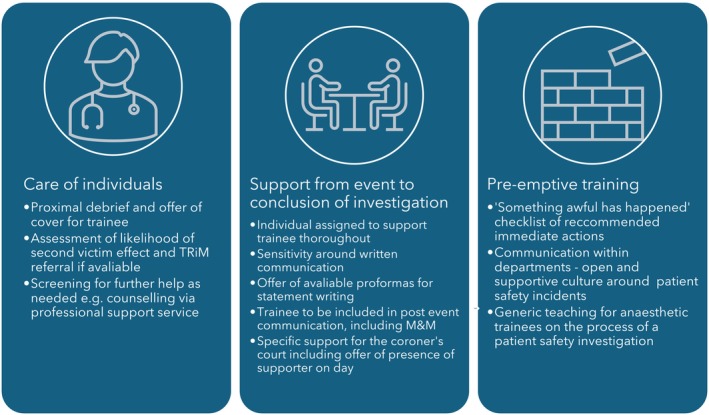
This study has shown the significant impact of safety incidents on anaesthetic trainees in one training region in the UK and highlights the importance of implementing early, tailored debriefs led by trained facilitators, the value of a supportive work environment and the need to raise awareness of system-based approaches to learning from incident investigations. Further research should guide the format and delivery of support for trainees to provide more helpful and timely interventions after patient safety incidents and reduce the risk of future harm to both patients and trainees.
麻醉培训一直将患者安全作为课程的一部分。然而,对于事情未按计划进行时会发生什么的关注有限。我们的目的是了解参与患者安全事件对我们地区麻醉实习医生的影响,描述目前提供的支持范围,并提出改进建议。
向英国一个医疗保健地区的所有麻醉实习医生发送了初步电子调查问卷,以收集有关患者安全事件的定性和定量信息。完成问卷后,要求参与者同意参与半结构化访谈,以更详细地了解安全事件的影响。使用描述性统计和主题分析对问卷和访谈记录的数据进行分析。
分析了34份完整问卷,发现27名实习医生曾参与患者安全事件。进行了10次半结构化访谈,确定了六个主题:团队动态(包括人员配备充足和支持性部门文化);事件背景;事件发生后的即时反应性支持;调查完成前的工作环境;个人影响(包括身心健康);以及对未来支持的建议。
本研究表明安全事件对英国一个培训地区的麻醉实习医生有重大影响,并强调了由训练有素的主持人进行早期、量身定制的汇报的重要性、支持性工作环境的价值以及提高对基于系统的事件调查学习方法的认识的必要性。进一步的研究应指导为实习医生提供支持的形式和方式,以便在患者安全事件后提供更有帮助和及时的干预,并降低未来对患者和实习医生造成伤害的风险。