Paul Sabina Mary, Anitha Kuttae Viswanathan, Balasubramaniam Muthukumar
Department of Prosthodontics and Crown & Bridge, SRM Dental College, Bharathi Salai, Ramapuram, Chennai, TamilNadu, India.
J Oral Biol Craniofac Res. 2024 Nov-Dec;14(6):756-760. doi: 10.1016/j.jobcr.2024.10.004. Epub 2024 Oct 17.
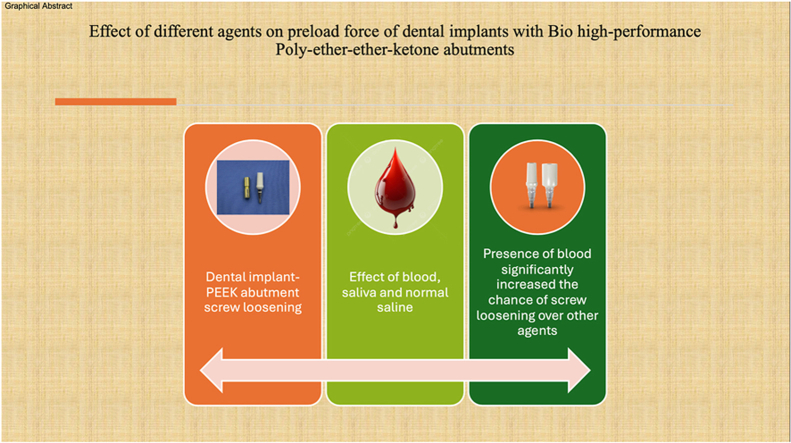
This study evaluated the influence of different agents such as blood, artificial saliva, and normal saline on preload force of dental implants with bio-high-performance poly-ether-ether-ketone (Bio-HPP) abutments to determine its effect on screw loosening.
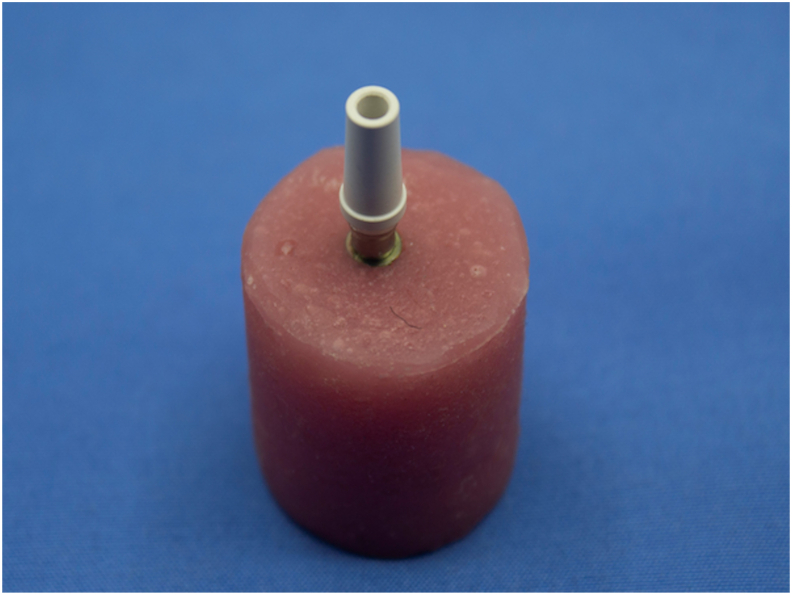
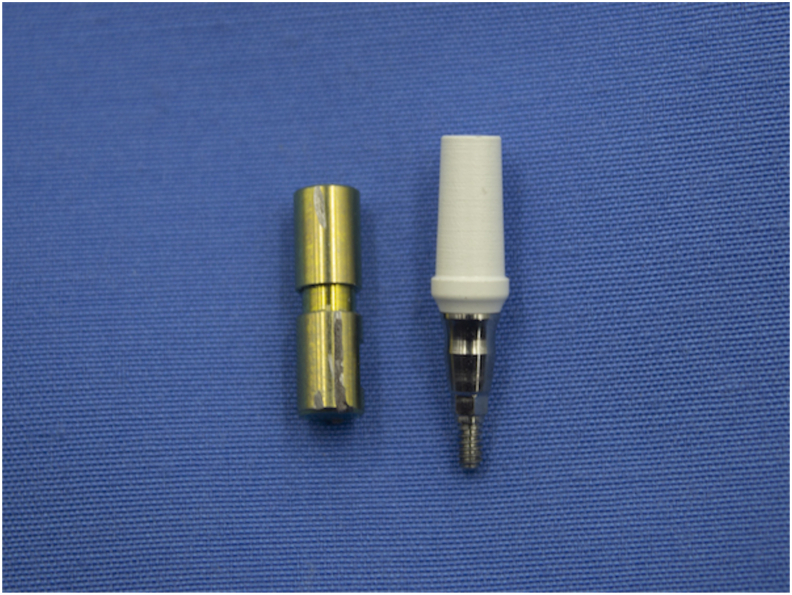
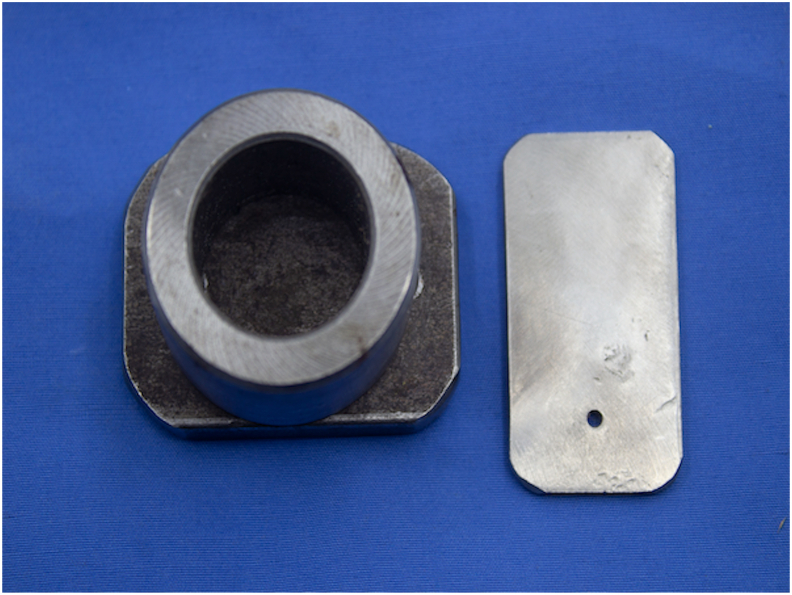
Forty (N = 40) Grade 5 titanium dental implant analog (GM Implant Analog; Neodent, Straumann) with Bio-HPP poly ether-ether ketone (PEEK) abutment and titanium screw was used in the study. The samples were embedded in acrylic split mold. In the control Group C, no agent was added. In the other three groups, blood (B), normal saline (N) and saliva (S) was added in the access cavity of the samples. A sequential torque of 15 Ncm, 20 Ncm, 25 Ncm, 30 Ncm up to 35 Ncm was applied with a digital torque meter (Eclatorq, model: SD-05bn, range:2.5-50 Ncm, torque accuracy: ± 2%cw). Samples were subjected to thermomechanical cyclic loading at 5-55 Celsius for 1000 cycles (Chewing simulator, CS 4.4) to simulate six months of clinical service. Preload was measured as reverse torque value (RTV). Raw data in the form of mean ± standard deviation was documented and subjected to statistical analysis. A one-way ANOVA was performed to contrast the groups. Tukey HSD test was used to determine the multiple comparison assessment ( < 0. 05).
A mean reverse torque value of 35 Ncm ±0.00 was observed in both control and in groups exposed to normal saline (.05). Measurements of 33.4 Ncm ±2.51 and 34.8 Ncm ±0.40 were found when exposed to blood and artificial saliva in order ( < .05). When compared with control, exposure to blood showed significant variation in preload ( = .03).
A significant reduction in reverse torque force was observed when titanium implants and Bio-HPP abutments were exposed to blood, suggesting a potential risk of screw loosening (P < .05). In contrast, minimal decrease and no significant change in preload were noted with exposure to saliva and normal saline (P > .05).
本研究评估了血液、人工唾液和生理盐水等不同介质对采用生物高性能聚醚醚酮(Bio-HPP)基台的牙种植体预紧力的影响,以确定其对螺钉松动的作用。
本研究使用了40个(N = 40)五级钛牙种植体模拟物(GM种植体模拟物;Neodent,士卓曼),搭配Bio-HPP聚醚醚酮(PEEK)基台和钛螺钉。样本被嵌入丙烯酸分体模具中。在对照组C中,未添加任何介质。在其他三组中,在样本的接入腔中分别添加了血液(B)、生理盐水(N)和唾液(S)。使用数字扭矩计(Eclatorq,型号:SD-05bn,量程:2.5 - 50 Ncm,扭矩精度:±2%cw)依次施加15 Ncm、20 Ncm、25 Ncm、30 Ncm直至35 Ncm的扭矩。样本在5 - 55摄氏度下进行热机械循环加载1000次(咀嚼模拟器,CS 4.4),以模拟六个月的临床使用情况。预紧力以反向扭矩值(RTV)来测量。以均值±标准差形式记录原始数据并进行统计分析。进行单因素方差分析以对比各组。使用Tukey HSD检验来确定多重比较评估(P < 0.05)。
在对照组和暴露于生理盐水的组中,均观察到平均反向扭矩值为35 Ncm ±0.00(P > 0.05)。暴露于血液和人工唾液时,依次测得的值为33.4 Ncm ±2.51和34.8 Ncm ±0.40(P < 0.05)。与对照组相比,暴露于血液时预紧力出现显著变化(P = 0.03)。
当钛种植体和Bio-HPP基台暴露于血液时,观察到反向扭矩力显著降低,提示存在螺钉松动的潜在风险(P < 0.05)。相比之下,暴露于唾液和生理盐水时,预紧力仅有微小下降且无显著变化(P > 0.05)。