Sinha Drishti D, Foeller Megan, Bell Abigail S, Nixon Anthony J, Hudson Darrell, James Aimee S, Scheffer Amy R, Baumann Ana A, Diveley Emily, Carter Ebony B, Raghuraman Nandini, Mysorekar Indira U, Kelly Jeannie C
Department of Obstetrics and Gynecology, Washington University School of Medicine, St. Louis, MO (Sinha, Bell, and Mysorekar).
Saint Alphonsus Health System, Boise, ID (Foeller).
AJOG Glob Rep. 2024 Aug 31;4(4):100392. doi: 10.1016/j.xagr.2024.100392. eCollection 2024 Nov.
The Coronavirus disease 2019 (COVID-19) pandemic led to healthcare system changes aimed at minimizing disease transmission that impacted experiences with obstetric healthcare.
To explore experiences of clinicians providing obstetric care during the COVID-19 pandemic.
Qualitative, in-depth, semi-structured interviews were conducted with five nurse practitioners and 16 obstetrical physicians providing a mix of outpatient and inpatient obstetric care during the COVID-19 pandemic in a mid-sized, Midwestern city in the United States. Interviews elucidated challenges and facilitators of obstetric care provision and vaccination of pregnant patients against COVID-19 during the pandemic. Transcripts were coded inductively then deductively using the Health Equity Implementation Framework (HEIF), which integrates a disparities framework and implementation framework to highlight multilevel factors that influence obstetric care. Thematic analysis was conducted, and thematic saturation was reached.
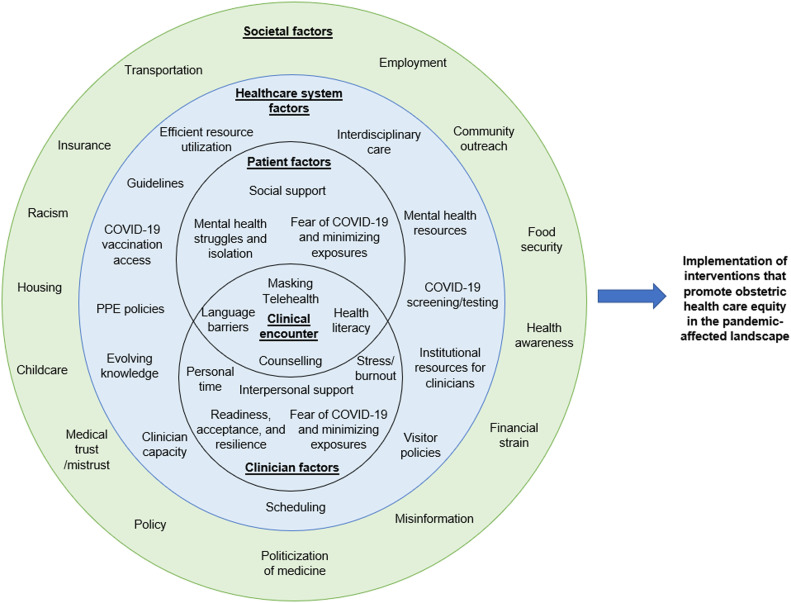
We interviewed 21 clinicians. Clinicians recounted personal challenges such as social isolation and burnout that could be countered by social support. Challenges within the clinical encounter included implementation of infection mitigation efforts, vaccine counseling, and limitations of telehealth. However, when successfully implemented, telehealth facilitated care and circumvented barriers. Clinicians cited challenges at the healthcare system level such as rapidly evolving knowledge and recommendations, restrictive visitor policies, personnel shortage, and inadequate institutional resources to support pandemic-related stressors. However, interdisciplinary care and guidelines available for clinicians facilitated care. Clinicians reported that challenges at the societal level included financial strain, lack of childcare, medical mistrust, politicization of medicine, misinformation, and racism. Societal-level facilitators included insurance access, community outreach, positive policy changes, and fostering trust in medicine.
The pandemic produced unique stressors and exacerbated existing challenges for clinicians providing obstetric care. Applying the HEIF to the findings emphasizes the influence of societal factors on all other levels. Identified facilitators can inform interventions to address stressors in obstetric care that have resulted from the changed sociopolitical landscape of the pandemic.
2019年冠状病毒病(COVID-19)大流行导致医疗保健系统发生变革,旨在尽量减少疾病传播,这对产科医疗保健体验产生了影响。
探讨在COVID-19大流行期间提供产科护理的临床医生的经历。
在美国中西部一个中型城市,对五名执业护士和16名产科医生进行了定性、深入、半结构化访谈,这些医生在COVID-19大流行期间提供门诊和住院产科护理。访谈阐明了在大流行期间提供产科护理和为孕妇接种COVID-19疫苗的挑战与促进因素。对访谈记录先进行归纳编码,然后使用健康公平实施框架(HEIF)进行演绎编码,该框架整合了差异框架和实施框架,以突出影响产科护理的多层次因素。进行了主题分析,并达到了主题饱和。
我们采访了21名临床医生。临床医生讲述了个人面临的挑战,如社会隔离和职业倦怠,社会支持可以应对这些挑战。临床诊疗过程中的挑战包括感染防控措施的实施、疫苗咨询以及远程医疗的局限性。然而,当远程医疗成功实施时,它促进了医疗服务并克服了障碍。临床医生提到了医疗保健系统层面的挑战,如知识和建议迅速变化、访客政策严格、人员短缺以及缺乏支持与大流行相关压力源的机构资源。然而,为临床医生提供的跨学科护理和指南促进了医疗服务。临床医生报告说,社会层面的挑战包括经济压力、缺乏儿童保育、对医疗的不信任、医学政治化、错误信息和种族主义。社会层面的促进因素包括保险覆盖、社区外展、积极的政策变化以及增强对医学的信任。
大流行给提供产科护理的临床医生带来了独特的压力源,并加剧了现有挑战。将HEIF应用于研究结果强调了社会因素对所有其他层面的影响。确定的促进因素可为应对因大流行改变的社会政治格局而导致的产科护理压力源的干预措施提供参考。